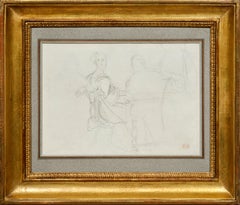
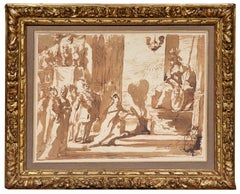
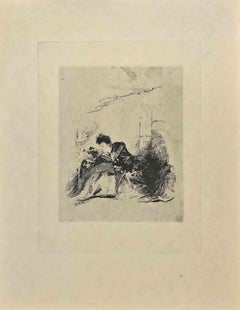
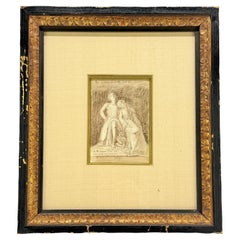
Rapidly executed with the tip of a brush, this wash bordering on abstraction seduced us with its great spontaneity. This (unsigned) study is a first thought for a small licentious canvas painted by Delacroix in the troubadour style on his return from England in 1825: Le Duc d'Orléans montrant sa maîtresse (The Duke of Orleans showing his Mistress - last photo in the gallery). Delacroix used one of the very first proofs of the lithograph "Homme noir à cheval" (Black Man on Horseback) published in 1823 as a support for this study.
This drawing comes from the collection of Philippe Burty, an important art critic of the second half of the 19th century, who was commissioned by Delacroix to classify his prints and drawings in preparation for the sale of the contend of his studio after his death.
1. Eugène Delacroix "for mortal hearts [...] divine opium".
Eugène Delacroix was born in 1798, the son of Charles Delacroix who had served briefly as minister of foreign affairs under the Directory and who was on a mission to Holland, as the French ambassador, at the time of his son's birth. His mother, Victoire Oeben, was descended from a family of artisans and craftsmen. Both parents died early, his father in 1805, his mother in 1814, leaving Eugène in the care of his older sister, Henriette de Verninac, wife of a former ambassador to Turkey and minister-plenipotentiary to Switzerland. As a child he had played on the knees of Talleyrand, his father's successor in the Ministry of Foreign Affairs. It has been suggested, but not proven, that Talleyrand, to whom Delacroix in later life bore a marked facial resemblance, was in fact his actual father.
In 1815 Delacroix, aged seventeen, began to take painting lessons from Pierre Guérin (1774-1833) through whose studio Théodore Gericault had briefly passed a little earlier. His classicist instruction had little effect on Delacroix; it was less important for his development than the literary education that he had received at the lycée. Like many of his contemporaries, Delacroix was a self-taught artist, whose real school was the Louvre, where the splendor of Titian, Veronese, and Rubens shone brightly enough to eclipse the school of David. Among his fellow copyists in its galleries he met the young Englishman Richard Parkes Bonington (1801-1828) who, together with his friend Raymond Soulier, was to introduce him to watercolor painting and a British tradition of colorism, and who helped to awaken his interest in Shakespeare, Byron, and Scott, the main literary sources of his romanticism.
In 1822 at his Salon debut, the Bark of Dante (Louvre), attracted some attention. Two years later, his Massacres of Chios (Louvre) burst upon the Salon of 1824 as "a terrifying hymn in honor of doom and irremediable suffering" . The government's purchase of the work enabled Delacroix to visit England in the spring and summer of 1825.
The colossal, orgiastic Death of Sardanapalus (Louvre), shown at the Salon of 1827, came as a shock to the public. Delacroix had taken the subject from a play by Byron but supplied the voluptuous cast of this scene of slaughter from his own imagination. The Revolution of 1830 inspired his one truly popular work, Liberty Leading the People (Louvre). For once, public and critics united in praise of the artist, and the government of Louis-Philippe awarded him the Legion of Honor.
In early 1832 Delacroix visited North Africa in the suite of a French embassy to the sultan of Morocco. Islamic Africa surpassed all his expectations. The classical beauty for which he had vainly looked among the plaster casts in Guérin's studio he now encountered along roadsides under the African sky. He filled sketchbooks with observations of Arab life and gathered a store of ideas that served him for the rest of his life. On his return to Paris, he began a series of oriental subjects. Algerian Women in Their Apartment (1834, Louvre) records his recollection of a visit to a harem. It signals the attainment of his mature style, quieter but grander than his earlier manner, more restrained but more powerful.
After 1830 Delacroix increasingly identified himself with the grand traditions of the Venetians and Flemings, with Veronese and Rubens above all. Behind Delacroix' new concern with compositional structure and balance lay the experience he had gained in carrying out the architectural decorations that occupied him during the latter part of his life. The governments of Louis-Philippe and Napoleon III favored him with important monumental commissions, beginning in 1833 with the allegorical decorations of the Salon du Roi in the Palais Bourbon (Chamber of Deputies). This was closely followed by the even larger enterprise of the Palais Bourbon's library (1838-1847) followed by the library of the Senate in the Luxembourg Palace (1840-1846). There followed the ceiling of the Galerie d'Apollon in the Louvre (1850-1851), the decorations in the Salon de la Paix of the Hôtel de Ville of Paris (1852-1854, destroyed in 1871), and the Chapel of the Holy Angels in the church of Saint-Sulpice (1854-1861). His murals prove that this nervously frail artist had the energy to compose on immense surfaces and the mental vigor to invent images that dominate those walls.
The Universal Exposition in 1855 showed thirty-six of his paintings, a tribute to him (together with Ingres) as one of France's two preeminent living artists. Having long been denied admission to the Academy, he was at last admitted to this body in 1857. Frequently ill with bronchial infections and economizing his physical strength, he lived a frugal bachelor's life but worked with unabated energy until the end. He died on 13 August 1863.
2. Description of the drawing and related artworks
This study is directly related to a small painting produced by Delacroix in 1825 on his return from England. It shows the Duke of Orléans (recognizable by his jacket embroidered with fleurs-de-lis) presenting his chamberlain Aubert Le Flamenc with the naked body of his mistress Mariette d'Enghien (whose head remains hidden from view), even though she is none other than ... the chamberlain's own wife! The anecdote finds its literary inspiration in an episode from Prosper de Barante's Histoire des ducs de Bourgogne (republished in 1824); it also appears in Brantôme's Vie des dames galantes (republished in 1822). Some commentators have also seen a veiled allusion to Delacroix's youth, when in 1822-1823 he shared the same mistress, Madame de Pron, with his friend Soulier.
In our study, we find the two main protagonists, the Duke and his chamberlain, facing each other in the huis-clos of an alcove lined with heavy curtains. As the Duke, seated casually on the right, reveals his mistress, the chamberlain betrays his surprise with a gesture of his left arm, which will be replaced by a much gentler movement (perhaps suggesting gentle contemplation of the beauties revealed to him) in the painted version. For the mistress, Delacroix sticks to the essentials: with a touch of sepia, he evokes her head hidden in the shadows behind the sheet, and with a fine, wave-like brushstroke, her voluptuous forms laid bare...
Eugène Delacroix used the same sepia wash technique in a study preserved in the Musée du Louvre. Produced in 1822, it depicts walls and towers in flames, and is a preparatory study for the city of Dité, which appears in the background of the Bark of Dante presented at the 1822 Salon.
A year later, in 1823, Delacroix published his first "artistic" lithograph, a departure from his earlier work, which consisted mainly of satirical caricatures. The print whose verso was used for our drawing is a poor-quality edition, off-center and tilted in relation to the sheet, suggesting that it may be one of the very first prints made before the definitive settlement of the lithographic press.
3. Provenance and framing
An inscription at the bottom of the leaf indicates its prestigious provenance: the art critic and expert Philippe Burty. He was part of a four-member committee appointed by the artist shortly before his death to organize the sale of the artworks contained in his studio. Philippe Burty, a great lover of prints, was artistic director and critic of the Gazette des Beaux-Arts. It was to him that the committee entrusted the classification of the drawings (and engravings) and the preparation of the sale catalog, for which he wrote the general preface. Our sheet does not appear to have been part of these sales, as it bears no stamp, and we can only assume that it was given to him by Delacroix (with whom he had exchanged letters as early as 1862 concerning a proposed catalog of his engraved work).
Our sheet later became part of the collection of Marcel Lecomte (Paris 1914 - 1996), an art dealer specializing in drawings, prints and antiquarian books.
In 1938, he set up his shop at 17, rue de Seine, and published his first book catalog. In the 1940s-1950s, he took advantage of the boom in the print market, particularly in the United States. In 1947, he was approved as an expert by the Compagnie des commissaires-priseurs, and held his first sale at Hôtel Drouot.
Alongside his activities as an expert and dealer, Marcel Lecomte built up three personal collections: of old drawings, old prints and romantic and modern books from the 19th and 20th centuries. His black stamp does not appear on the drawings sold in 1989, but only on the prints. These drawings and prints were sold in public sales at Drouot on March 15, 1989 (for the drawings) and June 26, 2020 (for the prints).
Our drawing was a real headache to frame: we had to respect the dimensions of the sheet but also adapt to the drawing, which was slightly off-center. We chose a nineteenth-century French frame that was wide enough to preserve the sheet in its entirety while centering the drawing. A window on the back of the frame allows the lithograph (which could not be centered) to be seen on the verso.
Main bibliographical reference :
(Under the supervision of) Sébastien Allard and Côme Fabre - Delacroix 1798-1863 - catalog of the exhibition presented at the Musée du Louvre from March 29 to July 23, 2018