Karen Margolis
Vacuity, 2026
watercolor, gouache, thread on burnt Abaca paper
14 x 11 in. $4000
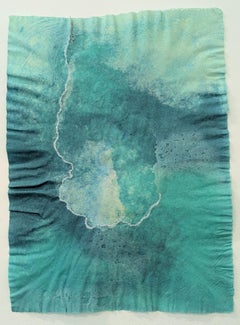
In Vacuity (2026), Karen Margolis combines watercolor, gouache, thread, and intricately burned abaca paper to create a richly textured biomorphic abstraction. Clusters of circular perforations form dense, cellular structures that appear suspended within a luminous field of turquoise, copper, rose, gold, and violet. The composition moves between open networks of irregular holes and tightly concentrated formations, suggesting microscopic organisms, cellular membranes, and the shifting structures of biological systems.
Unlike Margolis's works that rely primarily on pigment and perforation, Vacuity introduces small accumulations of thread that project from the paper's surface. An ochre-colored bundle near the upper right and a darker blue-green cluster below it provide tactile interruptions within the composition. These elements create a dialogue between the fragile, perforated paper and the denser, three-dimensional presence of fiber, bringing the work closer to relief sculpture.
The circular openings vary considerably in scale, from tiny pinpricks to large, irregular voids along the edges. Some gather into dark, concentrated masses near the center, while others spread outward into loosely connected networks. The burned edges and thin bridges of remaining paper emphasize the tension between structural fragility and continuity. The white wall visible through the openings becomes an integral part of the composition, contributing light, depth, and spatial variation.
The title Vacuity introduces a conceptual dimension to the work's relationship between matter and absence. Although the term suggests emptiness, the composition is remarkably active: its open spaces define the surrounding forms, while the thread and pigment give physical presence to an otherwise porous structure. Margolis makes absence a constructive force, using the removal of material to generate pattern, connection, and movement.
Margolis's approach reflects her ongoing investigation of psychology, microscopy, and the organizational patterns of the natural world. Her distinctive combination of controlled burning, watercolor, gouache, and fiber extends the traditions of biomorphic abstraction and contemporary works on paper, bringing together drawing, painting, textile processes, and sculptural construction.
About the Artist
Karen Margolis is a New York–based contemporary artist whose interdisciplinary practice encompasses experimental works on paper, drawing, sculpture, and installation. Her work explores relationships among psychology, scientific observation, natural systems, and material transformation.
Margolis earned a BS in Psychology from Colorado State University and pursued further studies in neural psychology while studying portraiture at the Art Students League of New York. She also attended Parsons School of Design and the School of Visual Arts. Her studies in microscopy through the New York Microscopical Society helped shape her interest in the recurring structural patterns found across microscopic and macroscopic environments.
Her work is characterized by intricate networks of circular forms, burned and perforated paper, layered pigments, and sculptural interventions. Through processes of subtraction and accumulation, Margolis investigates relationships between order and disorder, physical presence and absence, and the connections between psychological states and biological structures.
Margolis has exhibited at institutions including the Brooklyn Museum, Aldrich Contemporary Art Museum, Weatherspoon Art Museum, Parrish Art Museum, and the Rijswijk Museum in the Netherlands. Her exhibition history also includes the Hunterdon Art Museum and Sugar Hill Children's Museum of Art & Storytelling in New York.
Her public commissions include Cerebration (2018), a permanent mosaic installation for MTA Arts & Design at the 86th Street subway station in Brooklyn, and Continuum (2023), an installation for Amtrak's Metropolitan Lounge at Moynihan Train Hall in New York. Her work has also been commissioned for Union Station in Washington, DC.
Margolis received a Pollock-Krasner Foundation Grant in 1998 and participated in a workspace residency at Dieu Donné Papermill in 2000. Her work is included in collections such as the Hood Museum of Art at Dartmouth College and the Werner and Sally Kramarsky Collection.
Through her distinctive use of burned paper, pigment, thread, and perforation, Margolis contributes to contemporary conversations around biomorphic abstraction, process-based art, material experimentation, and the relationship between scientific imagery and psychological experience.