Want more images or videos?
Request additional images or videos from the seller.

Arthur William Brown
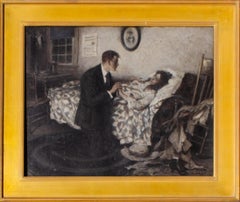
“You have no right to interfere” Story illustration for Saturday Evening Post

1936

$1,500
£1,141.11
€1,367.32
CA$2,139
A$2,193.29
CHF 1,252.10
MX$28,425.42
NOK 14,225.61
SEK 14,970.73
DKK 10,218.86

About the Item

Story illustration for “Spotlight” by Clarence Budington Kelland for The Saturday Evening Post, published August 15, 1936. The full caption reads: “‘My point,’ he said, ‘is that you have no right to interfere. If you shut yourself away from me, my career goes to pot.’” Artwork Dimensions: 14.25 x 14.25 in. Frame Dimensions: 20.25 x 20.25 in. Medium: Mixed media on board Signature: Inscribed, signed & dated upper right
  • Creator:
    Arthur William Brown (1881 - 1966, American)
  • Creation Year:
    1936
  • Dimensions:
    Height: 20.25 in (51.44 cm)Width: 20.25 in (51.44 cm)
  • Medium:
  • Period:
  • Condition:
  • Gallery Location:
    Fort Washington, PA
  • Reference Number:
    Seller: 48501stDibs: LU384317544352

More From This Seller

View All
“Julie, do you love me?” Story illustration for the Post

“Julie, do you love me?” Story illustration for the Post

By Clarence Underwood

Located in Fort Washington, PA

Story illustration for “Julie” by Frederick Orin Bartlett for The Saturday Evening Post, published August 14, 1920, page 7. The full caption reads: “‘Julie, do you love me?’ She ...

Category

20th Century Interior Paintings

Materials

Gouache, Board

“It’s up to a woman to have a good time.” Story illustration for Hearst’s Mag

“It’s up to a woman to have a good time.” Story illustration for Hearst’s Mag

By Clarence Underwood

Located in Fort Washington, PA

Great condition. Bad glare when photo taken. Please let me know if you would like a better image Story illustration for “Zero” by Roland Pertwee for Hearst’s magazine, April 1919,...

Category

20th Century Figurative Paintings

Materials

Board, Gouache

"Preview" Story Illustration for Saturday Evening Post, Nov. 5, 1938

"Preview" Story Illustration for Saturday Evening Post, Nov. 5, 1938

By John LaGatta

Located in Fort Washington, PA

Medium: Mixed Media on Board Signature: Signed Lower Center "Dancing the minuet before a camera and the hundred people behind it isn't the same as just dancing because you like the ...

Category

1930s Mixed Media

Materials

Crayon, Mixed Media, Oil, Gouache, Board

"There is No Love, " Saturday Evening Post Magazine Illustration

"There is No Love, " Saturday Evening Post Magazine Illustration

By Wilson Mortimer Jr.

Located in Fort Washington, PA

Medium: Oil on Canvas The oil on canvas illustration is bearing a Saturday Evening Post label verso, used to illustrate the short story There Is No Love, in the October 18th, 1941 i...

Category

1940s Figurative Paintings

Materials

Canvas, Oil

You May Also Like

The Vera Stretz Murder Trial

The Vera Stretz Murder Trial

By William Sharp

Located in Fairlawn, OH

The Vera Stretz Murder Trial Lithograph, 1936 Signed in pencil lower right (see photo) Initialed W.S. in the image lower right (see photo) Dated in the image lower right (see photo) ...

Category

1930s American Realist Figurative Prints

Materials

Lithograph

William Fisher Classic American Illustration on Canvas

William Fisher Classic American Illustration on Canvas

By William Fisher

Located in New York, NY

William Fisher (American, 1891-1985) Untitled, 20th Century Oil on canvas/illustration 23 3/4 x 29 3/4 in. Framed: 31 x 37 1/4 x 1 in. Signed lower right: William Fisher William Fis...

Category

20th Century American Modern Figurative Paintings

Materials

Canvas, Oil

Vanity Fair Illustration High Brow Types with Relationship Issues

Vanity Fair Illustration High Brow Types with Relationship Issues

Located in Miami, FL

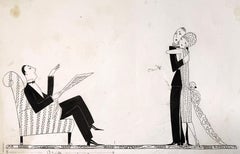
Hight brow couple having relationship issues rendered in a black and white stylized Art Deco fashion. In pencil the caption reads "Are you willing to divorce your wife the minute sh...

Category

1820s Art Deco Figurative Drawings and Watercolors

Materials

Paper, Ink, Graphite

Life Magazine Satirical Society Cartoon Illustration

Life Magazine Satirical Society Cartoon Illustration

Located in Wilton Manors, FL

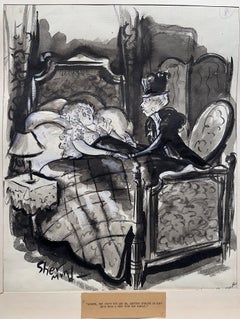
Barbara Shermund (1899-1978). Society Satirical Cartoon, ca. 1940s. Gouache on heavy illustration paper, image measures 17 x 14 inches; 23 x 20 inches in matting. Signed lower left. Very good condition but matting panel should be replaced. Unframed. Provenance: Ethel Maud Mott Herman, artist (1883-1984), West Orange NJ. For two decades, she drew almost 600 cartoons for The New Yorker with female characters that commented on life with wit, intelligence and irony. In the mid-1920s, Harold Ross, the founder of a new magazine called The New Yorker, was looking for cartoonists who could create sardonic, highbrow illustrations accompanied by witty captions that would function as social critiques. He found that talent in Barbara Shermund. For about two decades, until the 1940s, Shermund helped Ross and his first art editor, Rea Irvin, realize their vision by contributing almost 600 cartoons and sassy captions with a fresh, feminist voice. Her cartoons commented on life with wit, intelligence and irony, using female characters who critiqued the patriarchy and celebrated speakeasies, cafes, spunky women and leisure. They spoke directly to flapper women of the era who defied convention with a new sense of political, social and economic independence. “Shermund’s women spoke their minds about sex, marriage and society; smoked cigarettes and drank; and poked fun at everything in an era when it was not common to see young women doing so,” Caitlin A. McGurk wrote in 2020 for the Art Students League. In one Shermund cartoon, published in The New Yorker in 1928, two forlorn women sit and chat on couches. “Yeah,” one says, “I guess the best thing to do is to just get married and forget about love.” “While for many, the idea of a New Yorker cartoon conjures a highbrow, dry non sequitur — often more alienating than familiar — Shermund’s cartoons are the antithesis,” wrote McGurk, who is an associate curator and assistant professor at Ohio State University’s Billy Ireland Cartoon Library & Museum. “They are about human nature, relationships, youth and age.” (McGurk is writing a book about Shermund. And yet by the 1940s and ’50s, as America’s postwar focus shifted to domestic life, Shermund’s feminist voice and cool critique of society fell out of vogue. Her last cartoon appeared in The New Yorker in 1944, and much of her life and career after that remains unclear. No major newspaper wrote about her death in 1978 — The New York Times was on strike then, along with The Daily News and The New York Post — and her ashes sat in a New Jersey funeral...

Category

1940s Realist Figurative Paintings

Materials

Gouache