Want more images or videos?
Request additional images or videos from the seller.

19th century French School
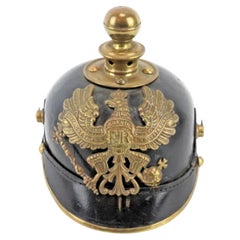
Partial Shako from Napoleon III's 42nd Infantry Regiment

$3,504.39
£2,572
€3,143.96
CA$4,945.92
A$5,099.52
CHF 2,875.24
MX$65,270.48
NOK 33,151.19
SEK 34,674.20
DKK 23,509.21

About the Item

19th Century French Shako Partial Shako from Napoleon’s 42nd Infantry Regiment 1869 Brass and leather Dimensions: 7 1/4 x 11 1/2 x 3 inches (18.2 x 29 x 8 cm) Handmade display case This brass plate of the French Imperial Eagle belonged to a member of Napoleon III’s 42nd Infantry Regiment. Miraculously, it is still affixed to a substantial part of its leather shako, whose stitching and buttons are still apparent despite its provenance being a shipwreck. This item presents a unique opportunity to own a piece of world history, as it is very rare to find a plare still attached to such a large and well-preserved piece of leather. The shako is from the wreck of the SS General Abbatucci, which was a 282-ton cargo steamship. On the 13th of May 1869, she left Marseilles for Civitavecchia, Italy, to deliver several million French francs to Pope Pius IX for his birthday, as well as pay for the French Army in Italy. A number of wealthy merchants and dignitaries were on board, as well as the Pontifical Consul and guards who had been representing the Pope in Marseilles. Unfortunately, the Abbatuci never reached Civitavecchia - it collided with a 500-ton Norwegian ship just off of the coast of Corsica, sinking within two hours of being hit. 16 soldiers and 15 Papal recruits died, as well as 23 passengers and crew members. The Captain and 54 others survived and were taken the rest of the way to Italy by another sailing ship. The wreck was presumed lost until it was discovered in May 1996.
  • Creator:
    19th century French School
  • Dimensions:
    Height: 7.25 in (18.42 cm)Width: 11.2 in (28.45 cm)Depth: 3 in (7.62 cm)
  • Medium:
  • Period:
  • Condition:
    It is a historical artefact that has survived a shipwreck.
  • Gallery Location:
    London, GB
  • Reference Number:
    1stDibs: LU52417192942

More From This Seller

View All
The Souls of the Righteous

The Souls of the Righteous

Located in London, GB

Etching, signed bottom right Image size: 2 1/2 x 9 3/4 inches (6.5 x 35 cm) Mounted This is an original print from a copper plate etching by Robert Smith Forrest. It depicts one of ...

Category

1920s Modern Figurative Prints

Materials

Paper, Etching

Carved Frame, 16th Century European School

Carved Frame, 16th Century European School

Located in London, GB

European School 16th Century Carved Frame Fruit wood Remnant's of pigment can be found on the carving.

Category

18th Century and Earlier More Art

Materials

Wood

The Battle of Britiain: No. 65 Squadron

The Battle of Britiain: No. 65 Squadron

Located in London, GB

Oil on board, signed lower right  Image size: 36 x 24 inches (91.5 x 61 cm) Handmade frame  Provenance:   Sotheby's Hendon: Historic Aircraft and Aeronautica, The Royal Flying Corps and Royal Air Force 1912-1990, 15 September 1990, lot 394. Here we see the Supermarine Spitfires of the RAF's 65 squadron, ascending to attack during the Battle of Britain in the Second World War. The spitfires climb in a well drilled line from the bottom right of the canvas to the top left, behind them a mass of hundreds of other allied planes come to join them. Above them the sky is a calm blue, beneath them white clouds catch the sunlight and part to reveal glimpses of the British coastline below. With the benign weather, Olive creates a bright picture, imparting more of a sense of optimism at ending the War, rather than foreshadowing the destruction that is soon to come.Olive has taken great pains to accurately depict the Supermarine Spitfires. On the side of the planes we see a 'YT' indicating the No. 65 Squadron, and the individual aircraft letters, the other side of the fuselage roundel (the RAF symbol of concentric red, white and blue discs). The RAF would change the squadron code if it ever thought that Germans had managed to link a particular squadron to a code. The Spitfires are shown with their characteristic brown and green camouflage on their upper surface and the roundels on the top of the wing, missing the white meaning the aircraft was less easy to see, particularity if it was on the ground. The hundreds of unidentified aircraft behind the Spitfires are an imposing sight, rows of propellers and wings advancing towards the viewer, capturing the sheer operational scale of the Battle of Britain. The No. 65 Squadron was formed in 1916 during the First World War and was based at RAF Hornchurch during the second. The squadron was active during the Battle of Britain, with at least one pilot, Bolesław Drobiński, shooting down at least seven enemy aircraft.Charles Gordon Chaloner Olive Charles...

Category

20th Century Landscape Paintings

Materials

Oil, Board

St George Slaying the Dragon

St George Slaying the Dragon

Located in London, GB

18th Century European School St George Slaying the Dragon Wood, gilded 8 inches in height, 6 3/4 x 4 inches base This 18th century carved and gilt wood statuette depicts the moment ...

Category

18th Century Figurative Sculptures

Materials

Wood

The Battle of Raz de Sein

The Battle of Raz de Sein

By Thomas Luny

Located in London, GB

Thomas Luny 1759-1837 The Battle of Raz de Sein Oil on canvas, signed and dated 'Luny 1834' lower left Image size: 15 1/4 x 20 1/8 inches (38.7 x 51.2 cm) Provenance The Parker Gall...

Category

19th Century Paintings

Materials

Canvas, Oil

Scene of a Massacre

Scene of a Massacre

Located in London, GB

Jean-Joseph Benjamin-Constant Scene of a Massacre 1845 - 1902 Oil on canvas, unsigned Image size: 46 1/2 x 67 inches (118.5 x 170.5 cm) The French School of Orientalists are best kn...

Category

19th Century Figurative Paintings

Materials

Canvas, Oil

You May Also Like

A military cap snuffbox, Paris, France beginning of 20th century.

A military cap snuffbox, Paris, France beginning of 20th century.

Located in Milan, IT

Snuffbox in white metal, brass and fabric, depicting a military cap with visor. This French snuffbox was made in the early 19th century. France circa 1915.

Category

Early 20th Century French Other Tobacco Accessories

Materials

Metal, Brass

Mid 19th Century Coat Of Arms

Mid 19th Century Coat Of Arms

Located in New York, NY

Hand-picked by buyers at Ann-Morris Inc.

Category

Antique Mid-19th Century English Decorative Art

Materials

Cut Steel

The Royal Fusiliers

The Royal Fusiliers

Located in New York, NY

Hand-picked by buyers at Ann-Morris Inc.

Category

Antique 1880s English Paintings

Materials

Crayon

Vintage French Military Academy Officers Hat, Mid Century

Vintage French Military Academy Officers Hat, Mid Century

Located in New York, NY

A rare French Military Academy Officer's hat or cap from the 1970s. These special and unique hats are part of the uniform of students studying to beco...

Category

Vintage 1970s French Historical Memorabilia

Materials

Felt

A military cap snuffbox, Paris, France beginning of 20th century

A military cap snuffbox, Paris, France beginning of 20th century

Located in Milan, IT

Snuffbox in white metal, brass and fabric, depicting a military cap with visor. This French snuffbox was made in the early 19th century. Hallmarks (E. D. Paris), France circa 1915.

Category

Early 20th Century French Other Tobacco Accessories

Materials

Brass

WWI German Prussian M1895 Artillery Pickelhaube Kugelhelm Helmet

WWI German Prussian M1895 Artillery Pickelhaube Kugelhelm Helmet

Located in Nottingham, GB

An original Imperial German Prussian M1895 Artillery Pickelhaube, or Kugelhelm, issued to enlisted ranks (Mannschaften) and dating from the preFirst World War period, with this model continuing in service during the early years of WWI. The helmet features the distinctive Kugel, or ball-shaped finial, traditionally associated with artillery troops and used in place of the pointed spike found on infantry Pickelhauben. Constructed from black lacquered leather, the helmet is fitted with traditional brass mounts including the Kugel and its base, front peak trim and rear reinforcing spine. The front is dominated by the characteristic Prussian spread eagle plate...

Category

Antique Late 19th Century Arms, Armor and Weapons

Materials

Brass