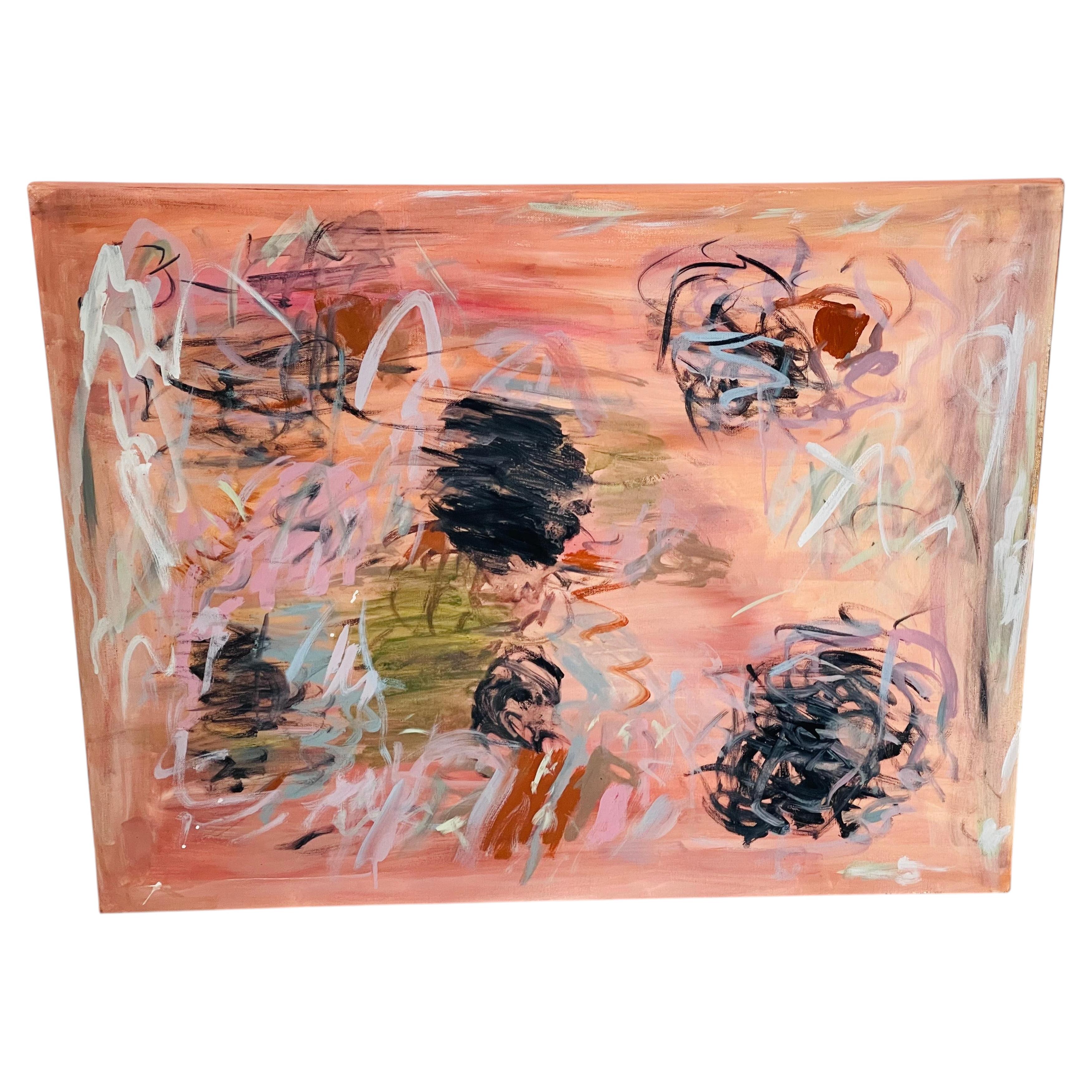
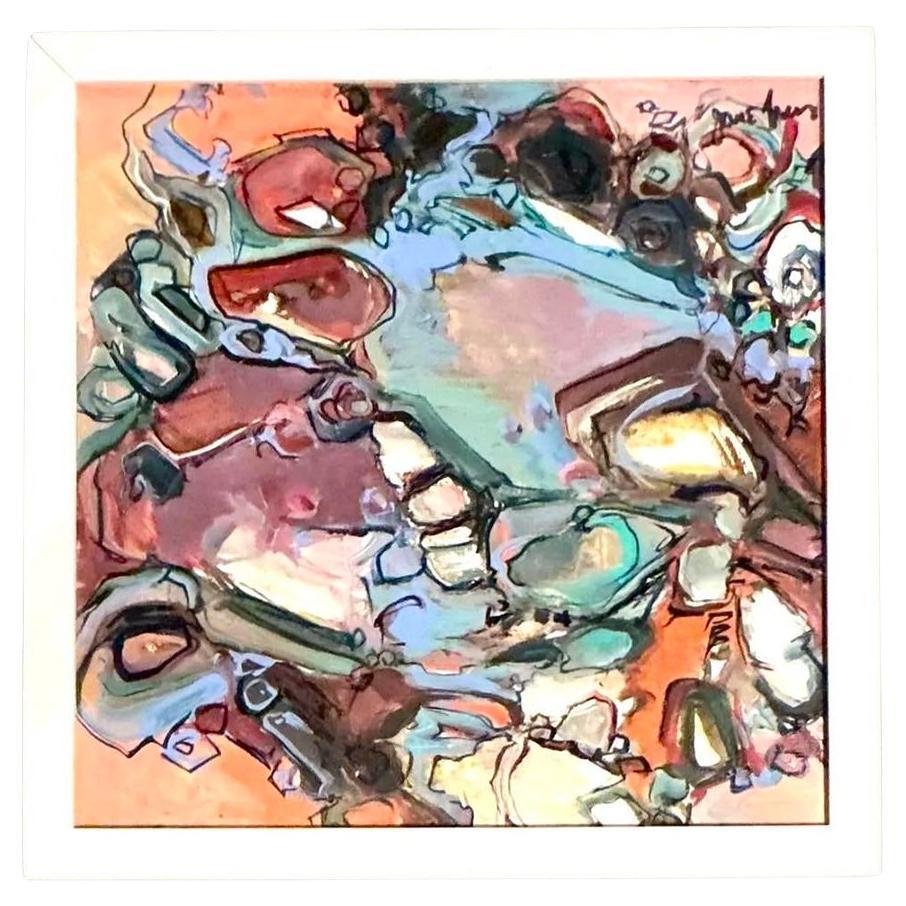
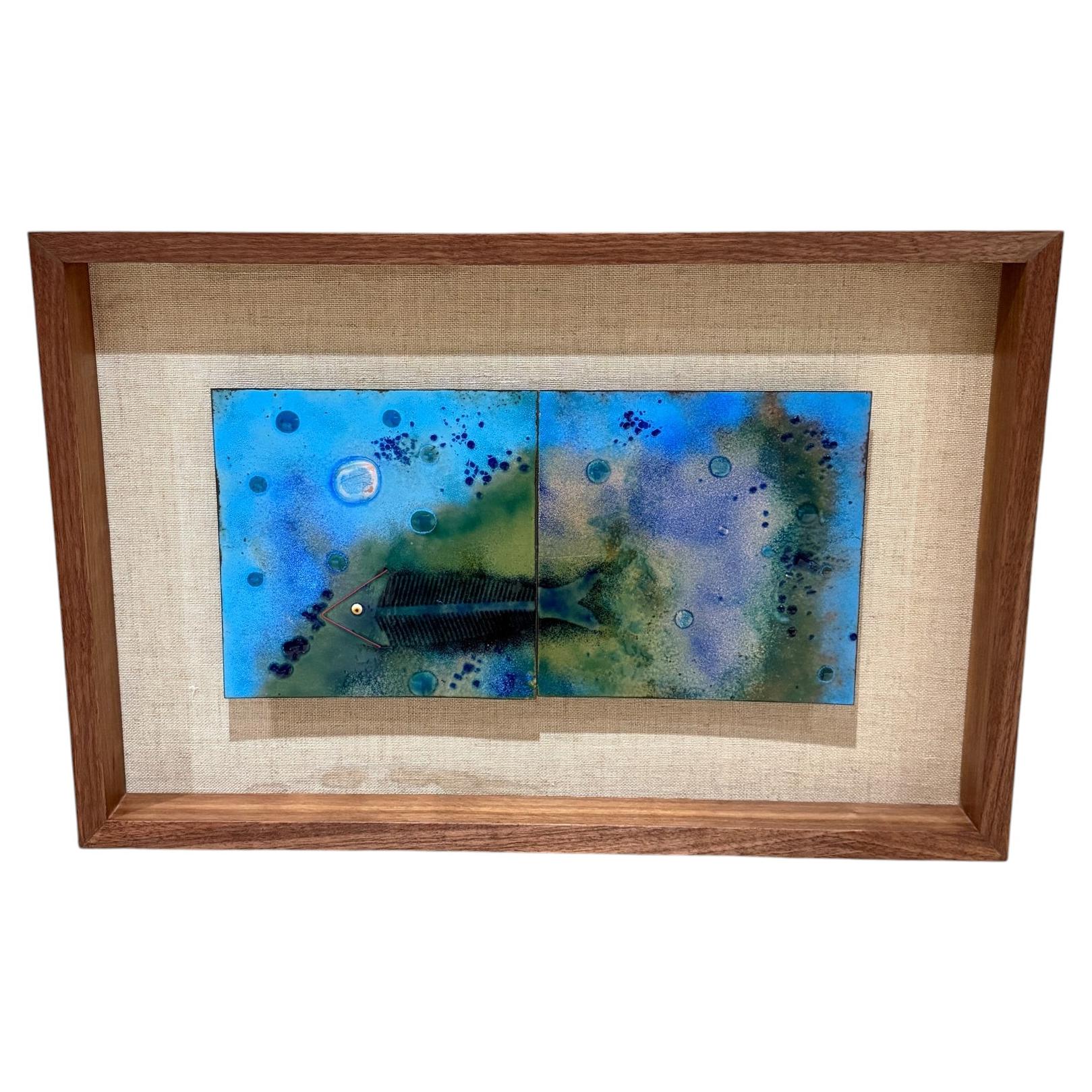
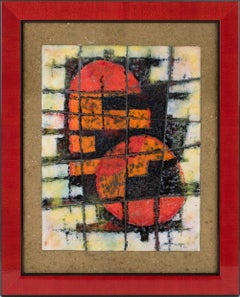
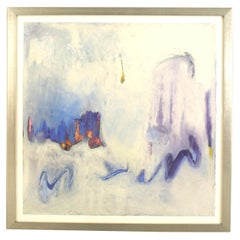
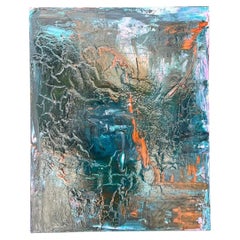
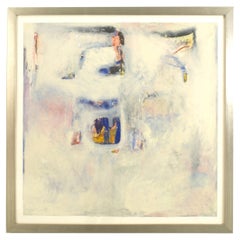
A striking Mid‑Century modernist enamel on copper by George F. Welch (1926–2003). This large square wall‑mounted plaque showcases Welch's distinctive blend of Abstract and Brutalist design, incorporating Hebrew characters and numerals across the upper register—an element that adds both mystery and symbolic resonance to the composition.
The surface reveals the rich textural depth typical of enamel work, with layered color fields and expressive organic forms. Welch's signature is inscribed at the lower right, and the reverse retains the original paper label featuring the artist's statement, preserved beneath the protective backing.
Notably, the circular dents at the lower corners appear to be intentional interventions by the artist, consistent with techniques referenced in his biography.
The piece is presented in a contemporary metallic wood frame, brushed and silvered, complemented by an almond‑green and off‑white mat that enhances the artwork's tonal contrasts and modernist character.
Measurements:
Frame size: 23 in wide (58.5 cm) by 23 in high (58.5 cm)
Plaque size: 16 in wide (40.5 cm) by 16 in high (40.5 cm).
Note:
George F. Welch 1926-2003
Welch said he became interested in enameling after taking a jewelry-making course at University College in the 1950s. He stated, "Enamel is often used to enhance jewelry pieces by adding color, so I decided to try it with larger metal pieces."
A native of New Britain, Connecticut, Welch came to Syracuse after graduating from the School of Worcester (Mass.) Art Museum, the Hartford Art School, and four years as a Marine Corps artist.
As an artist, he finds his work rewarding.
Creating enamel is my greatest pleasure, he says. He goes on to explain that the uniqueness of the process is exciting and cannot be found in painting.
He explains that the method involves applying enamels tinted by oxides to a metal surface. Usually, I use copper, but silver, aluminum, gold, or stainless steel are other options.
The enamels, done by George F. Welch, are abstract works on copper, framed for hanging.
Welch was a full-time artist who painted and sculpted, considering his enamels a Fine Arts medium. He worked on flat copper, firing it repeatedly for desired effects and experimenting with oxides and tones.
According to him, his initial idea is only partially realized, but as the project develops, the design is strengthened by the addition of color and texture.
When finished, he gives it a title, usually on a nature theme, which allows people to relate to it. His enamel works are striking. The textures, colors, and design almost jump from the wall. Welch has a bold, direct style in handling the medium, using color to create three-dimensional effects.
The designs are impressive, sometimes accentuated by bending the flat copper or hammering three circular bumps into it. Additionally, some external components are incorporated, such as thumbtacks, which create a lovely spatial structure.
The textures and colors have an emotional substance: they reach out to the viewer. Welch used the enameling media with impressive results.
(Credit: "Ceramics, Enamels Exhibit Opens," published on March 7, 1975, in The Utica Daily Press.)