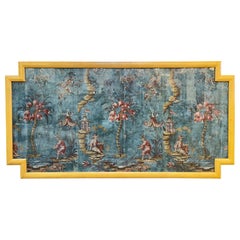
18th century oil on canvas chinoiserie scene painted 'en Camaïeu Bleu'. Originally part of a decorative scheme in a dining room as an overdoor set into panelling.
Provenance: From a Château in the South of France.
A very charming representation of a gentlemen sitting on a rocky outcrop playing a stringed instrument as birds and butterflies soar overhead, the whole is surrounded by a 'feigned' Rococo oval frame. It calls on all the fashionable influences of 18th century decorative schemes. The use of chinoiserie, rococo and rocaille elements and the interest in nature as well as the distinctive colour palette. It is clearly inspired by the works of Boucher and his circle who included all these elements in their compositions. This canvas would have been part of a much larger and important decorative scheme set into panelling or set above the doors in the corners of a room and therefore originally meant to have been viewed at an angle from below.
Camaïeu (also called en camaïeu) is a technique that employs two or three tints of a single colour, other than grey, to create a monochromatic image without regard to 'realistic' colour. When a picture is monochromatically rendered in grey, it is called grisaille; when in yellow, cirage
A major artist of the reign of Louis XV, François Boucher (1703-1770) is considered the emblematic painter of the rocaille style. His idyllic and voluptuous representations of classical and mythological themes, his allegories and his pastoral scenes particularly appealed to the Court and the King's favourite, Madame de Pompadour, who gave him many commissions, and who later became his pupil and friend from patron of the arts.
Many of the paintings of François Boucher, reveal another facet of the painter's talent and testify to the fascination exerted by China on the master. A lover of objects from the Far East, Boucher helped spread the fashion for "chinoiserie", the beginnings of Orientalism that tended to develop throughout Europe. The decorative arts of the eighteenth century were particularly marked by this thirst for exoticism, as evidenced by the appeal of porcelain imported from the East, the decoration of lacquered panels and the Chinese-style furniture of the English cabinetmaker Thomas Chippendale (1718-1779). These Chinese subjects were also made by Boucher "to be executed as tapestries at the Manufacture de Beauvais" as specified in the catalogue of the 1742 Salon where they were presented. The corresponding paintings are now kept at the Museum of Fine Arts in Besançon.
The history of these works originates from a commission from the Royal Manufacture of Beauvais, founded in 1664 by Colbert, who asked Boucher for models to create a new Chinese tapestry to follow the "History of the King of China" which included nine pieces, recounting the travels of the Emperor of China and the stay of Jesuit fathers astronomers at the court of Peking. executed around 1690 by Jean-Baptiste Monnoyer (1634-1699), Jean-Baptiste Belin de Fontenay (1653-1715) and Guy-Louis Vernansal (1648-1729).
The choice of Jean-Baptiste Oudry (1686-1755) and Nicolas Besnier (1686-1754), directors of the Manufacture de Beauvais, to entrust the design of the Chinese tapestry to François Boucher is not the result of chance. The Far East was a familiar theme for the artist, who himself had a large collection of Asian art objects composed of miniatures, paintings, lacquerware and porcelain, pieces probably acquired from his friend the dealer Edme-François Gersaint (1696-1750) manager of the shop "À la Pagode". Boucher had also already reproduced Chinese motifs after Watteau (1684-1721), in particular the Chinese-themed decorations of the Château de la Muette in the Recueil de Jean de Jullienne (1686-1766).
Boucher decided to approach Chinese life in its official aspects, such as in "The Audience of the Chinese Emperor" and in its popular aspects with, for example, "Chinese Dance" or "The Chinese Fair". To illustrate his subject, Boucher certainly used documentary sources such as travellers' chronicles or the writings and drawings of the Jesuits established at the court of Emperor Qiánlóng (1711-1799).
However, the artist seems to allow himself a certain freedom with regard to the Chinese reality, a certain number of anachronisms and inconsistencies are to be noted. Thus, in "The Audience of the Chinese Emperor", there are various elements that have nothing Chinese about them: a Polish-style bed, canopies supported by twisted columns similar to those of St. Peter's Basilica in Rome, an antique cassolette of Greco-Roman inspiration, characters wearing Persian turbans... moreover, this type of ceremony was subject to a stricter protocol than the scene depicted suggests.
More than real Chinese scenes, Boucher creates here a kind of oriental transposition of Western motifs and themes. He uses the same compositions, lines of force, framing and points of view, the same attitudes for his groups of characters... To give his compositions an appearance of local colour, he added elements known to the general public: pointed hats, porcelain objects, parasols, pagodas, etc. But Boucher's chinoiseries retain the codes of his universe. They prove his incredible ability to assimilate exotic motifs in order to recast them in the Rococo idiom, which led Edmond and Jules de Goncourt, in their book L'art du XVIIIe siècle, to say that Boucher had succeeded "in making China one of the provinces of the Rococo!"