Want more images or videos?
Request additional images or videos from the seller.

Adolphe Monticelli
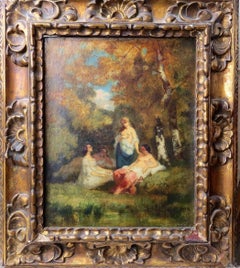
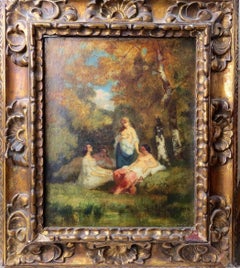
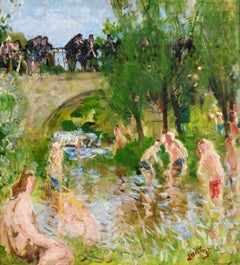
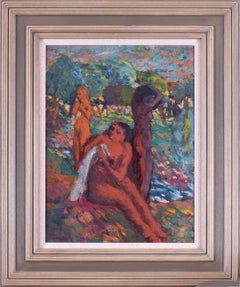
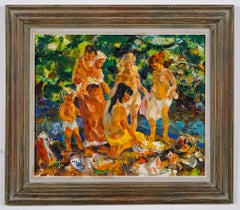
The Bathers ( Les Bagneuses )

Late 19th Century

$2,937.96
£2,150
€2,622.13
CA$4,106.24
A$4,179.77
CHF 2,420.41
MX$55,194.60
NOK 27,054.22
SEK 28,868.99
DKK 19,676.70

About the Item

Adolphe Joseph Thomas Monticelli 1824-1886, was a French painter and influencer of Vincent van Gogh. Monticelli was well known to Theo and Vincent Van Gogh, Theo acted as agent for Monticelli in order to sell his works, Vincent knew his paintings very well and was impressed by their thick impasto and unauthenticity with regards to the Salon authorities who thought him mad, consequently when Monticelli died Vincent wrote to Theo claiming that he would carry on where Monticelli left off. The similarity in their works is readily apparent and a style in which Vincent carried on to his own demise. Monticelli was a brilliant artist and has been very much underrated, however during his lifetime he was in great demand especially here in the UK, the Scottish art dealer and collector Alex Reid was a big buyer of his paintings so much so he was known as Monticelli Reid. Monticelli trained in Paris at the Ecole des Beaux Arts and under Paul Delaroche, he is known to have painted with the Barbizon School of painters in the forest of Fontainebleau, where this image may have been inspired and designed, he was influenced in the Romantic style of Watteau. His works are still widely sought and collected despite the general lack of recognition throughout the World's art aficionados who regularly deny his brilliance, I think he is great. This picture we think is unsigned, however we have another Adolphe Monticelli which has yet to be catalogued, the picture is considerably larger than this and will be entered, subject to acceptance, within the next few months. I have enclosed a short alternative biography of the artist for your interest. Adolphe Monticelli (October 14, 1824 – June 29, 1886) was an innovative French painter of the Romantic and pre-Impressionist eras. He is best known for developing a highly eccentric painting style characterized by vibrant colors, shimmering light, and a uniquely thick, encrusted application of paint (impasto). Though he lived much of his life in relative obscurity and poverty, his radical techniques profoundly influenced pioneering modern artists, most notably Vincent van Gogh and Paul Cézanne. Born in Marseille, France, to a humble family, spending his earliest years in the countryside. He studied at the École Municipale de Dessin in Marseille. He moved to Paris in 1846, training under academic painter Paul Delaroche at the École des Beaux-Arts. And he learned his most valuable lessons by copying Old Masters like Titian, Rembrandt, and Antoine Watteau in the Louvre . Monticelli was greatly inspired by the dramatic color work of Eugène Delacroix and the Barbizon School painter Narcisse Diaz de la Peña. He painted dreamlike courtly parties (fête galantes), operatic scenes, rich floral still lifes, and landscapes. He swapped out academic smooth blending for rough, rapid brushstrokes and he often squeezed paint directly from the tube or mixed resin into his pigments to layer paint like "liquid clay", and due to constant financial strain, he often painted on unprimed, reused wooden panels salvaged from old furniture rather than canvas. H fled Paris on foot during the outbreak of the Franco-Prussian War to return to Marseille, and lived out a strictly bohemian existence, single-mindedly dedicated to his craft while selling masterpieces for meager sums just to survive. He suffered a stroke in 1885 and died in Marseille in the summer of 1886. While his contemporaries were often confused by his nearly abstract approach to texture, Monticelli's legacy was rescued by the next generation of painters. Paul Cézanne frequently painted alongside Monticelli in the open air of Provence. And most famously, Vincent van Gogh discovered Monticelli's floral paintings, Van Gogh was so deeply struck by the thick impasto and emotional use of color that he transformed his own style, famously stating, "I sometimes think I am really continuing that man."
  • Creator:
    Adolphe Monticelli (1824 - 1886, French)
  • Creation Year:
    Late 19th Century
  • Dimensions:
    Height: 22 in (55.88 cm)Width: 25.25 in (64.14 cm)Depth: 3 in (7.62 cm)
  • Medium:
  • Period:
  • Condition:
    The picture is painted on canvas which I believe has been removed from the original stretcher and placed on a mahogany panel, the frame is associated by being reduced to fit, however it is in period and style and in keeping with the painting.
  • Gallery Location:
    Douglas, GB
  • Reference Number:
    Seller: No.3591stDibs: LU2373215810152

More From This Seller

View All
Fete Gallant

Fete Gallant

By Adolphe Monticelli

Located in Douglas, Isle of Man

Adolphe Joseph Thomas Monticelli 1824-1886, was a French painter and influencer of Vincent van Gogh. Monticelli was well known to Theo and Vincent Van Gogh, Theo acted as agent for ...

Category

Late 19th Century Landscape Paintings

Materials

Oil, Panel, Mahogany

Les Levandries    ( The washerwomen )

Les Levandries ( The washerwomen )

By Léonard Saurfelt

Located in Douglas, Isle of Man

Leonard Saurfelt !840-circa 1890, was a French landscape and genre subject painter. This subject sems to be a preferred demonstration of the hard work women endured during the 19th C...

Category

1870s Landscape Paintings

Materials

Canvas, Oil

Idyllic Landscape

Idyllic Landscape

Located in Douglas, Isle of Man

In the manner of Jean-Francoise Milet, 1814-1875, who was a French artist, and one of the founders of the Barbizon School of painters. Milet influenced a great many painters through...

Category

Late 20th Century Landscape Paintings

Materials

Canvas, Oil

Extensive landscape

Extensive landscape

By Thomas Creswick

Located in Douglas, Isle of Man

Thomas Creswick R.A. 1811 - 1869, was an English landscape painter and illustrator. Creswick was one of the leading members of the Birmingham School of landscape painters and exhibit...

Category

1840s Landscape Paintings

Materials

Canvas, Oil

Autumn Landscape

Autumn Landscape

By Arnold Marc Gorter

Located in Douglas, Isle of Man

Arnold Marc Gorter 1866 - 1933, was a Dutch landscape painter who preferred the calm tranquility of the Eastern Netherlands and the change of the seasons, grading light and ambience ...

Category

Early 1900s Landscape Paintings

Materials

Canvas, Oil

You May Also Like

The Swimmers  by the Cercle of Diaz

The Swimmers by the Cercle of Diaz

By Narcisse Virgilio Díaz de la Peña

Located in Pasadena, CA

After the Cercle of Narcisse Díaz ilisible signature Diaz de la Peña, born on August 20, 1807 in Bordeaux and died November 18, 1876 in Menton, is a French painter. From 1837, he...

Category

1870s Barbizon School Figurative Paintings

Materials

Oil

The Swimmers  by the Cercle of Diaz

The Swimmers by the Cercle of Diaz

By Narcisse Virgilio Díaz de la Peña

Located in Pasadena, CA

After the Cercle of Narcisse Díaz ilisible signature .Oil on canvas Diaz de la Peña, born on August 20, 1807 in Bordeaux and died November 18, 1876 in Menton, is a French painter....

Category

1870s Barbizon School Figurative Paintings

Materials

Oil

Les Baigneuses - Post Impressionist Figures in Landscape Oil by Pierre Montezin

Les Baigneuses - Post Impressionist Figures in Landscape Oil by Pierre Montezin

By Pierre Eugène Montezin

Located in Marlow, Buckinghamshire

Signed oil on canvas figures in riverscape circa 1910 by sought after French impressionist painter Pierre Eugene Montezin. The work depicts bathers in a river on a sunny summer's day...

Category

1910s Impressionist Figurative Paintings

Materials

Canvas, Oil

American oil painting 'Bathers II' by Frederick Little Packer

American oil painting 'Bathers II' by Frederick Little Packer

Located in Petworth, West Sussex

Frederick Little Packer (American, 1886–1956) Bathers II Oil on board Signed and inscribed with title (on a label, on the reverse) 19 ¾ x 15 in. (50.2 x 38.3 cm) Radiant and rhythmic...

Category

20th Century Post-Impressionist Figurative Paintings

Materials

Oil, Board

Bathers

Bathers

By John Edward Costigan

Located in Sheffield, MA

John Edward Costigan, N.A. American, 1888-1972 Bathers Oil on canvas Signed ‘J.E. Costigan N.A.’ lower left 20 by 24 in. W/frame 26 by 30 in. John Costigan was born of Irish-American parents in Providence, Rhode Island, February 29, 1888. He was a cousin of the noted American showman, George M. Cohan, whose parents brought the young Costigan to New York City and was instrumental in starting him on a career in the visual arts. They were less successful in encouraging him to pursue formal studies at the Art Students League (where, however, he later taught) than in exposing him to the commercial art world through the job they had gotten him with the New York lithographing firm that made their theatrical posters. At the H. C. Miner Lithographing Company, Costigan worked his way up from his entry job as a pressroom helper, through various apprenticeships, to the position of sketch artist. In the latter capacity he was an uncredited designer of posters for the Ziegfeld Follies and for numerous silent films. Meanwhile, he had supplemented his very meager formal studies in the fine arts with a self-teaching discipline that led to his first professional recognition in 1920 with the receipt of prizes for an oil painting and watercolor in separate New York exhibitions. A year earlier, Costigan had wed professional model Ida Blessin, with whom he established residence and began raising a family in the sleepy little rural New York hamlet of Orangeburg, the setting for the many idyllic farm landscapes and wood interiors with which he was to become identified in a career that would span half a century. John Costigan’s first national recognition came in 1922 with his winning of the coveted Peterson Purchase prize of the Art Institute of Chicago for an oil on canvas, “Sheep at the Brook.” It marked the start of an unbroken winning streak that would gain him at least one important prize per year for the remainder of the decade. The nation’s art journalists and critics began to take notice, making him the recurring subject of newspaper features and magazine articles. The eminent author and critic Edgar Holger Cahill was just a fledgling reporter when he wrote his first feature, “John Costigan Carries the Flame,” for Shadowland Magazine in 1922. Costigan had his first one-man show of paintings at the Rehn Gallery on New York’s 5th Avenue in November, 1924, to be followed less than three years later by another at the Art Institute of Chicago. In addition, Costigan’s work has been—and continues to be included, side-by-side with that of some of America’s most high-profile artists, in museum and gallery exhibitions throughout the country. His renown had peaked in the early 1930s, by which time his work had been honored with nearly every major award then being bestowed in the fine arts and had been acquired for the permanent collections of several prestigious American museums, including New York’s Metropolitan (which only recently, in 1997, deaccessioned his “Wood Interior,” acquired in 1934). Although Costigan’s celebrity had ebbed by the late 1930s, the Smithsonian Institution saw fit in 1937 to host an exhibition exclusively of his etchings. And, in 1941, the Corcoran Gallery (also Washington, D.C.) similarly honored him for his watercolors. (Another Washington institution, the Library of Congress, today includes 22 Costigan etchings and lithographs in its permanent print collection.) During World War II, Costigan returned briefly to illustrating, mainly for Bluebook, a men’s pulp adventure magazine. A gradual revival of interest in his more serious work began at the end of the war, culminating in 1968 with the mounting of a 50-year Costigan retrospective at the Paine Art Center and Arboretum in Oshkosh, Wisconsin. Oils, watercolors and prints were borrowed from museums and private collections throughout the country, and the exhibition was subsequently toured nationally by the Smithsonian Institution. John Costigan died of pneumonia in Nyack, NY, August 5, 1972, just months after receiving his final prestigious award —the Benjamin West Clinedinst Medal of the Artist’s Fellowship, Inc., presented in general recognition of his “...achievement of exceptional artistic merit...” in the various media he had mastered in the course of his career. This painting depicts one of the artist's favorite themes --the farm family bathing...

Category

1950s Post-Impressionist Figurative Paintings

Materials

Oil