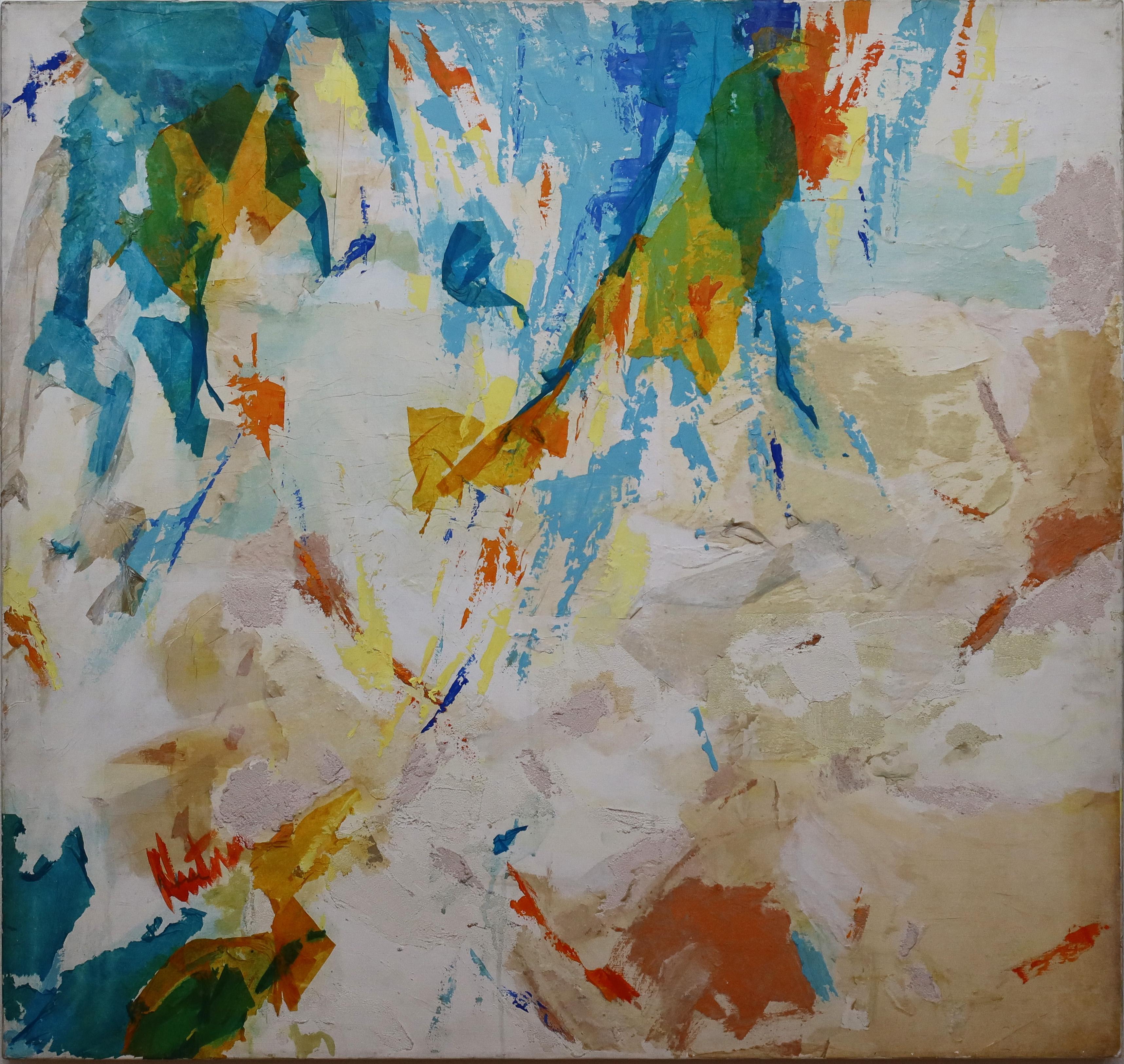
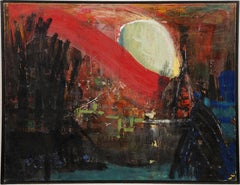
Southhampton 8:45 PM
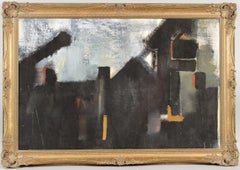
Signed Gray lower right
Titled on verso in black paint
Oil on canvas, 28 x 40 inches
Exhibited: Jacques Seligman Galleries (label) twice, original price $450. (See photo)
Condition: {Small slit in canvas, delivered to Monica for cleaning and repair}
Expertly repaired by Monica Radecki
The Jacque Seligmann relationship directly connects South Hampton 8:45 PM which features a Jacques Seligmann Galleries exhibition label on its verso (back). It was included in his fourth solo exhibition at the venue in 1950.
The Crucible of Form: Cleve Gray and the Jacques Seligmann GalleriesThe post-World War II American art landscape was defined by an tectonic shift. As the devastation of Europe left the traditional centers of Western modernism fractured, New York City rapidly emerged as the global epicenter of contemporary art. It was during this volatile and fertile window that the painter Cleve Gray (1918–2004) returned from military service to launch his professional artistic career. While history frequently groups Gray with the sweeping tides of Abstract Expressionism, his early trajectory was shaped by a highly specific institutional relationship. Between 1947 and 1950, Jacques Seligmann & Co. served as the primary crucible for Gray’s public debut, bridging his classical, European-influenced modernism with the burgeoning avant-garde culture of New York.Post-War Intersections: Paris to New YorkBefore finding a home at the Jacques Seligmann Galleries, Cleve Gray’s artistic vocabulary was forged amid the ruins and restorations of wartime Europe. Serving in the U.S. Army Signal Intelligence division across Britain, France, and Germany, Gray spent his nights drawing the scarred urban landscapes around him—a practice that culminated in his seminal London Ruins series. Following the liberation of Paris, Gray immersed himself in the remnants of French modernism, training informally under the late-Cubist masters André Lhote and Jacques Villon.When Gray returned to Manhattan in 1946, he faced a highly competitive post-war rental and gallery market. Operating out of a cramped studio above a grocery store on East 106th Street, he sought introductions to major contemporary tastemakers like Pierre Matisse and Curt Valentin. While these figures offered initial encouragement, it was Germain Seligman—director of Jacques Seligmann & Co.—who stepped forward. Acting on a recommendation from Valentin, Seligman recognized Gray’s unique synthesis of French intellectual rigor and American vitality.Historically, the Jacques Seligmann Gallery was synonymous with elite European antiquities, Old Masters, and historic French paintings. However, in the late 1940s, Germain Seligman aggressively expanded the gallery’s scope to champion contemporary American art. Cleve Gray became a centerpiece of this bold, modern pivot.The Gallery Years: 1947–1950The partnership between Gray and Jacques Seligmann & Co. catalyzed a period of intense productivity, marked by four consecutive annual solo exhibitions that mapped the artist's rapid evolution:1947 (The Solo Debut): Seligmann hosted Gray's first-ever New York solo exhibition. The show focused heavily on his London Ruins paintings, earning immediate critical praise. New York Times critic Edward Alden Jewell selected a piece from the show for the high-profile Critic's Choice exhibition.1948–1949 (Stylistic Consolidation): The subsequent exhibitions tracked Gray’s shifting balance between representation and geometric reduction. The gallery’s institutional backing allowed Gray to successfully exhibit parallelly at major institutions like the Whitney Museum of American Art and the Metropolitan Museum of Art.1950 (The Mature Early Style): Gray’s fourth solo exhibition solidifed his reputation as a formidable talent. This landmark show included the painting South Hampton 8:45 PM (1950), a work that captures the exact stylistic threshold Gray occupied at the turn of the decade.
NY Times Cleve Gray Obit:
Large Abstract Works, Dies
By Ken Johnson
Dec. 10, 2004
Cleve Gray, a painter admired for his large-scale, vividly colorful and lyrically gestural abstract compositions, died on Wednesday in Hartford. He was 86.
The cause was a massive subdural hematoma suffered after he fell on ice and hit his head on Tuesday outside his home in Warren, Conn., said his wife, the writer Francine du Plessix Gray.
Mr. Gray achieved his greatest critical recognition in the late 1960's and 70's after working for many years in a comparatively conservative late-Cubist style. Inspired in the 60's by artists like Jackson Pollock, Clyfford Still, Mark Rothko and Helen Frankenthaler, Mr. Gray began to produce large paintings using a variety of application methods -- pouring, staining, sponging and other nontraditional techniques -- to create compositions combining expanses of pure color and spontaneous calligraphic gestures.
In 1972 and 73 he produced "Threnody," a suite of 14 paintings, each measuring 20 feet by 20 feet, dedicated to the dead on both sides in the Vietnam War. The series was commissioned by the Neuberger Museum of Art at Purchase College, part of the State University of New York, and is considered one of the largest groups of abstract paintings created for a specific public space.
PUBLIC COLLECTIONS:
Addison Gallery of American Art, Phillips Academy, Andover, MA
Albright-Knox Art Gallery, Buffalo, NY
The Brooklyn Museum, Brooklyn, NY
Cathedral of Saint John the Divine Art Gallery, New York, NY
Colby College Museum of Art, Waterville, ME
Columbia University Art Gallery, New York, NY
Columbus Museum of Art, Columbus, OH
The Corcoran Gallery of Art, Washington, D.C.
Grey Art Gallery and Study Center, New York University, New York, NY
Solomon R. Guggenheim Museum, New York, NY
Heckscher Museum, Huntington, New York, NY
Honolulu Academy of the Arts, Honolulu, HI
The Jewish Museum, New York, NY
Krannert Art Museum, University of Illinois, Champaign, IL
Mattatuck Museum, Waterbury, CT
The Metropolitan Museum of Art, New York, NY
Minnesota Museum of Art, St. Paul, MI
Museum of Art, Rhode Island School of Design, Providence, RI
Museum of Fine Arts, Boston, MA
Museum of Fine Arts, Houston, TX
The Museum of Modern Art, New York, NY
National Museum of American Art, Smithsonian Institution, Washington, D.C.
The Neuberger Museum, State University of New York, Purchase, NY
New Britain Museum of American Art, New Britain, CT
The Newark Museum, Newark, NJ
Norton Gallery of Art, West Palm Beach, FL
Oklahoma City Art Center, Oklahoma City, OK
The Phillips Collection, Washington, D.C.
The Art Museum, Princeton University, Princeton, NJ
Rose Art Museum, Brandeis University, Waltham, MA
Shearson Lehman Hutton Collection, New York, NY
Sheldon Memorial Art Gallery, University of Nebraska, Lincoln, NE
Shite Museum of Art, University of Notre Dame, Notre Dame, IN
Tennessee Botanical Gardens and Fine Arts Center, Nashville, TN
Union Station, Hartford, CT
Vanderbilt Art Gallery, Nashville, TN
The Wadsworth Atheneum, Hartford, CT
Whitney Museum of American Art, New York, NY
Williams College Museum of Art, Williamstown, MA
Yale University Art Gallery, New Haven, CT
Willard Gibbs Research Laboratory, Yale University, New Haven, CT