Fred Ingrams was born in 1964 in England.
He studied at the Camberwell College of Arts and later at the Central Saint Martins (St Martins School of Art), though he left Camberwell for refusing to work in oils and was expelled from St Martins for being a “disruptive influence”.
During the 1980s, he lived and painted above the pub Coach & Horses in Soho, London, while exhibiting in central-London galleries.
He also worked as a graphic designer and art-director for magazines such as the Sunday Times, The Field, Tatler, Vogue and House & Garden.
In 1998 he relocated to Norfolk, where he lives and works, dividing his time between painting on location and in his studio.
His primary subject has been the flat landscape of the East English Fens and, more recently, the Flow Country in northern Scotland. Ingrams is known for working predominantly in acrylic paint, preferring its intensity and quick-drying properties over oil.
His works often present large swathes of colour, strong horizons, minimal human figures, and a heightened sense of place and atmosphere.
Artistic Approach & Themes
Ingrams’s style is characterised by bold use of colour, simplified form, and a strong sense of geometry in the landscape. He paints en plein air (on-site) sketches and then develops larger finished works in the studio. The landscapes he chooses are often perceived as marginal or neglected: the Fens, reclaimed land, flat horizon lines, industrial drainage systems, and more recently remote northern bogland. He seeks to capture the fragility and quiet power of these places.
His work has been exhibited widely in the UK including solo shows such as Flat Earth (2016) and A Year in the Fens (2018).
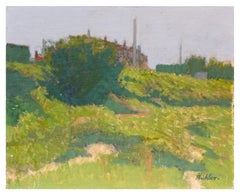
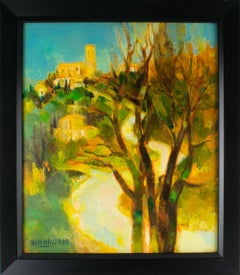
In “Issyrac, Provence; Evening Light” Ingrams abandons his usual East Anglian or Scottish setting and interprets a southern-French scene with exuberant colour and compositional simplicity. The painting presents a foreground of trees rendered in bright, almost neon green blocks of unmixed acrylic paint. Behind them, perhaps a river flows silently, and far beyond lies a diminutive town or city, rendered in flat tone. The sky above is a plain, unmodulated blue field—clean, synthetic, child-like but courageous in its boldness. The colour zones are separate: the greens of the trees, the plain blue of the sky, the muted morphology of the town behind. The evening light is implied not by subtle gradations of tone but by the vibrancy of each block of colour—the glowing greens, the strong blue overhead, the simplified backdrop, the small city nestling into the distant landscape. The effect is joyous, fresh, spontaneous and slightly naïve, yet underpinned by Ingrams’s mastery of colour and composition.
In this work, Ingrams appears to experiment with a more playful and synthetic palette than his usual linear and austere Fens landscapes—with unmixed blocks of paint, bright synthetic hues, a child-like clarity of shape, yet still composed and deliberate. The colour relationships become the subject: bright greens against plain blue, the distant city as a figurative anchor but not dominating the composition. The river or water element brings vertical calm, the trees deliver vertical rhythm, and the plain sky gives the painting a sense of openness and lightness.
This painting, by shifting the locale to Provence, suggests Ingrams’s willingness to transpose his landscape sensibility into a different environment—bringing the flatness, clarity, and large colour masses of his usual practice into a more Mediterranean setting. The use of unmixed, bright acrylic blocks resonates with the artist’s preference for direct, vibrant colour over detailed modelling. The result is both a departure and a reaffirmation of his style: landscape as colour-field, as emotion set in place.
The title “Evening Light” is interesting: rather than using subtle tonality to suggest dusk, the painting uses strong flat planes of colour to evoke the sense of time through colour intensity and contrast. The small city in the background reminds the viewer of human habitation as tiny and subordinate to the coloured landscape; the major focus remains on nature’s formal qualities—the trees, the sky, the river.
Fred Ingrams continues to explore landscape with a fresh eye and bold palette. Although the painting described may not be catalogued in major public databases, it aligns with his known love of landscape, bold use of acrylics, and simplified but vibrant compositional style. If you’d like, I can check for provenance or catalogue entries to see if “Issyrac, Provence; Evening Light” is verifiably listed in his body of work.
Signed on the lower right:
Ingrams
Size without frame:
41 x 72 cm
Provenance:
Charles Mayes Fine Art
Mr and Mrs David Meddings 1996