Circle of Arthur Devis (1712-1787)
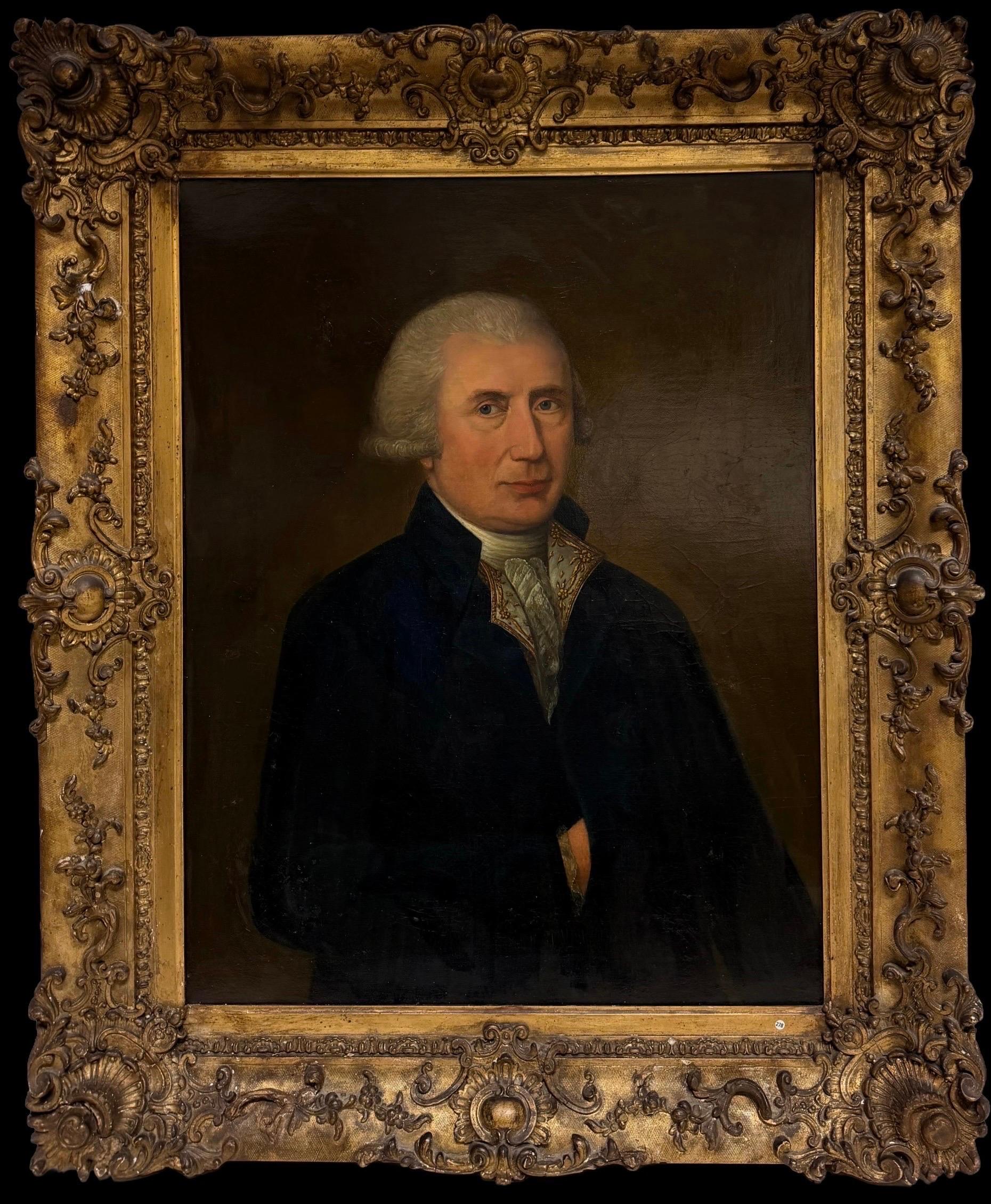
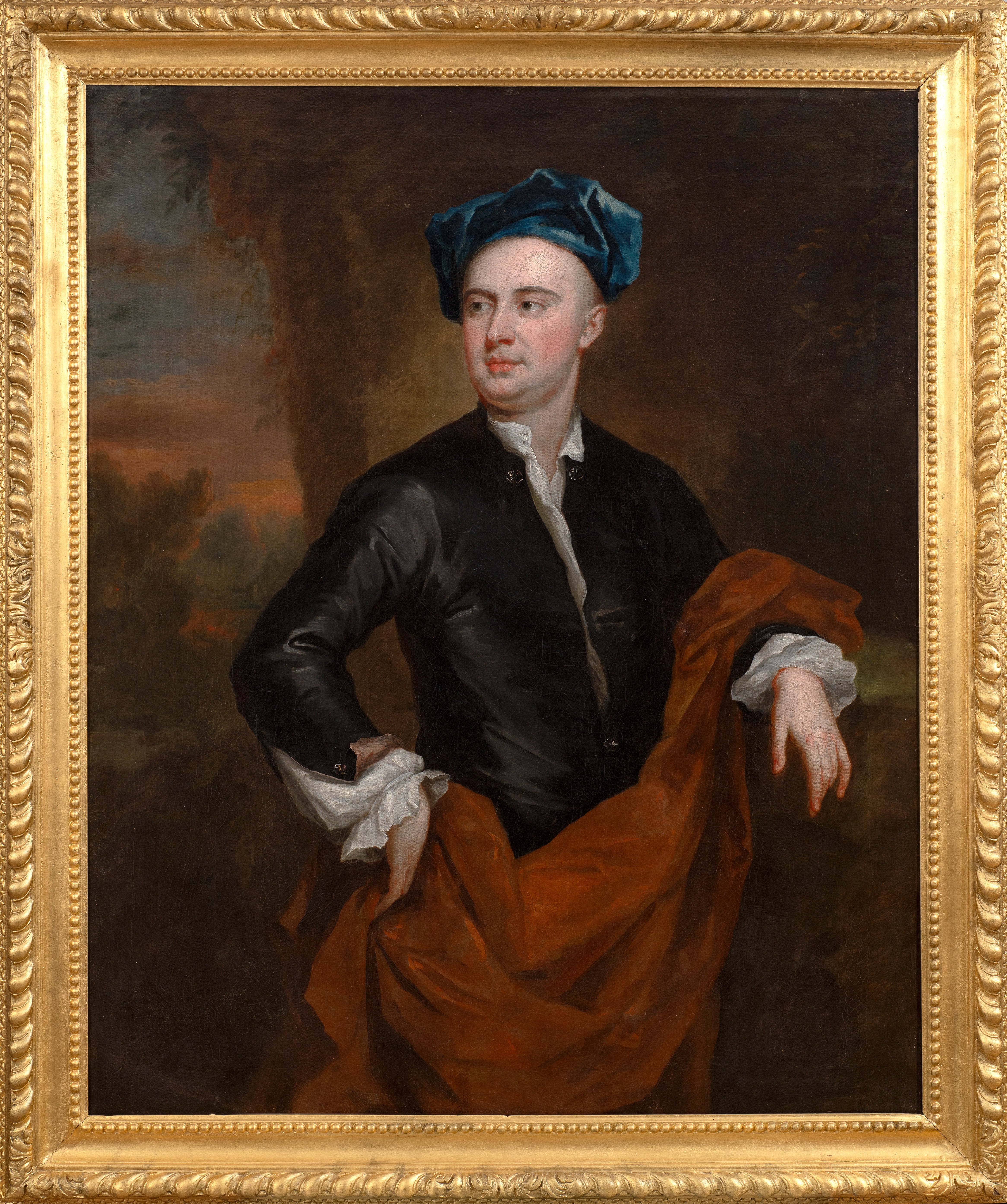
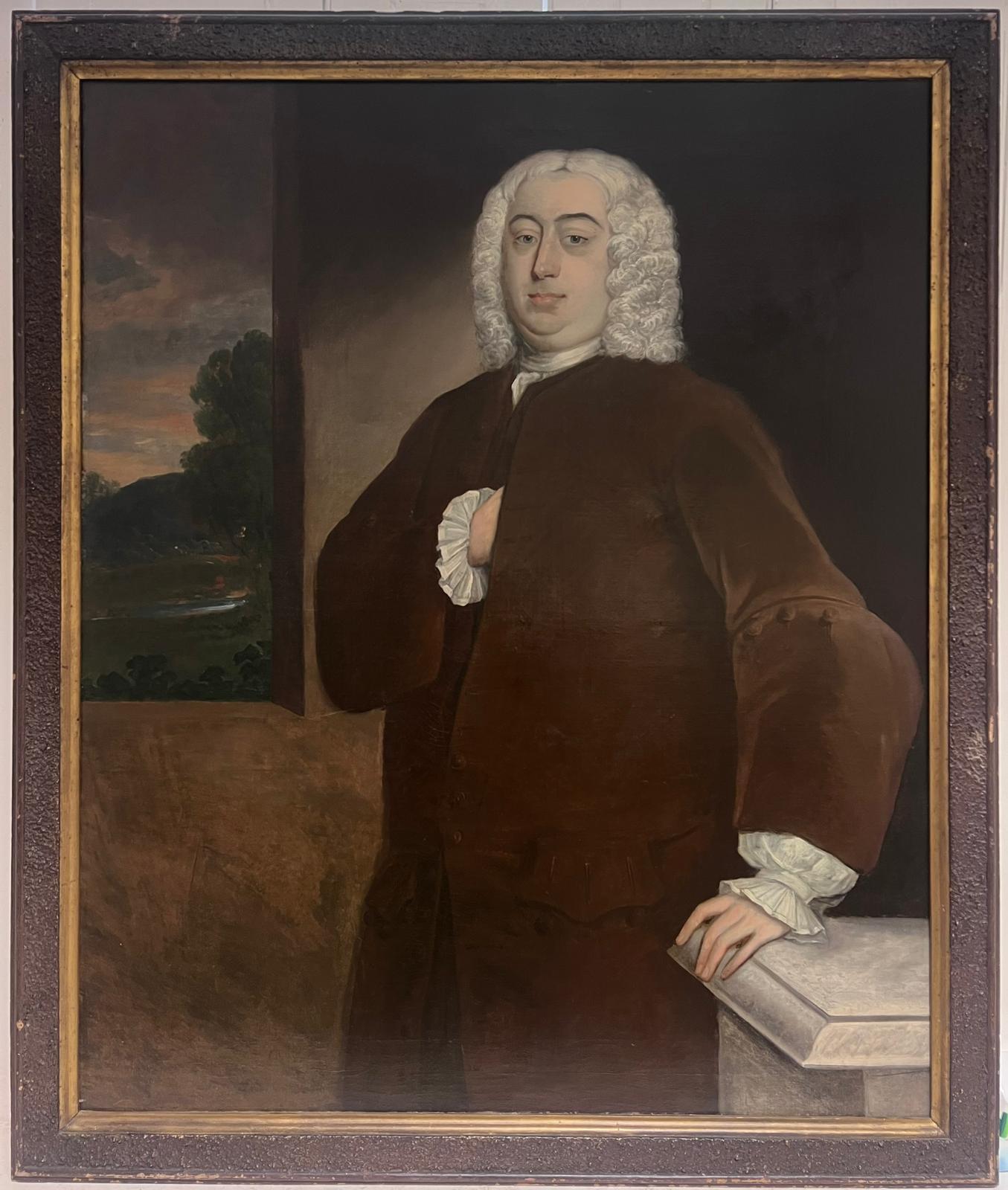
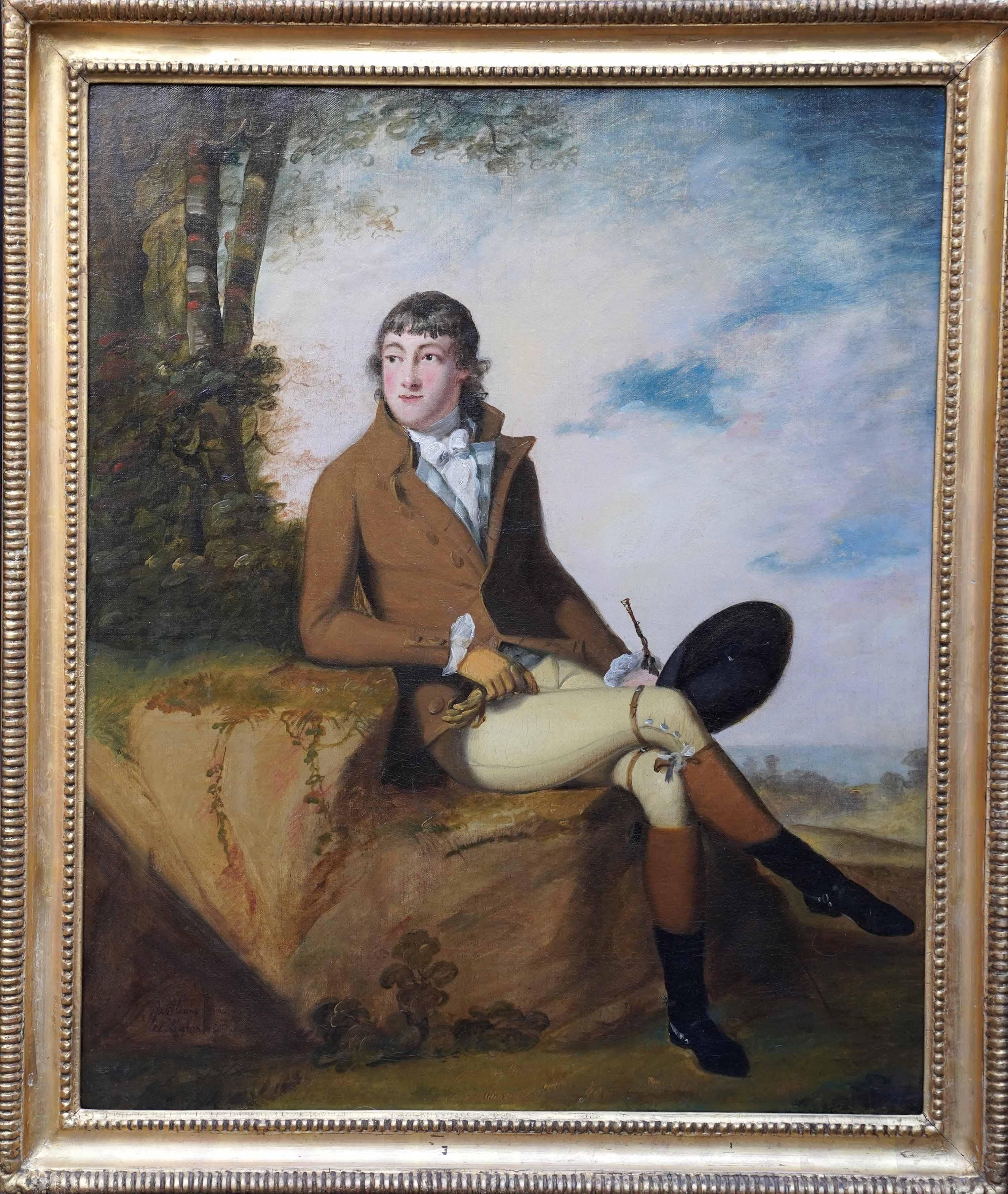
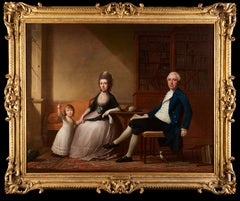
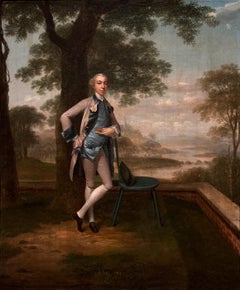
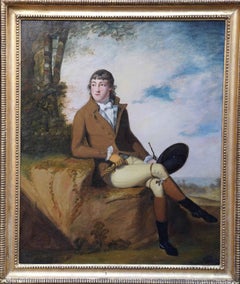
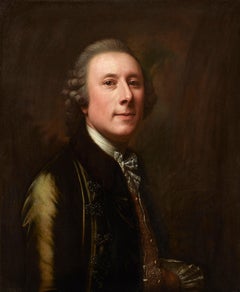
Portrait of a gentleman, standing full length, wearing a blue jacket, waistcoat and breeches, at a desk in a library
Oil on canvas
Signed lower centre
Canvas size 30 x 25 in
Frame size 37 1/2 x 33 in
Arthur Devis was born on 19 February 1712 in Preston, Lancashire, and baptised there on 22 February, the eldest of the four sons of Anthony Devis (b. c.1682, d. after 1761), carpenter and town councillor, and his wife, Ellin, née Rauthmell (d. 1727). After his mother's death his father married, in 1728, Anne Blackburne (bap. 1695?), with whom he had two sons, the elder of whom was Anthony Devis the landscape painter.
Arthur Devis trained with the sporting and topographical landscape artist Peter Tillemans, whose sale in London in 1733 included nine of Devis's Italianate landscapes with ruins. His earliest documented work is a bird's-eye view, Hoghton Tower, Lancashire (1735, priv. coll.), for which he was paid £6 6s. Soon thereafter he began to produce portraits in the conversation piece genre. In 1742, when he was described in the Preston guild roll as ‘of London, Painter’, he married, on 20 July, Elizabeth Faulkner (1723–1788) at St Katharine by the Tower, London. By 1747 the couple had moved to Great Queen Street, where they lived until moving to Brighton in 1783. Of their twenty-two children only six survived, including Ellin Devis (1746–1820), author and a headmistress of a girls' school, and Thomas Anthony Devis (1757–1810) and Arthur William Devis (1762–1822), both painters.
Devis's speciality, the conversation piece, is described as a painting of one or more full-length figures in small scale, frequently accompanied by family members with their possessions, furnishings, and domestic animals, in compositions set within proprietary interiors or landscapes. Taken up in England during the 1720s by William Hogarth and used by Thomas Gainsborough and George Romney (early in their careers), the genre was popular with numbers of unnamed provincial artists whose works have been attributed wrongly to Devis. The most prolific of the eighteenth-century conversation piece artists, Devis produced more than 300 paintings in the format for members of the established, and largely tory, landed gentry and professional classes. For several years after he moved to London he relied on commissions which drew him back to Lancashire and adjacent counties. Thereafter he travelled less frequently, and attracted sitters to his studio in London where he refined his craft to produce, from 1745 until the early 1760s, his most important works.
Devis exhibited at the Free Society of Artists between 1761 and 1763, between 1767 and 1770, in 1775, and in 1780, and was elected president of the organization in 1768. He restored paintings for Sir Roger Newdigate in 1762–4 and was hired by the commissioners of the Royal Naval Hospital, Greenwich, in 1777 to clean and repair the Painted Hall for £1000. Devis also supplemented his income by producing paintings on glass. He had an apprentice, George Senhouse, from 1752 to 1755, and his pupils included Robert Marris and his sons Arthur William and Thomas Anthony. In 1783, the year in which Devis moved to Brighton, the London auctioneer Barford offered for sale, on 10 and 11 April, ‘Pictures belonging to Mr. Devis of Great Queen Street, Portrait Painter and Picture-Cleaner’.
Untrained in academic study from the live human model, Devis frequently used a small wooden manikin, or lay figure (Harris Museum and Art Gallery, Preston), and occasionally clothed it in costumes kept to hand. Although the practice made apparent his deficiencies in anatomical rendering, he was valued by his clients for his ability to describe a wealth of information and to place his figures within legible interior spaces or landscapes. His use of layered glazes and his meticulous handling of the brush, the result of a study of seventeenth-century Dutch masters and his own occasional work as a miniature painter, gave his canvases a highly crafted finish which increased their visual appeal. In such compositions as William Atherton, Mayor of Preston, and his Wife Lucy (c.1743–4, Walker Art Gallery, Liverpool) and Gentleman and Lady at a Harpsichord (1749, Victoria and Albert Museum, London) he demonstrates a topographer's eye for describing the sheen of satin dresses and waistcoats, and the glowing polish on furnishings and floorboards, and for placing his sitters within the vertical and horizontal planes of an interior. In his landscape conversation pieces he also defined with clarity of detail the natural features of a setting. For example, in Sir George and Lady Strickland (1751, Ferens Art Gallery, Hull) the burdock weeds, tree trunks, and winding river are so distributed as to present the figures within an ordered scheme. Only a few of Devis's compositions represent actual locations, among them the interior in Sir Roger Newdigate in his Gothic Library at Arbury, Warwickshire (1756–8, priv. coll.) and the river scenery in Philip Howard of Corby Castle, Cumbria (1759, priv. coll.). Within his restrained and carefully planned group compositions each figure is spaced at wide intervals, isolated by local detail and defined contours rather than assembling into an integrated pictorial whole. Interpreted as a visual allusion to his patrons' codes of behaviour, his conversation pieces record hierarchies of age, gender, and property. His sitters, such as Mr and Mrs Hill (c.1750–51, Yale U. CBA), comport themselves in a range of polite attitudes illustrated in contemporary etiquette manuals. Later in his career Devis attempted to give his figures greater mobility and several of his landscapes allude to the picturesque or summon up wilder aspects of the English countryside. But most of his tableaux remain static owing to their smooth finish, graphic precision, and pervasive reliance on displays of decorum. His work was criticized by those for whom such displays betrayed the sitter's social aspirations. After the Royal Academy's founding in 1768 (the year in which Devis became president of the far less prestigious Free Society of Artists), English artists were no longer marginalized by connoisseurs, and many enjoyed international reputations. In this competitive milieu, Devis's modest reputation suffered a steep decline, not to be reassessed until the 1930s. He has since been recognized as a master of his special craft, that of describing, in small compass, the ideals of a privileged society