Want more images or videos?
Request additional images or videos from the seller.

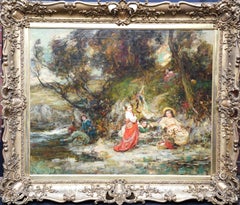
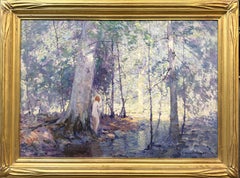
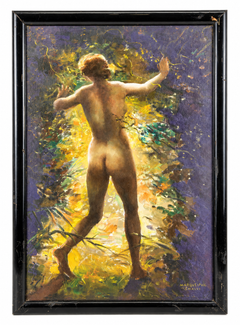
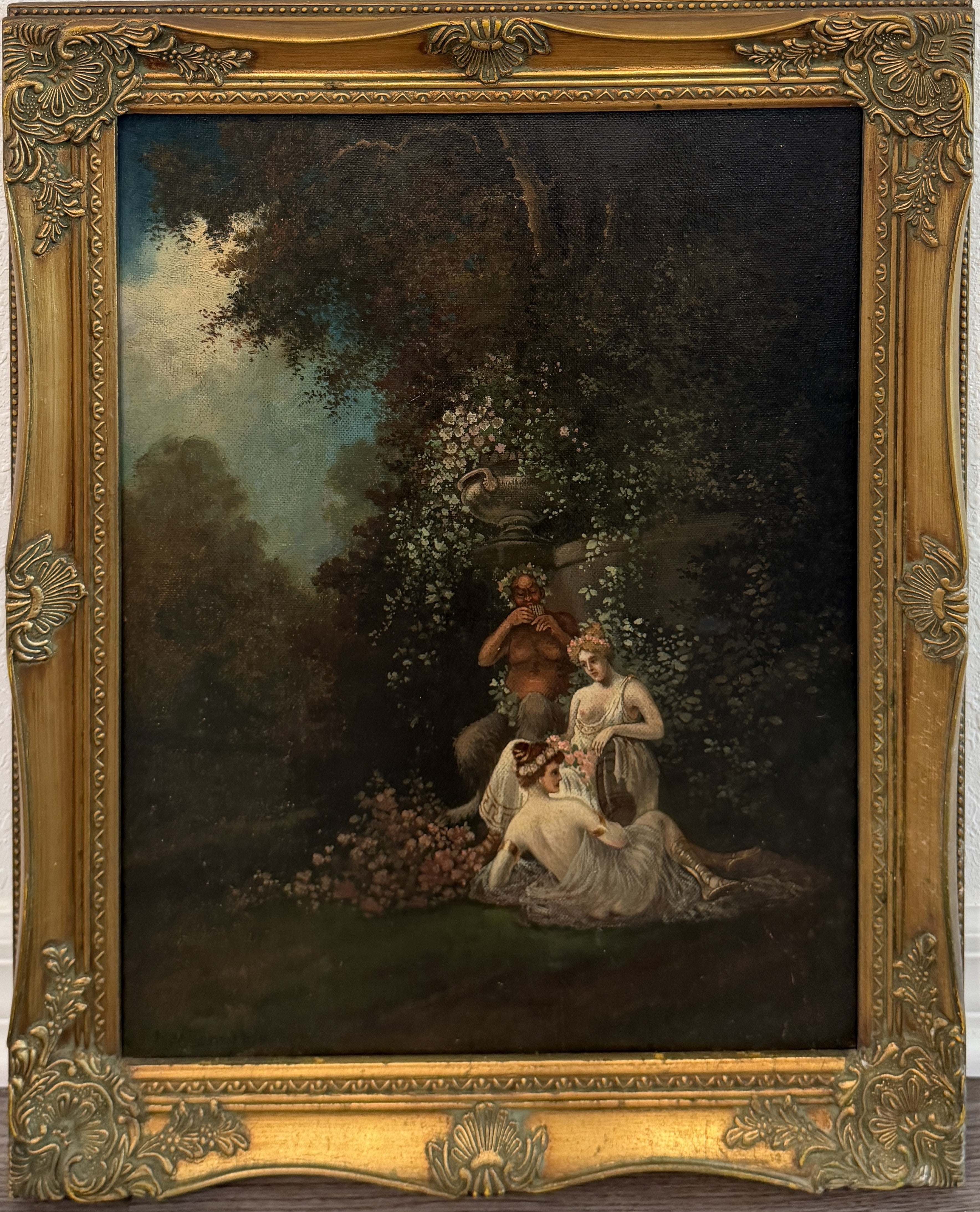
Tree Nymph in a Landscape - American Impressionist 1920's art oil painting

Circa 1928

$10,892.77
£8,000
€9,755.68
CA$15,467.43
A$15,836.57
CHF 8,994.73
MX$202,528.68
NOK 103,469.18
SEK 107,518.18
DKK 72,924.78

About the Item

This gorgeous large American Impressionist oil painting is attributed to Lillian M. Genth. She was a favourite pupil of Whistlers whilst at an art school in Paris. She is best known for depicting female forms or nymphs in landscapes such as this, up until about 1928 when she focused on other topics. She had an estate in Connecticutt and would often paint models in the woods there. Although not initially accepted by Victorian Society, In 1908 her painting, The Lark, won her the Shaw Memorial Prize at the 83rd Annual Exhibition of the National Academy of Design. The Lark depicts a full female nude strolling through the woods with her head turned looking toward the sky as if she just heard a lark, as the title suggests. This painting successfully demonstrates Whistler’s influence on Genth through the integration of the nude form and the landscape. Our lovely painting's composition is of a nymph seated in a tree playing pipes with a blue sky as background, while sheep graze beyond her in a landscape. The dappled sunlight on her skin and hair are beautiful. This is a superb example of work by a female American Impressionist in the 1920's and visually stunning. Unsigned. Provenance: Berkshire estate. Christies London Condition. Oil on canvas, image size is 50 inches by 37 inches and in good condition. Frame. House an ornate gilt frame. Framed size is 57 inches by 44 inches and in good condition. Lillian Mathilde Genth (1876 – March 28, 1953) was an American impressionist artist. She is best known for her depiction of female nudes in landscape settings. However, in the middle of her career she swore off painting female nudes and began painting more conservative paintings inspired by her travels. In about 30 years Genth appeared in 233 exhibitions, and while well renowned for her paintings while alive, her story and artwork have been lost in the retelling of American art history. Lillian Mathilde Genth was born in Philadelphia, Pennsylvania, the daughter of Matilda Caroline Rebscher and Samuel Adam. Genth began her art career by attending the Philadelphia School of Design for Women in Pennsylvania on scholarship. During her schooling years she worked to help support herself as a dress designer. At the Philadelphia School of Design for Women her primary teacher was Elliott Daingerfield. Daingerfield greatly influenced her style, which can be seen in the similar tonalist and coloristic qualities of her landscape scenes. Genth graduated from Philadelphia School of Design for Women in 1900. She received the William L. Elkins European fellowship for attainment in art from the Philadelphia School of Design, which sponsored her to paint in Europe for a year. During her time in Europe, Genth first settled in Paris, France in October 1900 where she enrolled in art classes at the Académie Carmen, an art school run by James McNeill Whistler. Whistler became a large influence on Genth’s work and she was known to be a favorite pupil of his. During one of Whistler’s visits to the school in 1900, he was so impressed by Genth’s work that he gave her a paint palette; an honor that she used and treasured for the rest of her career. This was an incredible compliment from Whistler, who rarely accepted women painters. Genth’s style is typically attributed to Whistler because of her paintings' tonalist qualities and because he taught her to see her paintings as a whole instead of in individual parts. After the Academie Carmen closed in 1901, Genth stayed in Europe for three more years. During this time she worked on painting landscapes, genre scenes, and waterfronts; her nudes would not begin for a few more years. In 1904 Genth returned to the United States and was living in New York City. It was at this point that her career began to flourish. In 1904 Genth showed at three exhibitions: the National Academy of Design, Art Club of Philadelphia, and Worcester Museum. In October of that same year she appeared in her first individual show at the Pennsylvania Academy of Fine Arts. Also in 1904 Genth received the Mary Shaw Prize for the best landscape in the show for her work Peasant Houses, Normandy at an exhibition at the Pennsylvania Academy of Fine Arts. Critics and the general public began noticing and appreciating Genth’s work during this beneficial year. Through the next couple of years Genth continued to show at the nation’s most important art galleries, museums, and art clubs. In 1906 Genth developed her interest in the female nude. She quit drawing her European-inspired landscapes and focused on the female form. She quickly developed skills in drawing the nude female form and established her style that depicts nude females in landscape settings. When Genth was asked why she changed her form she responded, Because to me the most beautiful thing in the world is the human figure outdoors. In Brittany, one day I took a model out and posed her in the open and I was at once filled with resentment at all the beauty I had been missing. The conservative Victorian society was not ready to accept Genth’s nude figures and at first her paintings were often rejected by exhibitions and advisors told her to abandon her new iconography. However, Genth, known for her fierce personality, persevered through these setbacks. In 1908 her painting, The Lark, won her the Shaw Memorial Prize at the 83rd Annual Exhibition of the National Academy of Design. The Lark depicts a full female nude strolling through the woods with her head turned looking toward the sky as if she just heard a lark, as the title suggests. This painting successfully demonstrates Whistler’s influence on Genth through the integration of the nude form and the landscape. The success of the painting relies on the focus of the painting as a whole to make the nude form grounded in the landscape instead of looking out of place. Also in 1908, Genth was elected into the National Academy of Design as an Associate. She was the youngest woman ever elected to this position at the academy. From 1910 until 1929 Genth appeared in at least 164 exhibitions. During these years she experienced a lot of success, popularity, and wealth. She split her time between her two residences; one is an apartment in New York City, and the other is a large estate in the Berkshire Mountains in Connecticut, which she named Hermitcliff. Hermitcliff was an estate of 70 acres of woodland and it was here that Genth was able to paint her models uninterrupted. She loved coming to Hermitcliff and used it well throughout the years. She said about her beloved estate, The things I have learned have come from the soil in the depths of my woods in Connecticut. After overcoming preliminary obstacles and achieving success in her nude forms, Genth began exploring other art forms. On August 12, 1928, Genth announced that she would no longer paint female nudes. She released a press release that said: “Miss Genth begs to announce that she has definitely discontinued painting nudes. In the future, she will devote herself to Spanish and Oriental themes exclusively. Genth's reasoning to stop painting nudes is still a mystery, although several of her friends revealed that Genth had become very religious. They said her new friends of the church convinced her to stop painting her nude figures. However, these accounts go against Genth’s strong-willed and determined personality. She was not the type of woman To succumb to accepted societal norms, as seen in her earlier career when she persevered with her nude paintings. Throughout the 1920s Genth made multiple trips to Spain and became enamored with the sun and culture of the exotic country. She wrote an article on her travels throughout Spain called “Castles in Spain” in which she wrote, “No one knows the glamour of Spain unless you have lived there—the glorious sunlight and flowers. Between 1926 and 1927 she traveled throughout Spain. Her paintings from this time show her passion and admiration for Spanish culture and include images of powerful women. Her paintings use vibrant colors and portray her women as strong, beautiful, and courageous. One of her most famous paintings from this time is Las Abanicas, which depicts four women in brightly colored garments participating in the Seville Fair, a festival in Sevilla, Spain. The painting consists of many patterns, colors, and brushstrokes coming together to create a beautiful and bright composition. Another aspect of Spanish culture that intrigued Genth was bullfighting and she created two notable paintings surrounding this theme: La Novia del Torero and Bull Fight. During her 1926 travels, Genth also stopped in North Africa to paint in the major cities. Genth was a curious woman and determined to find new and interesting subjects to paint and explore. She travelled alone and carried all of her materials and paintings with her and her time in North Africa was short but hectic. The art she made during these travels depicted a variety of different scenes of everyday life and portraits of the local women. In Genth’s own article “A Painting Trip in North Africa” she writes about stories from the trip and the experiences and hardships painting on the road. She discusses the vibrant markets and the foreign culture, but mainly describes the beautiful yet unique colors of the cities. In 1931 Genth returned from a trip to Asia and announced that she would cease painting European and African subjects and focus on the Orient. When asked her reasoning, she simply said, “People live in cycles”. One of the main reasons for her trip was a commission from King Pradjadhipok, the King of Siam. After extensive travel in the far east, Genth lived the rest of her life in New York City and showed in a few more exhibitions during the 1930s, but her shows became increasingly less frequent. In her later years she was driven to upstate New York every fall to witness the leaves change and painted small landscape sketches. She died on March 28, 1953, at her home in New York City at age 76. Genth's work is held in the permanent collections of many institutions, including the Hickory Museum of Art, the Frye Art Museum, the New Britain Museum of American Art, the University of Michigan Museum of Art, the Cheekwood Estate and Gardens, the Salisbury House, and the Smithsonian American Art Museum.
  • Attributed to:
    Lillian Genth (American)
  • Creation Year:
    Circa 1928
  • Dimensions:
    Height: 57 in (144.78 cm)Width: 44 in (111.76 cm)Depth: 2 in (5.08 cm)
  • Medium:
  • Movement & Style:
  • Period:
  • Condition:
  • Gallery Location:
    Hagley, GB
  • Reference Number:
    1stDibs: LU853118079192

More From This Seller

View All
La Source - Nude in Landscape - French Impressionist art Victorian oil painting

La Source - Nude in Landscape - French Impressionist art Victorian oil painting

By Jean-Jacques Henner

Located in Hagley, England

This superb French 19th century oil painting, La Source, location previously unknown according to the Jean Jacques Henner Catalogue Raisonee, is a fantastic art historical re-discovery. It is by noted artist Jean Jacques Henner, a French painter, Henner was noted for his use of sfumato and chiaroscuro in painting nudes, religious subjects, and portraits. La Source, or Spring, is a magnificent, very large French Romantic oil painting depicting a subject for which Henner became famous. Painted in 1881 it was exhibited at the Paris Salon that year. The sitter is Dorothy Tenant (1855-1926) or Dolly, an English art pupil of Henner’s and also his model. (See her biography below). La Source is a painting of a beautiful young woman, Dolly, unclothed, with long auburn hair sat on the edge of a pool in a landscape. Her serene face and body are almost glowing against the darker landscape, all enhanced by the sfumato and chiaroscuro technique. Beyond is a patch of startling blue sky, reflected in the pool at her feet. The rough brush work in the flora and fauna around her, a precursor to French Impressionism, contrasts with the smoothness of her skin. A really stunning painting with excellent provenance. This painting is in the Henner Musee National catalogue raisonne by Isabelle de Lannoy, noted as location unknown and exhibited at the Salon in 1881. Also noted in the catalogue raisonne are two studies for La Source identifying the sitter as Dolly Tennant. One of the images is also shown on the front cover. Signed lower right. Provenance. Exhibited Paris Salon 1881 entitled La Source. Catalogue Raisonne, for National Museum of Jean Jacques Henner, France, p174. La Source, Salon 1881, location unknown. Plus study of Dolly Tennant for La Source and another study for La Source. . The New York Market for French Art in the Gilded Age, 1867-1893 by Dr Leanne Zalewski, published by Bloomsbury Visual Arts, 2022, page 39, La Source image 3.3. Formerly in the collection of Mary Jane Morgan (see below). Aitken Dott - The Scottish Gallery ref R9101. Sotheby sale 30th Dec 1985. Thomas Agnews and Sons. Condition. Oil on canvas, image size 35 inches by 27 inches and in good condition. Has been relined and had restoration during its life time. Housed in a fine frame, 45 inches by 37 inches, in good condition. Jean-Jacques Henner (15 March 1829 – 23 July 1905) was a French painter, noted for his use of painting nudes, religious subjects, and portraits. Henner was born at Bernwiller (Alsace). He began his studies in art as a pupil of Michel Martin Drolling and François-Édouard Picot. In 1848, he entered the École des Beaux Arts in Paris, and took the Prix de Rome with a painting of Adam and Eve finding the Body of Abel in 1858. In Rome, he was guided by Flandrin, and painted four pictures for the gallery at Colmar among other works. He first exhibited Bather Asleep at the Salon in 1863 and subsequently contributed Chaste Susanna (1865), now in the Musée d'Orsay. Other noted works include: Byblis turned into a Spring (1867); The Magdalene (1878); Portrait of M. Hayem (1878); Christ Entombed (1879); Saint Jerome (1881); Herodias (1887); A Study (1891); Christ in His Shroud and a Portrait of Carolus-Duran (1896); a Portrait of Mlle Fouquier (1897); and The Dream (1900).The Levite of the Tribe of Ephraim (1898) was awarded a first-class medal. Among other professional distinctions, Henner also took a Grand Prix for painting at the Paris Exposition Universelle of 1900. He was made Chevalier of the Legion of Honour in 1873, Officer in 1878, and Commander in 1889. In 1889, he succeeded Cabanel in the Institut de France. Henner's most widely known work is his 1885 portrait of Saint Fabiola. Although the original is now lost, it was copied by artists around the world for devotional purposes. Artist Francis Alÿs has collected over 500 copies of the portrait in a variety of media. The collection, known as the "Fabiola Project," is on exhibit at the Byzantine Fresco Chapel of the Menil Collection in Houston from May 21, 2016 - May 13, 2018. Henner had numerous pupils; among them were the American painter Mathilde Mueden Leisenring and the Romanian artist Dimitrie Serafim. From 1874 to 1889, organized with Carolus-Duran, what he called "the studio of the ladies" for women were not allowed entry to the École des Beaux-Arts. Some also served as his models. One of these was Dorothy Tennant who later married Henry Morton Stanley. Henner died at age 76 in Paris. SITTER BIOGRAPHY Dorothy Tennant (22 March 1855 – 5 October 1926) was an English painter of the Victorian era neoclassicism. She was married to the explorer Henry Morton Stanley. Tennant was born in Russell...

Category

19th Century Impressionist Nude Paintings

Materials

Oil

Woodland Path - British Impressionist art 1930 wooded landscape oil painting

Woodland Path - British Impressionist art 1930 wooded landscape oil painting

By Oliver Hall, R.A., R.E., R.S.W.

Located in Hagley, England

This lovely Impressionist landscape oil painting is by prolific exhibitor and British artist Oliver Hall. Painted circa 1930 the composition is a path curving through some trees with...

Category

1930s Impressionist Landscape Paintings

Materials

Oil

You May Also Like

Emile Albert Gruppe Impressionist Landscape Oil Painting, Woodland Nymph

Emile Albert Gruppe Impressionist Landscape Oil Painting, Woodland Nymph

By Emile Albert Gruppe

Located in Milford, NH

A wonderful impressionist landscape with a woodland nymph by American artist Emile Albert Gruppé (1896-1978). Gruppé was born in Rochester, NY, and is renowned for his New England la...

Category

Mid-20th Century American Impressionist Landscape Paintings

Materials

Canvas, Oil

20th Century Signed Nymph Painting by Pierre Bonnerot. Oil on Canvas

20th Century Signed Nymph Painting by Pierre Bonnerot. Oil on Canvas

Located in St. Albans, GB

Pierre Bonnerot (1891-1981) Signed Picture size 33 x 43", 84 x 117 cm Frame size 40 x 50", 102 x 127 Bonnerot was a French painter who studied at the Ecole Nationale Supérieure ...

Category

20th Century Impressionist Landscape Paintings

Materials

Canvas, Oil

Nymph - Modern Oil on Canvas Painting, Early 20th Century

Nymph - Modern Oil on Canvas Painting, Early 20th Century

Located in Roma, IT

Oil on Canvas realized by Walter Einbeck in 1915. It depicts a nymph bathing in a rippling lake, with a knight watching her in the background. The work features divisionist technica...

Category

Early 20th Century Modern Figurative Paintings

Materials

Oil

Water Nymph Symbolist Painting, Oil on Canvas, 19th Century, Signed

Water Nymph Symbolist Painting, Oil on Canvas, 19th Century, Signed

Located in Firenze, IT

"Symbolist Painting. “water Nymph”. Around 1890. Symbolist painting. Period: 19th century Style: Art Nouveau Material: Oil painting Width: 25cm Height: 38cm "The nude of a woman ...

Category

19th Century Symbolist Portrait Paintings

Materials

Canvas, Oil