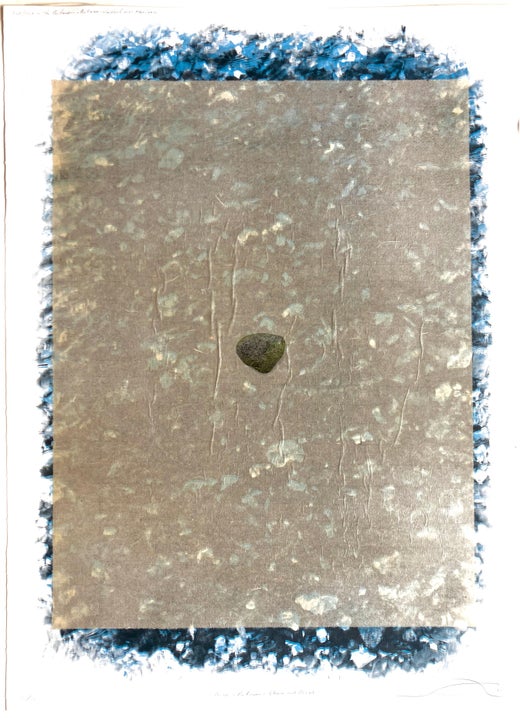
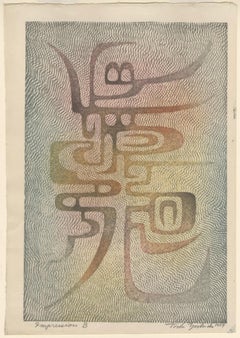
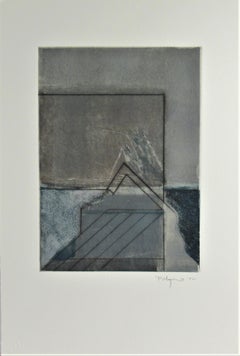
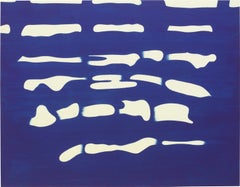
Between Air and Water #18
Color soft ground, Spit Bite Aquatint and Drypoint on Gampi Chine Colle, 1992
Signed, titled, and dated in pencil (see photo)
Annotated: A.P.4 (see photo)
Condition: Excellent
Archival framing
Plate: 7-3/4 x 12-7/8"
Sheet size: 16 7/8 x 21 1/8 "
Frame: 21 x 25 x 1"
Published by Crown Point Press, San Francisco (???)
Most probably printed in Shiubdo Workshop, Kyoto by master printer Tadashi Toda
Artist Proof No. 4
An impression of this image is in the Achenbach Foundation Collection, gift of Crown Point Press
Provenance: Ralph Drake, Cleveland, Ohio Ralph was the first President of the Trideca Society, Cleveland Museum of Art. He was a noted collector of Japanese art, purchasing many works at the annual College Women’s Association of Japan (CWAJ) Print Exhibition.
Regarding the artist:
"Shoichi Ida, who died in 2006, was born in 1941 in Kyoto, Japan. He was trained in both Western and Eastern art traditions, but his work remained essentially Japanese. In 1997 Margaret Hawkins wrote in the Chicago Sun-Times, “In Ida’s works there is a sense of purity and the feeling that he has uncluttered the vast abundance of nature so that we may see it more clearly.” Since the mid-1960s, he often focused on a concept he called “The Surface Is the Between,” which he first began to develop in printmaking and extended throughout his life to works in handmade paper, clay, bronze, steel, iron, and painting on paper and canvas. He explained his unifying concept in an interview published in the Hara Museum Review in 1987: “The surface can be the paper or canvas or whatever; it is the point of contact between me and the ideas I am working on. Through my work I try to make invisible phenomena visible by showing the point of contact.”
Shoichi Ida earned a postgraduate degree from the Kyoto Municipal University of Art in 1964. He received a grant in 1968 from the French government to live and work in Paris and also lived briefly in New York and in San Francisco. He exhibited at the Holly Solomon Gallery in New York, the Perimeter Gallery in Chicago, and Don Soker Contemporary Art in San Francisco. In 1990 five of his prints were shown at the Cincinnati Art Museum.
Ida was perhaps best known as a paper artist and printmaker. He told Constance Lewallen in a 1989 interview that he was moved to begin making prints in the early 1960s when a stone left an impression on a piece of paper in his studio. In addition to a great deal of print work in Japan, he produced five etching projects with Crown Point Press between 1984 and 1992 and a woodcut in Crown Point’s Japan program in 1986.
In 1986 Ida was presented with an Award for Excellence in International Cultural Exchange from the National Endowment for the Arts. In 1989 he was awarded the prestigious Suntory Prize in Japan. In 2003, in perhaps his final body of work, he collaborated with artist Robert Kushner on “East and West, Points of Contact,” at the Sheehan Gallery in Walla Walla, Washington. He was given a retrospective at the Toyota City Museum in 2005.
Shoichi Ida’s work is held in public collections around the world, including the Museum of Modern Art, New York; the Victoria and Albert Museum, London; and the National Museum of Modern Art, Tokyo, Cleveland Museum of Art (this image). His estate is represented by the Perimeter Gallery in Chicago."
Courtesy-Kim Bennett, Crown Point Press
Ralph Drake was a Cleveland-area collector best known for his enthusiasm for Japanese art and contemporary Japanese printmaking. He was closely associated with the Cleveland Museum of Art and was the founding president of the museum's Trideca Society, a collectors' and support organization established to encourage scholarship, collecting, and patronage among museum supporters. Evidence from artworks and collection records indicates that Drake assembled a thoughtful collection emphasizing Japanese prints, works on paper, ceramics, and contemporary Japanese artists.
One of the clearest references to Drake's collecting interests appears in the provenance of a work by the Japanese artist Shoichi Ida. The provenance notes identify Drake as "the first President of the Trideca Society, Cleveland Museum of Art" and describe him as "a noted collector of Japanese art," adding that he acquired many works through the annual exhibitions organized by the College Women's Association of Japan (CWAJ), one of the most important venues for contemporary Japanese printmakers seeking international exposure.
Drake was also a donor to the Cleveland Museum of Art. Museum collection records document his gift of a nineteenth-century porcelain plate designed by Félix Bracquemond and produced by Haviland & Co.. Significantly, the object was presented "in honor of the Trideca Society," suggesting that Drake viewed collecting not simply as a personal pursuit but as a means of strengthening museum collections and encouraging philanthropy.
Unlike earlier Cleveland collector-patrons such as Ralph Thrall King or Ralph Mortimer Coe, whose collections became foundational to the Cleveland Museum of Art, Drake belonged to a later generation of collectors who helped sustain the museum's collecting culture during the late twentieth century. His interests reflected the growing American appreciation for postwar Japanese printmaking, an area that attracted sophisticated collectors seeking alternatives to both traditional ukiyo-e and mainstream Western modernism.
Drake's collection appears to have been particularly strong in contemporary Japanese works on paper. The reference to his repeated purchases from CWAJ exhibitions suggests he followed developments in modern Japanese printmaking closely and acquired works directly from important annual exhibitions rather than solely through dealers or auctions. Such collecting activity helped introduce many Japanese artists to American audiences and contributed to the broader recognition of contemporary Japanese printmaking in museums and private collections.
Although a full biography remains to be written, Ralph Drake can be understood as part of the tradition of Cleveland collector-philanthropists who combined personal connoisseurship with institutional support. His legacy survives through museum gifts, provenance records, and the works he placed into circulation, particularly those connected with modern Japanese art. As additional archives of the Trideca Society and the Cleveland Museum of Art become available, a fuller picture of his collecting activities and influence on Cleveland's cultural life will likely emerge.