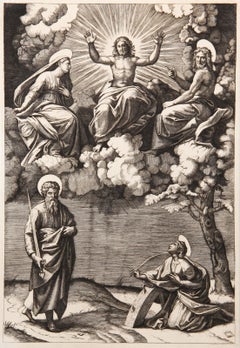
Agostino Carracci (1557-1602)
The Madonna Protecting Two Members of a Confraternity
Engraving, 1582
after a lost painting by Paolo Veronese (1528-1588)
Published by Orazio Bertelli
Selected museum and public holdings
Impressions are preserved in several major collections:
National Gallery of Art, Washington, D.C., accession 2002.14.1; Bohlin 106, state III/III. Its plate measures 29.6 × 22.1 cm. National Gallery of Art
British Museum, London, Department of Prints and Drawings, including impressions catalogued under museum numbers U,2.24 and U,2.97. British Museum
Philadelphia Museum of Art, accession 1985-52-3449; engraving with plate tone, plate 30.1 × 21.4 cm. The impression descended from the John S. Phillips collection. Philadelphia Museum of Art
Museum of Fine Arts, Budapest, which identifies its impression as the third state. Museum of Fine Arts, Budapest
Istituto Centrale per la Grafica, Rome, Fondo Corsini, inventory S-FC30396, catalogued from the opening words of the inscription, Color che uniti in charità perfetta. Istituto Centrale per la Grafica
National Trust, Saltram, Devon, NT 873018.2.41, preserved in a historic album and recorded at Saltram by 1771. National Trust Collections
Civiche Raccolte / Lombardia Beni Culturali, where an impression is catalogued as Madonna protettrice di due confratelli. Lombardia Beni Culturali
Significance
The Madonna Protecting Two Members of a Confraternity is significant on several levels. It is an accomplished example of Carracci’s early Venetian engraving, an expression of the communal devotional culture of Italian confraternities, and an indispensable record of a lost composition by Veronese. The subject’s formal symmetry embodies the fraternity’s ideals of unity and equality, while the enveloping mantle gives visible form to Mary’s protection.
The engraving also demonstrates the historical value of reproductive printmaking. Because Veronese’s painting has disappeared, Carracci’s plate is no longer merely a reproduction of another work; it has become the composition’s principal surviving witness. At the same time, the authority of Carracci’s line—disciplined, varied, and remarkably responsive to light and fabric—allows the engraving to stand as an independent work of art and as an important document of artistic exchange between Bologna and Venice.
Condition: Very good
Usual centerfold associated with paper manufacture
No thin spots, tears or other imperfections
Ample margins
one non obtrusive printer’s crease in image
Sheet size: 11 15/16 x 8 3/4 inches
Reference: Bartsch XVIII.95.105
Bohlin 106 iii/III
A crowned and haloed Virgin stands frontally, extending her voluminous mantle over two kneeling members of a religious confraternity. The men, dressed in the loose ceremonial robes associated with lay devotional brotherhoods, turn inward toward Mary from opposite sides of the composition. Beneath the mantle, two cherub-like figures peer outward from the surrounding darkness. The print reproduces—or, more accurately, preserves—the composition of a painting attributed to Paolo Veronese that is now lost.
Although the engraving itself is not dated in the plate, it has traditionally been assigned to 1582, the year of Agostino Carracci’s first documented period of intensive activity in Venice. It belongs to an important group of reproductive engravings that Carracci made after paintings by Veronese and other Venetian masters. The plate was issued by Orazio Bertelli, a member of the prominent Venetian family of print publishers and dealers. Bertelli’s address appears at lower right: “Horatio Bertelli for.,” an abbreviation of formis, indicating that the print was issued from his press or under his commercial direction.
Diane DeGrazia Bohlin catalogued the engraving as no. 106 and distinguished three states. The National Gallery of Art’s impression is recorded as the third and final state. The present impression appears to include the complete publisher’s address and the full Italian verse and therefore probably also belongs to the final state, although confirmation requires direct examination of the sheet, its watermark, and any minute alterations to the plate.
Inscription and confraternal meaning
Below the image are eight lines of Italian verse arranged in three sections:
Color che uniti in charità perfetta
Menan quà giù vivendo i giorni e l’hore,
Fratelli in Christo, dalla sua diletta
Madre, raccolti son con santo amore;
Ella gli custodisce, ella gli accetta
Come suoi figli, et mette in sommo honore;
Ella del mondo à lor dona vittoria,
E in Ciel gli tira à la beata gloria.
In modern English, the sense is:
Those who, united in perfect charity, pass their days and hours here below as brothers in Christ are gathered in holy love by his beloved Mother. She guards and accepts them as her sons and raises them to the highest honor. She grants them victory over the world and draws them toward blessed glory in Heaven.
The verses make clear that the kneeling men should be understood collectively rather than necessarily as individual portraits. They represent members of a confraternita or scuola: a lay religious association whose members undertook devotional exercises, charitable work, mutual assistance, and the commemoration and burial of deceased brethren.
The subject belongs to the long tradition of the Madonna della Misericordia, or Virgin of Mercy. Since the Middle Ages, Mary’s outspread mantle had symbolized a supernatural refuge beneath which individuals, families, monastic communities, cities, and confraternities might find protection. Here the traditional arrangement is unusually concentrated. Instead of sheltering a crowd, Mary covers only two prominently scaled men. This reduction makes the relationship between the Virgin and the confraternity immediate and personal: the brotherhood is represented by two exemplary members, while the inscription expands their experience to include all “brothers in Christ” united by charity.
The men’s robes carry an additional institutional meaning. Such garments suppressed distinctions of occupation and social rank, presenting the members as equals within a corporate body. Their symmetrical placement similarly expresses concord. One man extends an open hand toward the Virgin, while the other places his hand over his chest. The gestures suggest complementary forms of devotion—petition and inward faith, charitable action and personal submission.
Analysis
Carracci organized the composition as a monumental triangle. Mary’s crown forms its apex, while the broad bodies of the two kneeling confraternity members establish its base. The Virgin’s mantle creates a second, inverted arc that embraces the men and visually seals them within her protection. Her hands do not simply hold the fabric open; they appear to extend a blessing across the entire width of the image.
The strongly frontal presentation gives Mary the gravity of a cult image. Her calm, lowered gaze contrasts with the more animated profiles of the kneeling men. The radiant halo, constructed from unengraved paper and short linear rays, separates her head from the densely worked sky. Against the darkness, the untouched paper seems to emit light.
Carracci translates Veronese’s lost coloristic design into a rich vocabulary of engraved lines. Long, swelling strokes describe the folds of the mantle, while tighter cross-hatching gives substance to the darker garments and background. The faces and hands are modeled with finer, more delicate systems of parallel lines. Particularly effective is the contrast between the pale ceremonial robes of the confraternity members and the deep shadow beneath Mary’s mantle. This darkness functions both spatially and symbolically: it creates a protected interior, almost an architectural sanctuary formed from fabric.
The composition nevertheless retains qualities associated with Veronese. These include the statuesque scale of the figures, the luxurious abundance of drapery, the clarity of the symmetrical arrangement, and the transformation of religious ritual into a dignified public spectacle. Carracci’s engraving is not a neutral facsimile, however. Through the firmness of his contours and the patterned energy of his burin work, he gives the image a distinctly graphic unity. The print’s dense linear surface encourages slow, close viewing and therefore transforms an altarpiece-like invention into an object suited to personal or institutional contemplation.
The tiny figures visible under the mantle have sometimes been described as cherubs. Their presence is unusual within the standard Virgin of Mercy formula. They may serve as heavenly attendants who help animate the enclosed space, or they may reflect details in Veronese’s painting whose precise meaning has been obscured by the loss of the original. Their bright heads punctuate the dark interior and reinforce the idea that Mary’s mantle encompasses both earthly brotherhood and heavenly community.