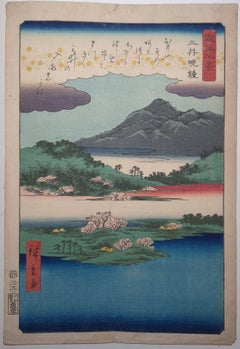
Woodcut Landscape Prints

606 Results
to
105
391
113
49
26
26
Overall Width
to
Overall Height
to
8
100
402
98
8
13
67
45
18
24
52
20
18
11
4
283
89
24
19
15
4
4
4
3
2
2
1
253
116
114
74
63
60
55
45
42
35
31
31
30
30
30
27
21
21
19
19
343
251

Use search to find more

22
11
10
10
7

Use search to find more

Medium: Woodcut
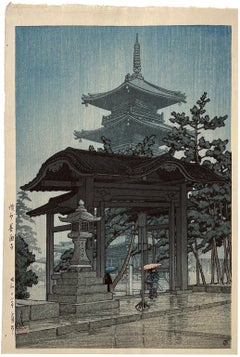
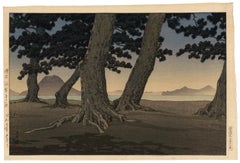
'The Beach at Kaiganji in Sanuki Province'  — Lifetime Impression

'The Beach at Kaiganji in Sanuki Province' — Lifetime Impression

By Kawase Hasui

Located in Myrtle Beach, SC

Kawase Hasui, 'The Beach at Kaiganji in Sanuki Province (Sanuki Kaiganji no hama),' from the series Collected Views of Japan II, Kansai Edition (Nihon fûkei shû II Kansai hen), woodblock print, 1934. A very fine, atmospheric impression, with fresh colors; the full sheet, in excellent condition. Signed 'Hasui' with the artist’s seal 'Kawase', lower left. Published by Watanabe Shozaburo with the Watanabe ‘D’ seal indicating an early impression printed between 1931 - 1941. Stamped faintly 'Made in Japan' in the bottom center margin, verso. Horizontal ôban; image size 9 3/8 x 14 1/4 inches (238 x 362 mm); sheet size approximately 10 5/16 x 15 1/2 inches ( 262 x 394 mm). Collections: Art Institute of Chicago; Austrian Museum of Applied Arts (Vienna); Honolulu Museum of Art; Museum of Fine Arts, Boston; National Museum in Warsaw; University of Wisconsin-Madison. ABOUT THE ARTIST “I do not paint subjective impressions. My work is based on reality...I can not falsify...(but) I can simplify…I make mental impressions of the light and color at the time of sketching. While coloring the sketch, I am already imagining the effects in a woodblock print.” — Kawase Hasui Hasui Kawase...

Category

1930s Showa Woodcut Landscape Prints

Materials

Woodcut

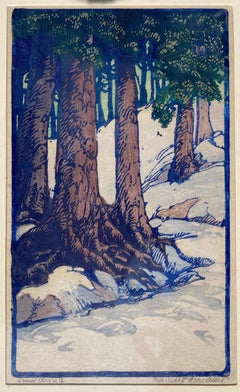
SNOWBOUND

SNOWBOUND

By Frances H. Gearhart

Located in Santa Monica, CA

FRANCES H. GEARHART (1869-1958) SNOWBOUND c.1928 Color block print, Signed and titled in pencil. 11 x 6 ½” sheet c. 14 x 9” Laid down on backing board. The usual slight browning a...

Category

1920s American Impressionist Woodcut Landscape Prints

Materials

Color, Linocut, Woodcut

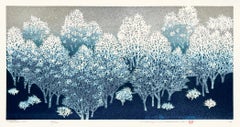
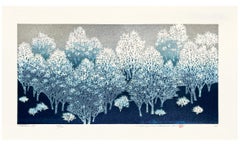
Winter Trees — Sōsaku Hanga Japanese Woodblock Print, Signed

Winter Trees — Sōsaku Hanga Japanese Woodblock Print, Signed

Located in Myrtle Beach, SC

Hajime Namiki, 'Tree Scene 159', color woodcut, edition 200, 2022. Signed in pencil and with the artist’s red seal. Titled, numbered '37/200' and dated, in pencil. A very fine impres...

Category

21st Century and Contemporary Contemporary Woodcut Landscape Prints

Materials

Woodcut

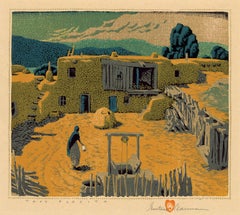
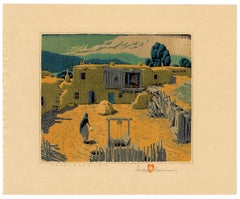
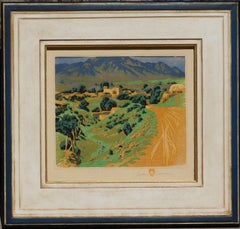
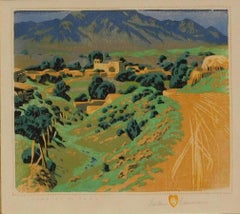
'Taos Placita' — American Southwest Masterwork, Signed Color Woodcut

'Taos Placita' — American Southwest Masterwork, Signed Color Woodcut

By Gustave Baumann

Located in Myrtle Beach, SC

Gustave Baumann, 'Taos Placita', color woodcut, 1947, edition 125. Baumann 132. Signed, titled, and numbered '20-125' in pencil; with the artist’s Hand-in-Heart chop. A superb, richly-inked impression, with fresh colors, on fibrous oatmeal wove paper; the full sheet with margins (2 to 3 1/8 inches); slight rippling at the left sheet edge, in excellent condition. Matted to museum standards, unframed. Image size 9 5/8 x 11 1/4 inches (244 x 286 mm); sheet size 13 1/4 x 17 inches (337 x 432 mm). Collections: Harwood Museum of Art, New Mexico Museum of Art, Phoenix Art Museum, Scottsdale Art Museum, Wichita Art Museum. ABOUT THE ARTIST Gustave Baumann (1881-1971) was a renowned printmaker and a leading figure of the American color woodcut revival whose exquisite craftsmanship and vibrant imagery captured the essence of the Southwest. "A brilliant printmaker, Baumann brought to the medium a full mastery of the craft of woodworking that he acquired from his father, a German cabinetmaker. This craftsmanship was coupled with a strong artistic training that resulted in the handsome objects we see in the exhibition today. After discovering New Mexico in 1918, Baumann began to explore in his woodblock prints of this period the light. color, and architectural forms of that landscape. His prints of this period are among the most beautiful and poetic images of the American West." —Lewis I. Sharp, Director, Denver Art Museum Baumann, the son of a craftsman, immigrated to the United States from Germany with his family when he was ten, settling in Chicago. From 1897 to 1904, he studied in the evenings at the Art Institute of Chicago, working in a commercial printmaking shop during the day. In 1905, he returned to Germany to attend the Kunstwerbe Schule in Munich, where he decided on a career in printmaking. He returned to Chicago in 1906 and worked for a few years as a graphic designer of labels. Baumann made his first prints in 1909 and exhibited them at the Art Institute of Chicago the following year. In 1910, he moved to the artists’ colony in Nashville, Indiana, where he explored the creative and commercial possibilities of a career as a printmaker. In 1915, he exhibited his color woodcuts at the Panama-Pacific International Exposition in San Francisco, winning the gold medal. Among Baumann’s ongoing commercial activities was his work for the Packard Motor Car Company from 1914 to 1920 where he produced designs, illustrations, and color woodcuts until 1923. In 1919, Baumann’s printmaking work dominated the important exhibition of American color woodcuts at the Detroit Institute of Arts. Twenty-six of his prints were included, far more than the works of any other artist. A set of his blocks, a preparatory drawing, and seven progressive proofs complemented the exhibition. That same year, Baumann worked in New York and, over the summer, in Provincetown, Massachusetts. His airy images of Cape Cod employed soft, pastel colors and occasionally showed the influence of the white-line woodcut technique. Many of his Chicago artist friends had traveled to the southwest, and Baumann became intrigued by their paintings, souvenirs, and stories of an exotic place named Taos, New Mexico. In the summer of 1918, he spent the summer in Taos sketching and painting before visiting Santa Fe. Paul Walter, the director of the Museum of New Mexico, offered him a studio in the museum's basement. Inspired by the rugged beauty of the Southwest—the vibrant colors and dramatic landscapes of the region became a central theme in his work, influencing his artistic style and subject matter for the remainder of his career. Later in the decade, he traveled to the West Coast and made prints of California landscape. Baumann's prints became synonymous with the Southwest, capturing the spirit of its place in America's identity with a unique sense of authenticity and reverence. His iconic images of desert vistas, pueblo villages, and indigenous cultures served as visual tributes to the region's rich cultural heritage, earning him a dedicated following among collectors and curators alike. A true craftsman and artist, Baumann completed every step of the printmaking process himself, cutting each block, mixing the inks, and printing every impression on the handmade paper he selected. His dedication to true craftsmanship and his commitment to preserving the integrity of his artistic vision earned him widespread acclaim and recognition within the art world. About the vibrant colors he produced, Baumann stated, “A knowledge of color needs to be acquired since they don’t all behave the same way when ground or mixed...careful chemistry goes into the making of colors, with meticulous testing for permanence. While complicated formulae evolve new colors, those derived from Earth and metal bases are still the most reliable.” In the 1930s, Baumann became interested in puppet theater. He designed and carved his own marionettes and established a little traveling company. From 1943 to 1945, the artist carved an altarpiece for the Episcopal Church of the Holy Faith in Santa Fe. In 1952, a retrospective exhibition of his prints was mounted at the New Mexico Museum of Fine Arts. Throughout his prolific career, Baumann executed nearly four hundred color woodcuts. Baumann’s woodcuts...

Category

1940s American Modern Woodcut Landscape Prints

Materials

Woodcut

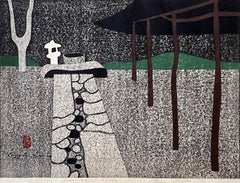
KYOTO (B)
KYOTO (B)

Kiyoshi SaitōKYOTO (B), 1966

$1,080Sale Price|20% Off

KYOTO (B)

By Kiyoshi Saitō

Located in Santa Monica, CA

KIYOSHI SAITO (Japanese 1907 - 1997) KYOTO (B) 1966 Color woodcut, signed, titled, dated and no. 5/100 in pencil. Edition 100. Image 14 3/4 x 20 5/8 inches. Full margins with deckle...

Category

1960s Modern Woodcut Landscape Prints

Materials

Woodcut, Color

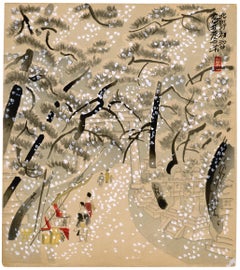
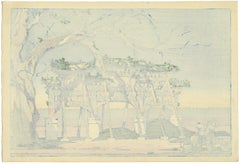
First Snow at Kitano Shrine — Sosaku Hanga Japanese Woodblock, Kyoto

First Snow at Kitano Shrine — Sosaku Hanga Japanese Woodblock, Kyoto

Located in Myrtle Beach, SC

Kamei Tobei, 'First Snow of the Year at Kitano (Kitano Hatsu Yuki)', color woodblock print, c. 1930s. Signed Kamei Tobei in black ink, with the artist red seal Eiichi (the artist’s g...

Category

1930s Showa Woodcut Landscape Prints

Materials

Woodcut

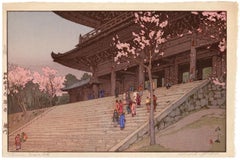
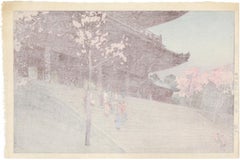
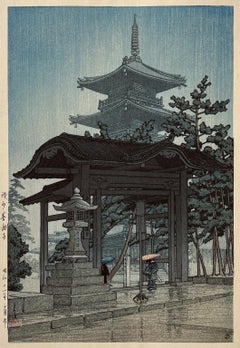
'Chion-in Temple Gate' from 'Eight Scenes of Cherry Blossoms' — Jizuri Seal

'Chion-in Temple Gate' from 'Eight Scenes of Cherry Blossoms' — Jizuri Seal

By Hiroshi Yoshida

Located in Myrtle Beach, SC

Hiroshi Yoshida, 'Chion-in Temple Gate (Sunset)' from the series 'Eight Scenes of Cherry Blossoms (Sakura hachi dai: Sakura mon)', color woodblock print, 1935. Signed in brush 'Yoshida' and in pencil 'Hiroshi Yoshida'. A superb, early impression, with fresh colors; the full sheet with margins, on cream Japan paper; an area of slight toning in the top right sheet corner, not affecting the image, otherwise in excellent condition. Marked with a jizuri (self-printed) seal, upper left margin. Self-published by the artist. Image size 9 5/8 x 14 3/4 inches (444 x 375 mm); sheet size 10 7/8 x 16 inches (276 x 406 mm). Archivally sleeved, unmatted. Provenance: M. Nakazawa, Tokyo. Literature: Tadao Ogura, 'Yoshida Hiroshi zenhangashu (The Complete Woodblock Prints of Hiroshi Yoshida)', 1987, p. 140, no. 194 Amy Reigle Stephens, gen. ed., 'The New Wave: Twentieth-Century Japanese Prints from the Robert O. Muller Collection', 1993, p. 121, no. 111 Ogura Tadao, 'Yoshida Hiroshi ten: shizen-e no manazashi, tokubetsuten, botosugo 50 shunen kinen (Yoshida Hiroshi Exhibition)', MOA Museum of Art, 2000, p. 96, cat. no. 127 Amanda T. Zehnder, 'Modern Japanese Prints: The Twentieth Century', Carnegie Museum of Art, 2009, p. 189 Yoshida Hiroshi: A Retrospective, Chiba City Museum of Art, 2016, p. 211, cat. no. 5-27 Collections: Carnegie Museum of Art, Crocker Art Museum, Honolulu Museum of Art, Museum of Fine Arts Boston, Seattle Art Museum, Toledo Museum of Art. ABOUT THE IMAGE Located in Kyoto, Chionin is the main temple of the Jodo sect of Japanese Buddhism, one of the most popular Buddhist sects in Japan, having millions of followers. The Sanmon Gate, Chionin's entrance gate, standing 24 meters tall and 50 meters wide, it is the largest wooden temple gate in Japan and dates back to the early 1600s. Behind the gate, a broad set of stairs leads to the main temple grounds. ABOUT THE ARTIST Painter and printmaker Yoshida Hiroshi (1876-1950) is regarded as one of the greatest artists of the Japanese 'shin hanga' (New Print) movement. Yoshida was born as the second son of Ueda Tsukane in Kurume, Fukuoka Prefecture, a schoolteacher from an old samurai family. In 1891 he was adopted by his art teacher Yoshida Kasaburo in Fukuoka and took his surname. In 1893 he went to Kyoto to study painting, and the following year to Tokyo to join Koyama Shotaro's Fudosha private school; he also became a member of the Meiji Fine Arts Society. These institutions taught and advocated Western-style painting, greatly influencing Yoshida’s artistic development. In 1899 Yoshida had his first American exhibition at Detroit Museum of Art (now Detroit Institute of Art), making the first of many visits to the US and Europe. In 1902 he helped reorganize the Meiji Fine Arts Society, renaming it the Taiheiyo-Gakai (Pacific Painting...

Category

1930s Showa Woodcut Landscape Prints

Materials

Woodcut

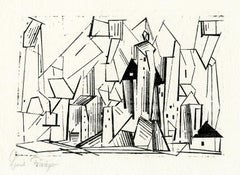
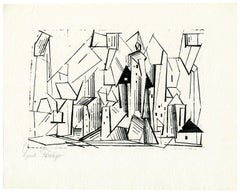
'Die Architektur' (Architecture) — Bauhaus Modernism, Signed Woodcut

'Die Architektur' (Architecture) — Bauhaus Modernism, Signed Woodcut

By Lyonel Feininger

Located in Myrtle Beach, SC

Lyonel Feininger, 'Die Architektur' (Architecture), also 'Stadtbild' (Cityscape), woodcut, edition – proofs only in 1920; 50 in 1921. Prasse W 232. Signed in pencil. A fine, richly-inked impression, on off-white Japan paper, with full margins (1 1/4 to 2 1/8 inches), in excellent condition. Matted to museum standards, unframed. Image size 6 x 8 7/8 inches (152 x 229 mm); sheet size 9 1/2 x 11 7/8 inches (241 x 302 mm). No. 11 of the portfolio 'Zwolf Holzschnitte von Lyonel Feininger', 1921. Provenance: Peter Deitsch collection; exhibited Weimar Museum, 1968. Impressions of this work are in the permanent collections of: the Busch-Reisinger Museum (Cambridge, Mass.), Bauhaus-Archiv (Germany), Hamburger Kunsthalie (Germany), Pfaizische Landesgewerbeanstalt (Germany), Kaiser Wilhelm Museum (Germany), Staatliche Graphische Sammlung (Germany), and the Philadelphia Museum of Art. ABOUT THE ARTIST Lyonel Feininger was born in New York City into a musical family—his father was a violinist and composer, his mother was a singer and pianist. He studied violin with his father, and by the age of 12, he was performing in public, but he also drew incessantly, most notably the steamboats and sailing ships on the Hudson and East Rivers, and the landscape around Sharon, Conn., where he spent time on a farm owned by a family friend. At the age of 16 he left New York to study music and art in Germany, from where his parents emigrated. Drawn more to the visual arts, he attended schools in Hamburg, Berlin, and Paris from 1887 to 1892. After completing his studies, Feininger began his artistic career as a cartoonist and illustrator, his originality leading him to great success. In 1906, after working for a dozen years in Germany, he was offered a job as a cartoonist at the Chicago Tribune, the largest circulation newspaper in the Midwest. He worked there for a year, inventing what became the standard design for the comic strip: in the words of John Carlin, “an overall pattern. . . that allowed the page to be read both as a series of elements one after the other, like language and as a group of juxtaposed images, like visual art.” His originality did not end there: he went on to become one of the great abstract painters. Like Kandinsky, music was his model, but Kandinsky only knew music from the outside—as a listener (inspired initially by Wagner, then by Schoenberg)—while Feininger knew it from the inside. He lived in Paris from 1906 to 1908, during which time he met and was influenced by the work of progressive painters Robert Delaunay and Jules Pascin, as well as that of Paul Cezanne and Vincent van Gogh. He began painting full-time, developing his distinctive Iyrical style based on Cubist and Expressionist idioms and a concern for the emotive qualities of light and color. He exhibited with the Der Blaue Reiter group in 1913, and in 1917, he had his first solo exhibition at Galerie Der Sturm in Berlin. One year after his solo exhibition, in 1918, Feininger began making woodcuts. He became enamored with the medium, producing an impressive 117 in his first year of exploring the printmaking medium. In 1919 at the invitation of the architect Walter Gropius, he was appointed the first master at the newly formed Staatliches Bauhaus in Weimar. His woodcut of a cathedral...

Category

1920s Bauhaus Woodcut Landscape Prints

Materials

Woodcut

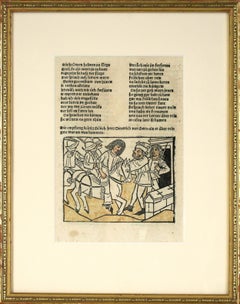
Wolfdietrich - Original leaflet from Johann Prüss' Das Heldenbuch

Wolfdietrich - Original leaflet from Johann Prüss' Das Heldenbuch

Located in Soquel, CA

Original leaflet from Johann Prüss' 1479 printing of "Das Heldenbuch." The Heldenbücher is the title given to a group of late medieval/early renaissance Germanic manuscripts primari...

Category

15th Century and Earlier Medieval Woodcut Landscape Prints

Materials

Paint, Laid Paper, Woodcut

'State Street, Columbia', California, San Francisco Museum of Modern Art, ASL

'State Street, Columbia', California, San Francisco Museum of Modern Art, ASL

By Charles Frederick Surendorf

Located in Santa Cruz, CA

Signed lower right, 'Charles Surendorf' for Charles Frederick Surendorf (American, 1906-1979), titled lower left, 'State Street, Columbia' and created circa 1960. (Framed Size: 18 x ...

Category

1950s Woodcut Landscape Prints

Materials

Paper, Woodcut

Three (3) images from Thirty-six Views of Mt. Fuji (Fuji sanjūrokkei)

Three (3) images from Thirty-six Views of Mt. Fuji (Fuji sanjūrokkei)

Located in Middletown, NY

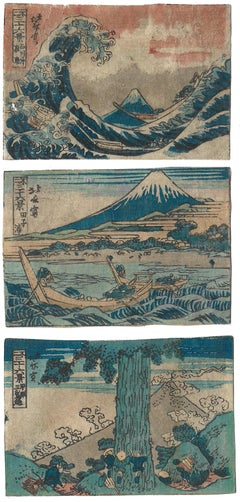
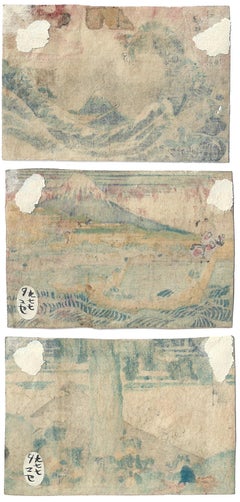
Tokyo: Kawaji, 1830. Three (3) woodblock prints (nishiki-e) in color on handmade mulberry paper, each 2 5/8 x 3 3/8 inches (67 x 82 mm), the full sheet, margins slightly trimmed. Ea...

Category

Early 19th Century Edo Woodcut Landscape Prints

Materials

Watercolor, Handmade Paper, Woodcut

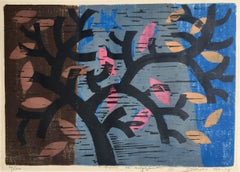
Tree at Night
Tree at Night

Tree at Night

By Werner Drewes

Located in Santa Monica, CA

WERNER DREWES (German-American 1899-1985) TREE AT NIGHT, 1964 (Rose 241) Color woodcut Signed titled, dated and numbered 40 /210 all in pencil below image. Image 11 1/8 x 15 7/8 inc...

Category

1960s Abstract Expressionist Woodcut Landscape Prints

Materials

Woodcut

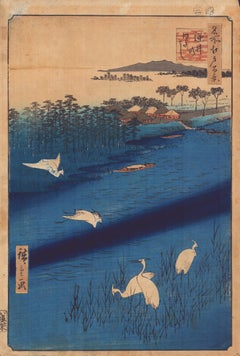
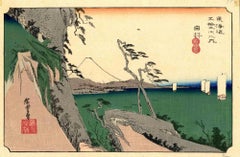
The Ferry at Sakasai - One Hundred Famous Views of EDO 名所江戸百景

The Ferry at Sakasai - One Hundred Famous Views of EDO 名所江戸百景

By Utagawa Hiroshige (Ando Hiroshige)

Located in BRUCE, ACT

Hiroshige (1797-1858) - One Hundred Famous Views of EDO 名所江戸百景 Artist: 広重 Hiroshige (1797-1858) Series: One Hundred Famous Views of EDO (名所江戸百景) Title: The Ferry at Sakasai (逆井のわたし...

Category

1850s Woodcut Landscape Prints

Materials

Woodcut

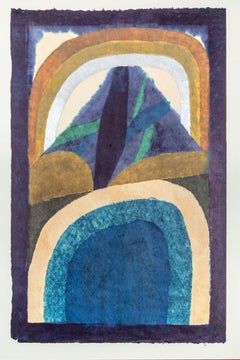
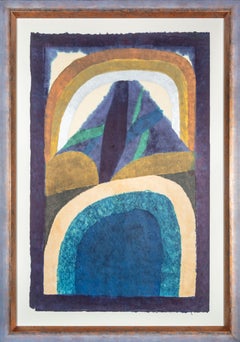
"Ravanna's Palace Burning, " Woodcut Landscape signed by Carol Summers

"Ravanna's Palace Burning, " Woodcut Landscape signed by Carol Summers

By Carol Summers

Located in Milwaukee, WI

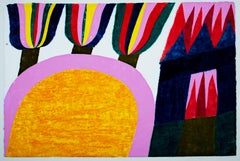
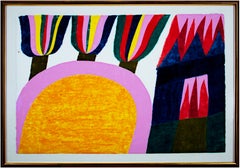
"Ravanna's Palace Burning" is a woodcut signed by Carol Summers. The image combines landscape and architecture, which is typical of the works Summers produced during the 1980s and '90s. In the image, a dark building stands burning, bright red flames licking from the windows and rooftop. It stands beside an orange field framed in pink, probably representing a plaza. Beyond the plaza are multicolored trees, their branches reaching upward like the flames on the building. The playfulness of the image is enhanced by Summers' signature printmaking technique, which allows the ink from the woodblock to seep through the paper, blurring the edges of each form. Art: 24.5 x 37.25 in Frame: 30 x 42.75 in Numbered 53 of the edition of 125 Carol Summers (1925-2016) has worked as an artist throughout the second half of the 20th century and into the first years of the next, outliving most of his mid-century modernist peers. Initially trained as a painter, Summers was drawn to color woodcuts around 1950 and it became his specialty thereafter. Over the years he has developed a process and style that is both innovative and readily recognizable. His art is known for it’s large scale, saturated fields of bold color, semi-abstract treatment of landscapes from around the world and a luminescent quality achieved through a printmaking process he invented. In a career that has extended over half a century, Summers has hand-pulled approximately 245 woodcuts in editions that have typically run from 25 to 100 in number. His talent was both inherited and learned. Born in 1925 in Kingston, a small town in upstate New York, Summers was raised in nearby Woodstock with his older sister, Mary. His parents were both artists who had met in art school in St. Louis. During the Great Depression, when Carol was growing up, his father supported the family as a medical illustrator until he could return to painting. His mother was a watercolorist and also quite knowledgeable about the different kinds of papers used for various kinds of painting. Many years later, Summers would paint or print on thinly textured paper originally collected by his mother. From 1948 to 1951, Carol Summers trained in the classical fine and studio arts at Bard College and at the Art Students League of New York. He studied painting with Steven Hirsh and printmaking with Louis Schanker. He admired the shapes and colors favored by early modernists Paul Klee (Sw: 1879-1940) and Matt Phillips (Am: b.1927- ). After graduating, Summers quit working as a part-time carpenter and cabinetmaker (which had supported his schooling and living expenses) to focus fulltime on art. That same year, an early abstract, Bridge No. 1 was selected for a Purchase Prize in a competition sponsored by the Brooklyn Museum. In 1952, his work (Cathedral, Construction and Icarus) was shown the first time at the Museum of Modern Art in New York City in an exhibition of American woodcuts. In 1954, Summers received a grant from the Italian government to study for a year in Italy. Woodcuts completed soon after his arrival there were almost all editions of only 8 to 25 prints, small in size, architectural in content and black and white in color. The most well-known are Siennese Landscape and Little Landscape, which depicted the area near where he resided. Summers extended this trip three more years, a decision which would have significant impact on choices of subject matter and color in the coming decade. After returning from Europe, Summers’ images continued to feature historical landmarks and events from Italy as well as from France, Spain and Greece. However, as evidenced in Aetna’s Dream, Worldwind and Arch of Triumph, a new look prevailed. These woodcuts were larger in size and in color. Some incorporated metal leaf in the creation of a collage and Summers even experimented with silkscreening. Editions were now between 20 and 50 prints in number. Most importantly, Summers employed his rubbing technique for the first time in the creation of Fantastic Garden in late 1957. Dark Vision of Xerxes, a benchmark for Summers, was the first woodcut where Summers experimented using mineral spirits as part of his printmaking process. A Fulbright Grant as well as Fellowships from the Louis Comfort Tiffany Foundation and the Guggenheim Foundation followed soon thereafter, as did faculty positions at colleges and universities primarily in New York and Pennsylvania. During this period he married a dancer named Elaine Smithers with whom he had one son, Kyle. Around this same time, along with fellow artist Leonard Baskin, Summers pioneered what is now referred to as the “monumental” woodcut. This term was coined in the early 1960s to denote woodcuts that were dramatically bigger than those previously created in earlier years, ones that were limited in size mostly by the size of small hand-presses. While Baskin chose figurative subject matter, serious in nature and rendered with thick, striated lines, Summers rendered much less somber images preferring to emphasize shape and color; his subject matter approached abstraction but was always firmly rooted in the landscape. In addition to working in this new, larger scale, Summers simultaneously refined a printmaking process which would eventually be called the “Carol Summers Method” or the “ Carol Summers Technique”. Summers produces his woodcuts by hand, usually from one or more blocks of quarter-inch pine, using oil-based printing inks and porous mulberry papers. His woodcuts reveal a sensitivity to wood especially its absorptive qualities and the subtleties of the grain. In several of his woodcuts throughout his career he has used the undulating, grainy patterns of a large wood plank to portray a flowing river or tumbling waterfall. The best examples of this are Dream, done in 1965 and the later Flash Flood Escalante, in 2003. In the majority of his woodcuts, Summers makes the blocks slightly larger than the paper so the image and color will bleed off the edge. Before printing, he centers a dry sheet of paper over the top of the cut wood block or blocks, securing it with giant clips. Then he rolls the ink directly on the front of the sheet of paper and pressing down onto the dry wood block or reassembled group of blocks. Summers is technically very proficient; the inks are thoroughly saturated onto the surface of the paper but they do not run into each other. The precision of the color inking in Constantine’s Dream in 1969 and Rainbow Glacier in 1970 has been referred to in various studio handbooks. Summers refers to his own printing technique as “rubbing”. In traditional woodcut printing, including the Japanese method, the ink is applied directly onto the block. However, by following his own method, Summers has avoided the mirror-reversed image of a conventional print and it has given him the control over the precise amount of ink that he wants on the paper. After the ink is applied to the front of the paper, Summers sprays it with mineral spirits, which act as a thinning agent. The absorptive fibers of the paper draw the thinned ink away from the surface softening the shapes and diffusing and muting the colors. This produces a unique glow that is a hallmark of the Summers printmaking technique. Unlike the works of other color field artists or modernists of the time, this new technique made Summers’ extreme simplification and flat color areas anything but hard-edged or coldly impersonal. By the 1960s, Summers had developed a personal way of coloring and printing and was not afraid of hard work, doing the cutting, inking and pulling himself. In 1964, at the age of 38, Summers’ work was exhibited for a second time at the Museum of Modern Art. This time his work was featured in a one-man show and then as one of MOMA’s two-year traveling exhibitions which toured throughout the United States. In subsequent years, Summers’ works would be exhibited and acquired for the permanent collections of multiple museums throughout the United States, Europe and Asia. Summers’ familiarity with landscapes throughout the world is firsthand. As a navigator-bombardier in the Marines in World War II, he toured the South Pacific and Asia. Following college, travel in Europe and subsequent teaching positions, in 1972, after 47 years on the East Coast, Carol Summers moved permanently to Bonny Doon in the Santa Cruz Mountains in Northern California. There met his second wife, Joan Ward Toth, a textile artist who died in 1998; and it was here his second son, Ethan was born. During the years that followed this relocation, Summers’ choice of subject matter became more diverse although it retained the positive, mostly life-affirming quality that had existed from the beginning. Images now included moons, comets, both sunny and starry skies, hearts and flowers, all of which, in one way or another, remained tied to the landscape. In the 1980s, from his home and studio in the Santa Cruz mountains, Summers continued to work as an artist supplementing his income by conducting classes and workshops at universities in California and Oregon as well as throughout the Mid and Southwest. He also traveled extensively during this period hiking and camping, often for weeks at a time, throughout the western United States and Canada. Throughout the decade it was not unusual for Summers to backpack alone or with a fellow artist into mountains or back country for six weeks or more at a time. Not surprisingly, the artwork created during this period rarely departed from images of the land, sea and sky. Summers rendered these landscapes in a more representational style than before, however he always kept them somewhat abstract by mixing geometric shapes with organic shapes, irregular in outline. Some of his most critically acknowledged work was created during this period including First Rain, 1985 and The Rolling Sea, 1989. Summers received an honorary doctorate from his alma mater, Bard College in 1979 and was selected by the United States Information Agency to spend a year conducting painting and printmaking workshops at universities throughout India. Since that original sabbatical, he has returned every year, spending four to eight weeks traveling throughout that country. In the 1990s, interspersed with these journeys to India have been additional treks to the back roads and high country areas of Mexico, Central America, Nepal, China and Japan. Travel to these exotic and faraway places had a profound influence on Summers’ art. Subject matter became more worldly and nonwestern as with From Humla to Dolpo, 1991 or A Former Life of Budha, 1996, for example. Architectural images, such as The Pillars of Hercules, 1990 or The Raja’s Aviary, 1992 became more common. Still life images made a reappearance with Jungle Bouquet in 1997. This was also a period when Summers began using odd-sized paper to further the impact of an image. The 1996 Night, a view of the earth and horizon as it might be seen by an astronaut, is over six feet long and only slightly more than a foot-and-a-half high. From 1999, Revuelta A Vida (Spanish for “Return to Life”) is pie-shaped and covers nearly 18 cubic feet. It was also at this juncture that Summers began to experiment with a somewhat different palette although he retained his love of saturated colors. The 2003 Far Side of Time is a superb example of the new direction taken by this colorist. At the turn of the millennium in 1999, “Carol Summers Woodcuts...

Category

1980s Contemporary Woodcut Landscape Prints
Materials

Woodcut

Victor Rebuffo (1903-1983) - Mid 20th Century Woodcut, Fuego En La Ribera

Victor Rebuffo (1903-1983) - Mid 20th Century Woodcut, Fuego En La Ribera

Located in Corsham, GB

An original woodcut print by the listed Italian-Argentinian artist Victor Luciano Rebuffo (1903-1983). Entitled 'Fuego En La Ribera' Fire on the Riverbank. Initialled within the prin...

Category

20th Century Woodcut Landscape Prints

Materials

Woodcut

STORM LINED - Large Format Gearhart

STORM LINED - Large Format Gearhart

By Frances H. Gearhart

Located in Santa Monica, CA

FRANCES H. GEARHART (1869-1958) STORM LINED c.1936 Color block print, signed and titled in pencil 13 ¼ x 10 1/8, full sheet 14 3/8 x 11 ¼” with deckle edge on her typical fibrous Ja...

Category

1930s Abstract Impressionist Woodcut Landscape Prints

Materials

Color, Woodcut

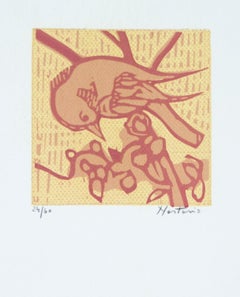
Bird on a Tree  by  Alessandro Nastasio

Bird on a Tree by Alessandro Nastasio

By Alessandro Nastasio

Located in Paonia, CO

Bird on a Tree is an original signed limited edition ( 24/60 ) woodblock print by the Italian artist Alessandro Nastasio. It is in very good condition. Paper size 16.25 x 13.75 image 7 x 6.75 Nastasio was born in Milan in 1934. In 1952 he followed the “free school of the nude” led by Aldo Salvatori. In 1960 he attended the Atelier of Giorgio Upilio where Giacometti, Lam, Fontana, De Chirico worked and where he had the opportunity to study the themes of the inspiring myths. He worked at the MAF foundry with the master Tullio Figini who shared the secrets of the lost wax Renaissance fusion and where he met the masters Crocetti, Manfrini, Manzu , Minguzzi, Fabbri,. He then moved on to Quinto de Stampi at the De Andreis foundry where Marino Marini, Pomodoro, Rudy Wach, Strebelle, Negri and Rosental operated. A regular reader of the great sapienzal texts of antiquity, he trained in particular on the Bible which he illustrated with woodcuts, aquatints, etchings and linocuts, especially the Song of Songs, the book of Ecclesiastes and several pages of the Gospels He also drew his inspiration from the philosophical-religious tradition of the Eastern world through the reading of Rig-Veda, Upanisad and the Matnavi of Rumi. In 1966-67 he obtained the chair at the Academy of Fine Arts of Brera and for thirty years he devoted himself to the teaching of Art Education in various schools. Nastasio created works both pictorial and plastic in collaboration with famous architects such as: Figini and Pollini, De Carli, Gardella, Faranda, Selleri, Ponti. His great talent soon came to the attention of various art dealers: first Max G...

Category

1980s Abstract Impressionist Woodcut Landscape Prints

Materials

Woodcut

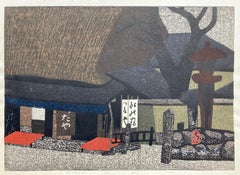
SNOW SCENE - Large Modern Japanese woodcut - Artist Proof

SNOW SCENE - Large Modern Japanese woodcut - Artist Proof

Located in Santa Monica, CA

KITAOKA FUMIO (Japanese 1918 – 2007) SNOW SCENE (Sekkei) 1969 Color woodcut, signed, titled and annotated “artist proof”. Image 21 ½ x 15 3/8”, sheet 25 x 18 3/4”. Good condition s...

Category

1960s Woodcut Landscape Prints

Materials

Color, Woodcut

Gustave Baumann Color Woodblock - Rancho de Taos

Gustave Baumann Color Woodblock - Rancho de Taos

By Gustave Baumann

Located in Phoenix, AZ

“Rancho de Taos” by well-known woodblock artist Gustave Baumann (1881-1971). The medium is color woodblock. It's a beautiful print in excellent condition. Baumann's personal Hand and...

Category

Mid-20th Century Woodcut Landscape Prints

Materials

Woodcut

VALLEY RAMPARTS -
VALLEY RAMPARTS -

VALLEY RAMPARTS -

By Frances H. Gearhart

Located in Santa Monica, CA

FRANCES H. GEARHART (1869-1958) VALLEY RAMPARTS 1933 Color block print, signed and titled in pencil. 10 1/8 x 12 inches. Very large and good impression In generally good condition. ...

Category

1930s Impressionist Woodcut Landscape Prints

Materials

Woodcut

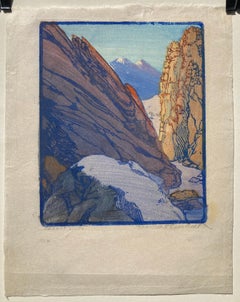
DESERT VISTA (Death Valley)

DESERT VISTA (Death Valley)

By Frances H. Gearhart

Located in Santa Monica, CA

FRANCES H. GEARHART (1869 – 1958) DESERT VISTA (Death Valley) c. 1930 Color linocut signed and titled in pencil. Image 8 3/8 x 8 7/8”. On fibrous japon paper. Sheet 11 ¾ x 8 ¼”. Gen...

Category

1920s American Modern Woodcut Landscape Prints

Materials

Color, Linocut, Woodcut

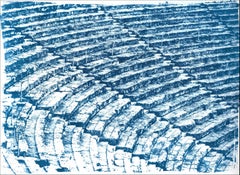
Greek Architecture Blueprint of Ancient Amphitheatre Cyanotype Print, Watercolor

Greek Architecture Blueprint of Ancient Amphitheatre Cyanotype Print, Watercolor

By Kind of Cyan

Located in Barcelona, ES

This is an exclusive handprinted limited edition cyanotype. Details: + Title: Ancient Roman Amphitheater + Year: 2022 + Edition Size: 50 + Stamped and Certificate of Authenticity provided + Measurements : 70x100 cm (28x 40 in.), a standard frame size + All cyanotype prints...

Category

2010s Academic Woodcut Landscape Prints

Materials

Photographic Film, Emulsion, Watercolor, C Print, Lithograph, Monotype, ...

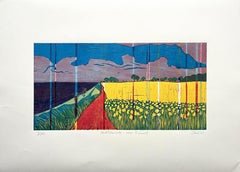
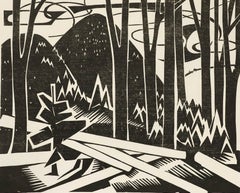
Ali Kurt Baumgarten (1914-2009) - 1980 Woodcut, Woodland Landscape

Ali Kurt Baumgarten (1914-2009) - 1980 Woodcut, Woodland Landscape

Located in Corsham, GB

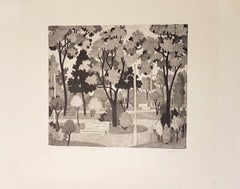
This woodcut by Ali Kurt Baumgarten (1914–2009) presents a stylised woodland landscape, where bold, simplified forms of trees, foliage, and terrain create a rhythmic, almost storyboo...

Category

20th Century Woodcut Landscape Prints

Materials

Woodcut

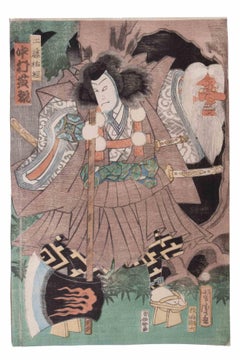
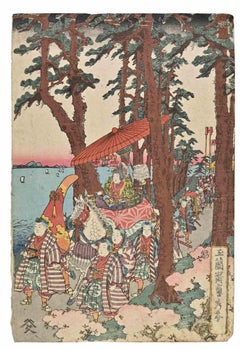
Parade - Woodblock Print by Utagawa Kunisada - Mid-19th Century

Parade - Woodblock Print by Utagawa Kunisada - Mid-19th Century

By Utagawa Kunisada (Toyokuni III)

Located in Roma, IT

Celebratory Parade is an original Woodcut print realized in mid 19th century after Utagawa Kunisada. Good condition and Beautiful colored woodblock print. This wonderful modern a...

Category

Mid-19th Century Modern Woodcut Landscape Prints

Materials

Woodcut

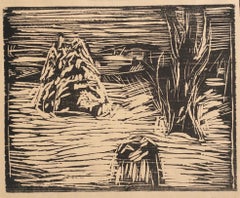
GARDEN IN SNOW
GARDEN IN SNOW

GARDEN IN SNOW

By Edvard Munch

Located in Santa Monica, CA

EDVARD MUNCH (1863 – 1944) GARDEN IN SNOW, II 1913 (WO 467: Sch. 418) Woodcut, 13 ½” x 16 7/8” signed in pencil. Generally very good condition. Irregular sheet of simili-japan ...

Category

1910s Expressionist Woodcut Landscape Prints

Materials

Woodcut

Katsura Kyoto (L)
Katsura Kyoto (L)

Katsura Kyoto (L)

By Kiyoshi Saitō

Located in San Francisco, CA

Artist: Kiyoshi Saito – Japanese – (1907-1997) Title: Katsura, Kyoto (L) Year: 1964 Medium: Woodblock Image size: 18 x 24 inches. Sheet size: 21.5x 28.5 inches. Signature: Signed, ...

Category

1960s Modern Woodcut Landscape Prints

Materials

Paper, Woodcut

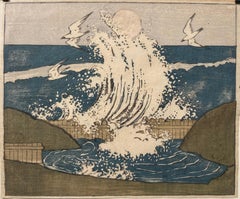
THE WAVE - MOONRISE
THE WAVE - MOONRISE

THE WAVE - MOONRISE

By Bror Julius Olsson Nordfeldt

Located in Santa Monica, CA

B. J. O. NORDFELDT (1878 - 1955) THE WAVE, MOONRISE, 1906 (Donovan 19) Woodcut printed in colors. Signed and dated faintly in sky upper left. Image 9 ¼ x 11 1/8”, sheet 9 5/8 x 11 ...

Category

Early 1900s Modern Woodcut Landscape Prints

Materials

Woodcut

THE THAW
THE THAW

THE THAW

By William Seltzer Rice

Located in Santa Monica, CA

WILLIAM SELTZER RICE (1873 - 1963) THE THAW c 1915-20 Color woodcut, signed and titled in pencil. Image 8 7/8 x 12 inches, sheet 10 3/4 x 14 3/8 inches. On textured fibrous paper. V...

Category

1910s American Modern Woodcut Landscape Prints

Materials

Color, Woodcut

Evening Snow on Mount Fuji... - Woodcut by Utagawa Toyokuni II - 19th Century

Evening Snow on Mount Fuji... - Woodcut by Utagawa Toyokuni II - 19th Century

By Utagawa Toyokuni II

Located in Roma, IT

Oban format, from the second edition of the series "Meisho Hakkei" (Eight Viewn of Famous Places). Publisher: Iseya Rihei. Censor Seal: Kiwame. Trimmed to the image, thereby removi...

Category

19th Century Modern Woodcut Landscape Prints

Materials

Woodcut

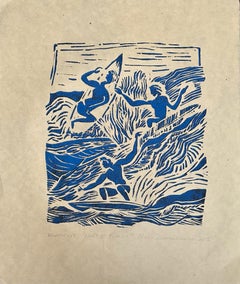
Three Turns - Surfing Art By Marc Zimmerman

Three Turns - Surfing Art By Marc Zimmerman

By Marc Zimmerman

Located in Carmel, CA

Three Turns - Surfing Art - Figurative - Woodcut Print By Marc Zimmerman Limited Edition 01/04 This masterwork is exhibited in the Zimmerman Gallery, Carmel CA. Immerse yourself i...

Category

2010s Contemporary Woodcut Landscape Prints
Materials

Woodcut

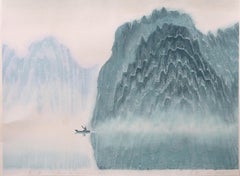
Music in Morning, Contemporary Woodcut Print with Ink Drawing by Lu Fang

Music in Morning, Contemporary Woodcut Print with Ink Drawing by Lu Fang

Located in Long Island City, NY

Lu Fang, Chinese (1932 - ) - Music in Morning, Year: 1983, Medium: Woodcut and water-soluble ink and Chine colle, signed, titled and dated in pencil, Image Size: 15 x 21 inches, S...

Category

1980s Contemporary Woodcut Landscape Prints
Materials

Ink, Woodcut

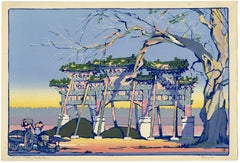
'Peking - Paifang Gate' — Mid-Century Watanabe Color Woodcut

'Peking - Paifang Gate' — Mid-Century Watanabe Color Woodcut

By Cyrus Le Roy Baldridge

Located in Myrtle Beach, SC

Cyrus Le Roy Baldridge, 'Peking '25', woodblock print, published 1926. Signed, titled, dated, and annotated 'No 124' in pencil. A fine impression, with fresh, undiminished colors; the full sheet, in excellent condition. Watanabe 6 mm seal, lower right, indicating an impression printed between 1945 and 1957. Archivally sleeved, unmatted. Image size 9 5/8 x 14 5/16 inches; sheet size 10 7/16 x 15 3/8 inches. ABOUT THE IMAGE A 'paifang', also known as a 'pailou', is a traditional style of Chinese architectural arch or gateway structure. It has been theorized that the paifang gate architecture was influenced by Buddhist torana temple gates. Paifang are designed with traditional Chinese architectural motifs including multi-tiered roofs, prominent supporting posts, and gracefully arched openings. This is an unusual ukiyo-e or 'floating world' woodcut published by Watanabe Shozaburo, Tokyo, in that the subject is of an early 20th-century scene in Peking, China. ABOUT THE ARTIST Cyrus Leroy Baldridge...

Category

1920s Showa Woodcut Landscape Prints
Materials

Woodcut

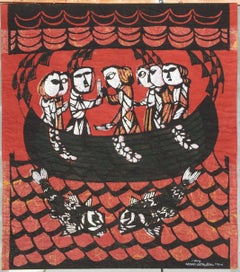
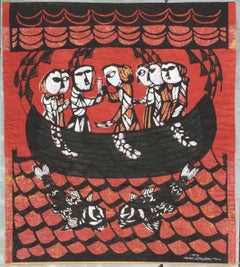
Jonah
Jonah

Sadao WatanabeJonah, 1959

$1,200Sale Price|20% Off

Jonah

By Sadao Watanabe

Located in Santa Monica, CA

SADAO WATANABE (Japanese 1913-1996) JONAH, 1959 Color stencil, signed, numbered and dated in white ink. Sheet, 25 5/8 x 22 5/8 inches. Edition: 44/50. Good color and generally good ...

Category

1950s Modern Woodcut Landscape Prints
Materials

Woodcut, Stencil

Woodcut landscape prints for sale on 1stDibs.

Find a wide variety of authentic Woodcut landscape prints available on 1stDibs. While artists have worked in this medium across a range of time periods, art made with this material during the 21st Century is especially popular. If you’re looking to add landscape prints created with this material to introduce a provocative pop of color and texture to an otherwise neutral space in your home, the works available on 1stDibs include elements of blue, orange, yellow, green and other colors. There are many well-known artists whose body of work includes ceramic sculptures. Popular artists on 1stDibs associated with pieces like this include Marc Zimmerman, Eve Stockton, Carol Summers, and Utagawa Hiroshige. Frequently made by artists working in the Modern, Contemporary, all of these pieces for sale are unique and many will draw the attention of guests in your home. Not every interior allows for large Woodcut landscape prints, so small editions measuring 0.01 inches across are also available