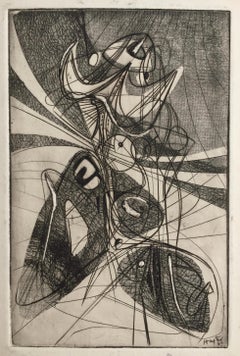
Stanley William Hayter (1901-1988)
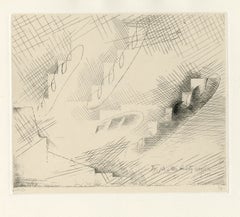
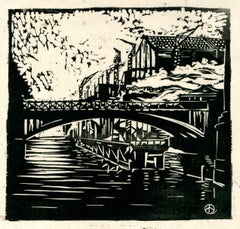
La Villette
Drypoint and Engraving, 1930
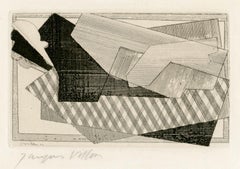
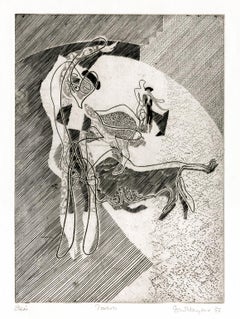
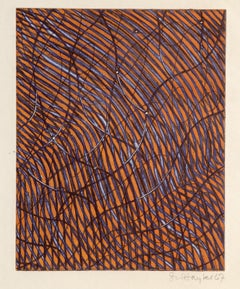
Signed and numbered in pencil by the artist (see photos)
Edition: 50 (33/50)
Condition: Excellent
Image/Plate size: 7 1/4 x 9 3/4 inches
Sheet size: 11 x 14 inches
From: Paysage Urban Suite (six plates)
Edition: 50
Printed by Paul Haasen, Paris
Published by Éditions des Quatre Chemins, Paris
La Villette belongs to Paysages urbains, Stanley William Hayter’s first formally commissioned portfolio of prints. Published in Paris in 1930 by Éditions des Quatre Chemins and printed by Paul Haasen, the portfolio records several Parisian neighborhoods through a distinctly modern combination of close observation, expressive line, and spatial distortion. The series includes La Villette, Rue de la Villette, Père Lachaise, Rue du Repos, Rue d’Assas, and Place Falguière.
Although sometimes described simply as an engraving, La Villette combines engraved lines with drypoint. The National Gallery of Art identifies its impression as the second and final state, printed on BFK Rives wove paper and numbered from an edition of fifty. The related but compositionally distinct Rue de la Villette is catalogued separately as Black and Moorhead 35; the present print, La Villette, is Black and Moorhead 34. This distinction is important because the two titles are frequently confused in auction and dealer descriptions.
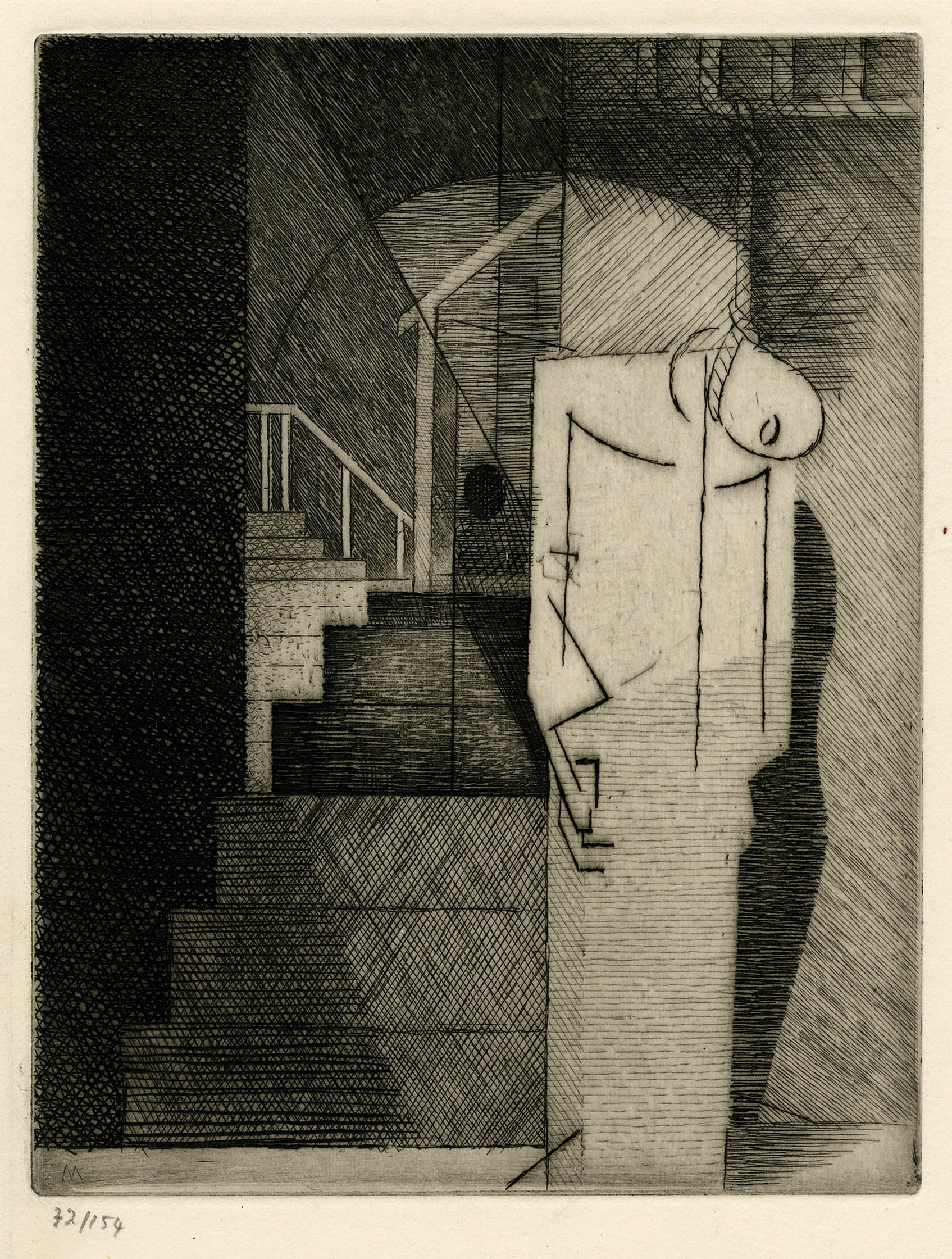
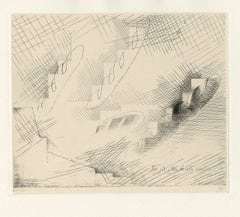
The print presents a steeply ascending street enclosed by irregular, tightly compressed buildings. Rooflines, façades, windows, and retaining walls overlap in a sequence of sharp diagonals. Rather than arranging the district according to conventional one-point perspective, Hayter fractures the view into interlocking planes. The observer seems to look simultaneously upward, inward, and across the street. The result is recognizable as an urban landscape yet already approaches abstraction.
Hayter’s engraved lines establish the architectural framework, while the more velvety drypoint passages introduce atmospheric shadow and tactile irregularity. Dense cross-hatching darkens the façades and gives weight to the foreground structures. Against these passages, areas of comparatively open paper suggest reflected light and pull the eye toward the upper reaches of the street. The visual movement is therefore strongly directional: lines climb, collide, and redirect the viewer through the composition.
La Villette was historically a working-class and industrial district of northeastern Paris, associated with canals, railways, warehouses, slaughterhouses, and the movement of goods into the city. Hayter avoids picturesque monuments and instead concentrates upon the district’s steep streets and crowded vernacular architecture. His choice of subject places the print within the modern tradition of depicting the city’s peripheral neighborhoods rather than its celebrated boulevards. The scene is neither sentimentalized nor treated as a documentary topographical record. Architecture becomes the vehicle for expressing instability, energy, and psychological tension.
Impressions of La Villette are held by several major public collections:
National Gallery of Art, Washington, D.C. — impression 7/50, Black and Moorhead 34, second state; Gift of Mrs. Robert A. Hauslohner in honor of the museum’s fiftieth anniversary. National Gallery of Art collection record
Museum of Fine Arts, Houston — impression 41/50; Gift of Mr. and Mrs. Alvin S. Romansky. The museum exhibited the work in Stanley William Hayter, Master Printmaker in 2016. Museum of Fine Arts, Houston collection record
Art Institute of Chicago — an impression from the Paysages urbains
portfolio, printed by Paul Haasen. Art Institute of Chicago collection record
Reference: Black and Moorhead 34 ii/II
Stanley William Hayter was born in London on December 27, 1901. He studied chemistry and geology at King’s College London and initially worked for the Anglo-Persian Oil Company in the Middle East. The drawings and paintings he produced during this period encouraged him to abandon his scientific career and move to Paris in 1926.
In Paris, Hayter studied briefly at the Académie Julian and learned engraving from the Polish-born artist Józef Hecht. He quickly became fascinated by the physical resistance of the copper plate and by the expressive possibilities of the engraved line. In 1927 he established an experimental print workshop that later became known as Atelier 17, after its address at 17 rue Campagne-Première.
Atelier 17 developed into one of the most influential printmaking workshops of the twentieth century. Hayter encouraged artists to work directly upon the plate, combine techniques, and regard printmaking as an independent creative medium rather than simply a means of reproducing paintings. Among the artists associated with the workshop at different times were Joan Miró, Max Ernst, Alberto Giacometti, André Masson, Pablo Picasso, Marc Chagall, Jackson Pollock, Mark Rothko, Louise Nevelson, and Helen Frankenthaler.
During the 1930s Hayter became closely associated with Surrealism, particularly its interest in automatism and the spontaneous generation of imagery. After moving Atelier 17 to New York during the Second World War, he exerted a significant influence upon the emerging Abstract Expressionists. He returned permanently to Paris in 1950 and later became celebrated for developing multicolor viscosity printing, through which inks of different consistencies could be applied to a single plate. He died in Paris in 1988.
Place within Hayter’s development
La Villette predates the fully Surrealist and abstract compositions for which Hayter later became best known, but it already contains several essential features of his mature work. The most important is his conception of line as an active force. In this print, line does more than describe buildings: it twists the space, directs movement, establishes pressure, and creates a visual rhythm independent of the subject.
The composition occupies a transitional position between representation and abstraction. Its subject remains legible, but the architectural planes have begun to detach themselves from conventional perspective. Streets, roofs, and façades function almost like the interacting forms in Hayter’s later biomorphic prints. The ascending street becomes less a specific view than a field of compressed energy.
The print also demonstrates Hayter’s early respect for traditional craftsmanship. The sharply controlled engraved passages reveal the influence of Hecht and the discipline of burin engraving, while the drypoint burr supplies softer, more spontaneous accents. Hayter would increasingly exploit this tension between deliberate incision and improvisational gesture. In La Villette, that dialogue remains attached to an observed landscape; within a few years it would become central to his Surrealist imagery.
Conclusion
La Villette is an important early statement of Hayter’s transformation of engraved line from an instrument of description into an independent expressive language. Its compressed buildings and dramatically rising street retain the recognizable character of a Parisian neighborhood, but the fractured perspective and agitated linear rhythms push the image toward abstraction. As part of Hayter’s first commissioned portfolio, the print documents a decisive moment when the young artist was mastering traditional intaglio processes while beginning to overturn their conventions. It therefore stands not merely as a Parisian cityscape, but as an early demonstration of the experimental principles that would make Hayter and Atelier 17 central to twentieth-century printmaking.