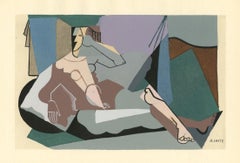
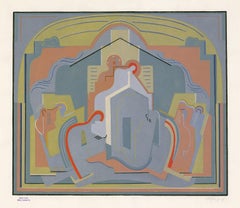
Albert Gleizes, The Bathers, 1929 (after)

1929

$1,916
$2,39520% Off
£1,458.77
£1,823.4720% Off
€1,745.01
€2,181.2620% Off
CA$2,731.46
CA$3,414.3220% Off
A$2,780.76
A$3,475.9520% Off
CHF 1,609.99
CHF 2,012.4920% Off
MX$36,714.15
MX$45,892.6920% Off
NOK 17,996.36
NOK 22,495.4420% Off
SEK 19,203.54
SEK 24,004.4220% Off
DKK 13,088.86
DKK 16,361.0820% Off

About the Item

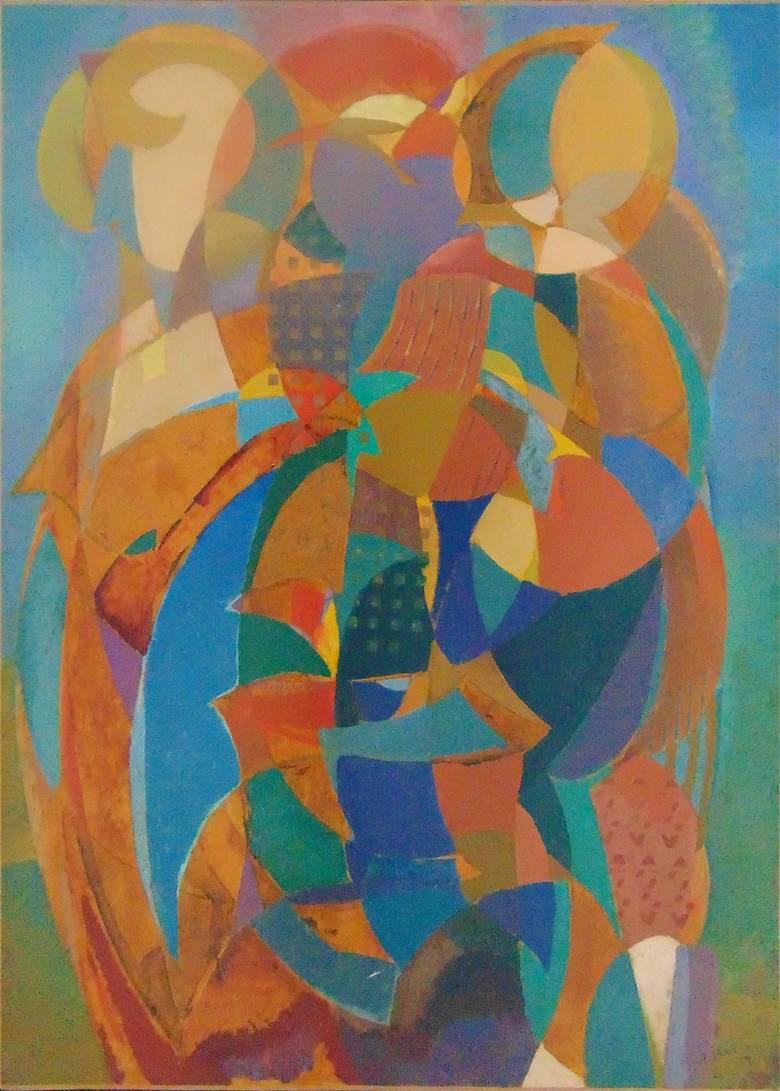
This exquisite lithograph and pochoir after Albert Gleizes (1881–1953), titled Les Baigneuses (The Bathers), from the album L'Art Cubiste, Theories et Realisations, Etude Critique (Cubist Art, Theories and Achievements, Critical Study), originates from the 1929 edition published by Editions Charles Moreau, Paris, and printed by Atelier Daniel Jacomet, Paris, May 1929. Les Baigneuses (The Bathers) embodies Gleizes’s pioneering synthesis of geometry, rhythm, and form, transforming a traditional theme into a vibrant study of structure and motion. The interlocking planes and dynamic color harmonies reveal the artist’s pursuit of “plastic dynamism,” his philosophy that geometry could express the universal laws of balance and movement underlying all natural phenomena. In this work, Gleizes transcends representation to create a vision of harmony between body, space, and rhythm—an elegant manifestation of Cubism’s intellectual and spiritual evolution. Executed as a lithograph and pochoir on velin paper, this work measures 10.83 x 8.27 inches. Unsigned and unnumbered as issued. The edition exemplifies the exceptional craftsmanship of Atelier Daniel Jacomet, Paris, under the direction of Editions Charles Moreau, Paris. Artwork Details: Artist: After Albert Gleizes (1881–1953) Title: Les Baigneuses (The Bathers), from the album L'Art Cubiste, Theories et Realisations, Etude Critique (Cubist Art, Theories and Achievements, Critical Study), 1929 Medium: Lithograph and pochoir on velin paper Dimensions: 10.83 x 8.27 inches (27.5 x 21 cm) Inscription: Unsigned and unnumbered as issued Date: May 1929 Publisher: Editions Charles Moreau, Paris Printer: Atelier Daniel Jacomet, Paris Condition: Well preserved, consistent with age and medium Provenance: From the album L'Art Cubiste, Theories et Realisations, Etude Critique, published by Editions Charles Moreau, Paris, and printed by Atelier Daniel Jacomet, Paris, May 1929 Notes: Excerpted from the album (translated from French): This album was composed in Didot Characters and completed to print in May 1929 by Ducros et Colas, Maitres-Imprimeurs in Paris. Boards have been executed by D. Jacomet in an edition of D examples, numbered on the colophons. About the Publication: L'Art Cubiste, Theories et Realisations, Etude Critique (Cubist Art, Theories and Achievements, Critical Study), published in 1929 by Editions Charles Moreau, stands as one of the most significant and beautifully produced homages to the Cubist movement. Combining theoretical essays and color plates by its leading practitioners—including Pablo Picasso, Georges Braque, Juan Gris, Fernand Leger, Albert Gleizes, Andre Lhote, Louis Marcoussis, Auguste Herbin, and Georges Valmier—the album explored both the intellectual foundation and the visual power of Cubism. Each plate was printed in lithograph and finished in pochoir by Daniel Jacomet, whose technical precision preserved the movement’s chromatic subtleties and compositional integrity. The publication remains a landmark in the history of modern art printing—a collaboration between artist, publisher, and printer that captured the harmony of thought and form at the heart of early 20th-century abstraction. About the Artist: Albert Gleizes (1881–1953) was a groundbreaking French painter, theorist, and philosopher whose visionary ideas and innovations established him as one of the founding fathers of Cubism and a central figure in the evolution of modern art. Born in Paris and largely self-taught, Gleizes began his career painting lyrical scenes influenced by Symbolism and Neo-Impressionism before developing a bold geometric style that redefined visual perception in the early 20th century. As a co-founder of the Cubist movement alongside Pablo Picasso and Georges Braque, and the co-author with Jean Metzinger of the seminal treatise Du “Cubisme” (1912), Gleizes was not only one of the movement’s leading artists but also its principal theorist. His Cubist works, exhibited at the Salon d’Automne and Salon des Independants, introduced an intellectual dimension to abstraction, focusing on rhythm, proportion, and the simultaneity of multiple viewpoints. After World War I, he evolved beyond Cubism into a highly structured and spiritual abstraction he called “plastic dynamism,” expressed through interlocking arcs, balanced color harmonies, and rhythmic geometry designed to evoke the universal laws of nature. His 1924 treatise La Peinture et ses lois (Painting and Its Laws) became one of the most influential texts in 20th-century art, laying the theoretical foundations for movements such as Constructivism, Bauhaus design, and Concrete Art. Deeply spiritual and philosophical, Gleizes sought to unite science, mathematics, and mysticism through painting, believing that geometry was the key to understanding the divine order of the cosmos. His later works, created in his studio in Saint-Remy-de-Provence, embody his quest for cosmic harmony—geometric abstractions that vibrate with musical rhythm and meditative balance. A contemporary of Pablo Picasso, Alexander Calder, Alberto Giacometti, Salvador Dali, Joan Miro, Wassily Kandinsky, Marcel Duchamp, and Man Ray, Gleizes shared with them a desire to transcend representation and express the unseen forces shaping modern life. His influence extended to later generations of artists including Victor Vasarely, Serge Poliakoff, Ellsworth Kelly, Frank Stella, and Josef Albers, who carried forward his vision of art as a synthesis of reason, rhythm, and emotion. Today, Gleizes’s work is held in major museum collections such as the Centre Pompidou, the Musee d’Art Moderne de Paris, the Guggenheim Museum, and the Museum of Modern Art in New York. The highest auction record for Albert Gleizes was achieved by Composition cubiste (Cubist Composition), which sold for $2,940,000 USD at Christie’s, New York, on May 15, 2018, reaffirming his enduring significance as one of the most intellectual and spiritually profound artists of the modern era. After Albert Gleizes Les Baigneuses, Gleizes L'Art Cubiste, Gleizes Atelier Daniel Jacomet, Gleizes Editions Charles Moreau, Gleizes pochoir lithograph, Gleizes Cubism.
  • Creation Year:
    1929
  • Dimensions:
    Height: 10.83 in (27.51 cm)Width: 8.27 in (21.01 cm)
  • Medium:
  • Movement & Style:
  • After:
    Albert Gleizes (1881-1953, French)
  • Period:
  • Condition:
  • Gallery Location:
    Southampton, NY
  • Reference Number:
    1stDibs: LU1465215469222

You May Also Like

'Descente de Croix' (Descent from the Cross) — 1920s French Cubism

'Descente de Croix' (Descent from the Cross) — 1920s French Cubism

By Albert Gleizes

Located in Myrtle Beach, SC

Albert Gleizes, 'Descente de Croix', color pochoir, 1928, edition c. 50. Signed and dated in pencil. A fine, painterly impression, with fresh colors, on heavy, cream wove paper; the full sheet with margins (3 to 4 inches), in very good condition. The publisher's ink stamp 'EDITIONS MOLY-SABATA' beneath the image, lower left. Matted to museum standards, unframed. Image size 12 x 14 inches (305 x 356 mm); sheet size 18 x 22 inches (457 x 559 mm). ABOUT THE IMAGE After the 1927 painting 'Descente de Croix', one of three religious-themed works that Gleizes developed as preliminaries for murals at the church at Serrières, France, the project was terminated at its final phase, and Gleizes commissioned master printer Robert Pouyaud to create prints of the paintings, closely overseeing the production. ABOUT THE MEDIUM Pochoir is a refined stencil-based technique employed to create multiples or to add color to prints produced in other mediums. Characterized by its crisp lines and rich color, the print-making process was most popular from the late 19th century through the 1930s, with its center of activity in Paris. The pochoir process began with the analysis of an image’s composition, including color tones and densities. The numerous stencils (made of aluminum, copper, or zinc) necessary to create a complete image were then designed and hand-cut by the 'découpeur.' The 'coloristes' applied watercolor or gouache pigments through the stencils, skillfully employing a variety of different brushes and methods of paint application to achieve the desired depth of color and textural and tonal nuance. The pochoir process, by its handcrafted methodology, resulted in the finished work producing the effect of an original painting, and in fact, each print was unique. ABOUT THE ARTIST Albert Gleizes (1881-1953), born in Paris, France, was a pioneering figure in the development of abstract art and one of the leading proponents of Cubism. His contributions to the art world extended beyond his paintings; he was also a prolific writer and theoretician, advocating for a new approach to art that emphasized the geometric abstraction of form and a departure from representational traditions. Gleizes initially studied painting at the Académie Julian and the École des Beaux-Arts in Paris, where he was exposed to the academic conventions of the time. However, his artistic vision was profoundly influenced by encounters with avant-garde movements, including Fauvism and the work of Paul Cézanne. These influences led Gleizes to experiment with form and color, gradually moving away from traditional representation toward a more abstract and geometric style. After completing his secondary schooling, Gleizes spent four years in the French army and then began pursuing a career as a painter, primarily doing landscapes. Initially influenced by the Impressionists, he was only twenty-one years of age when his work titled ‘La Seine à Asnières’ was exhibited at the Société Nationale des Beaux-Arts in 1902. The following year, he was part of the first Salon d'Automne and soon came under the influence of Fernand Léger, Robert Delaunay, Jean Metzinger, and Henri Le Fauconnier. In 1907, Gleizes and some of his friends pursued the idea of creating a self-supporting community of artists that would allow them to develop their art free of any commercial concerns. For nearly a year, Gleizes  , with other painters, poets, musicians, and writers, lived at a large house in Créteil, but a lack of funds forced them to give up their facility in early 1908, and Gleizes moved temporarily into La Ruche, the artist commune in the Montparnasse Quarter of Paris. In the early 1910s, Gleizes became associated with the Cubist movement, which was spearheaded by artists such as Pablo Picasso and Georges Braque...

Category

1920s Cubist Abstract Prints

Materials

Stencil

Paysage

Paysage

By Albert Gleizes

Located in London, GB

Mobilized in 1914, like many of his Cubist friends, Albert Gleizes was sent to a barracks in Toul, Lorraine, near the front line. Supported by a military doctor, Major Lambert, of wh...

Category

1910s Paintings

Materials

Canvas, Oil

(after) Andre Lhote - 1929 pochoir

(after) Andre Lhote - 1929 pochoir

By André Lhote

Located in Henderson, NV

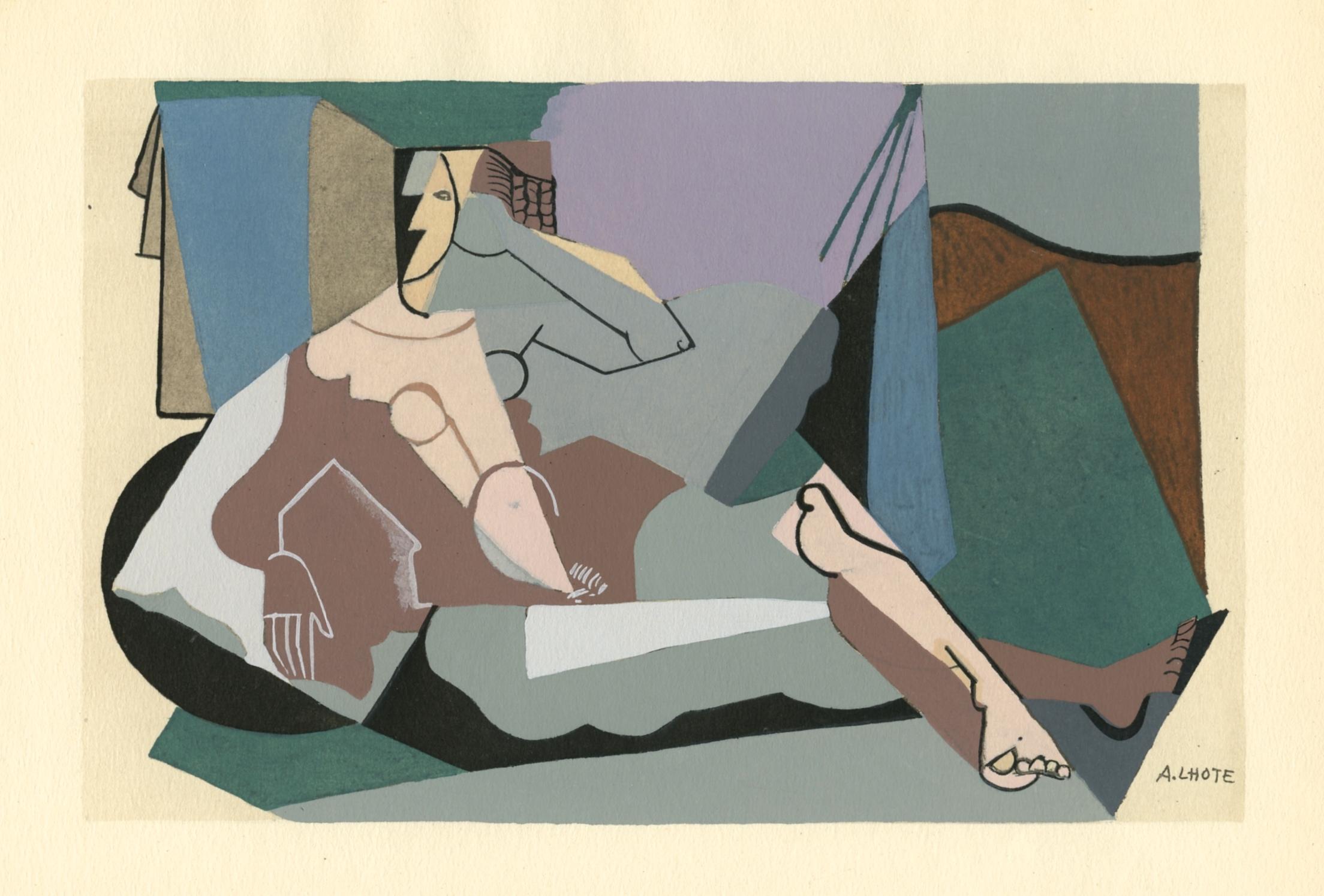
Medium: pochoir (after the gouache). Printed in Paris in 1929 at the atelier of Daniel Jacomet for L'Art Cubiste. Image size: 5 1/4 x 8 1/8 inches (132 x 205 mm). A text inscription ...

Category

1920s Prints and Multiples

Materials

Lithograph, Stencil

Algebraic Poetry  Poésie algébrique - Italian Futurism Cubism

Algebraic Poetry Poésie algébrique - Italian Futurism Cubism

By Gino Severini

Located in London, GB

This original lithograph is hand signed in pencil by the artist "Gino Severini" at the lower right margin. It is hand numbered 69 in pencil from the edition of 120, at in the lower l...

Category

1960s Abstract Prints

Materials

Lithograph, Wove Paper