Video Loading
Want more images or videos?
Request additional images or videos from the seller.

Angelo Di Benedetto
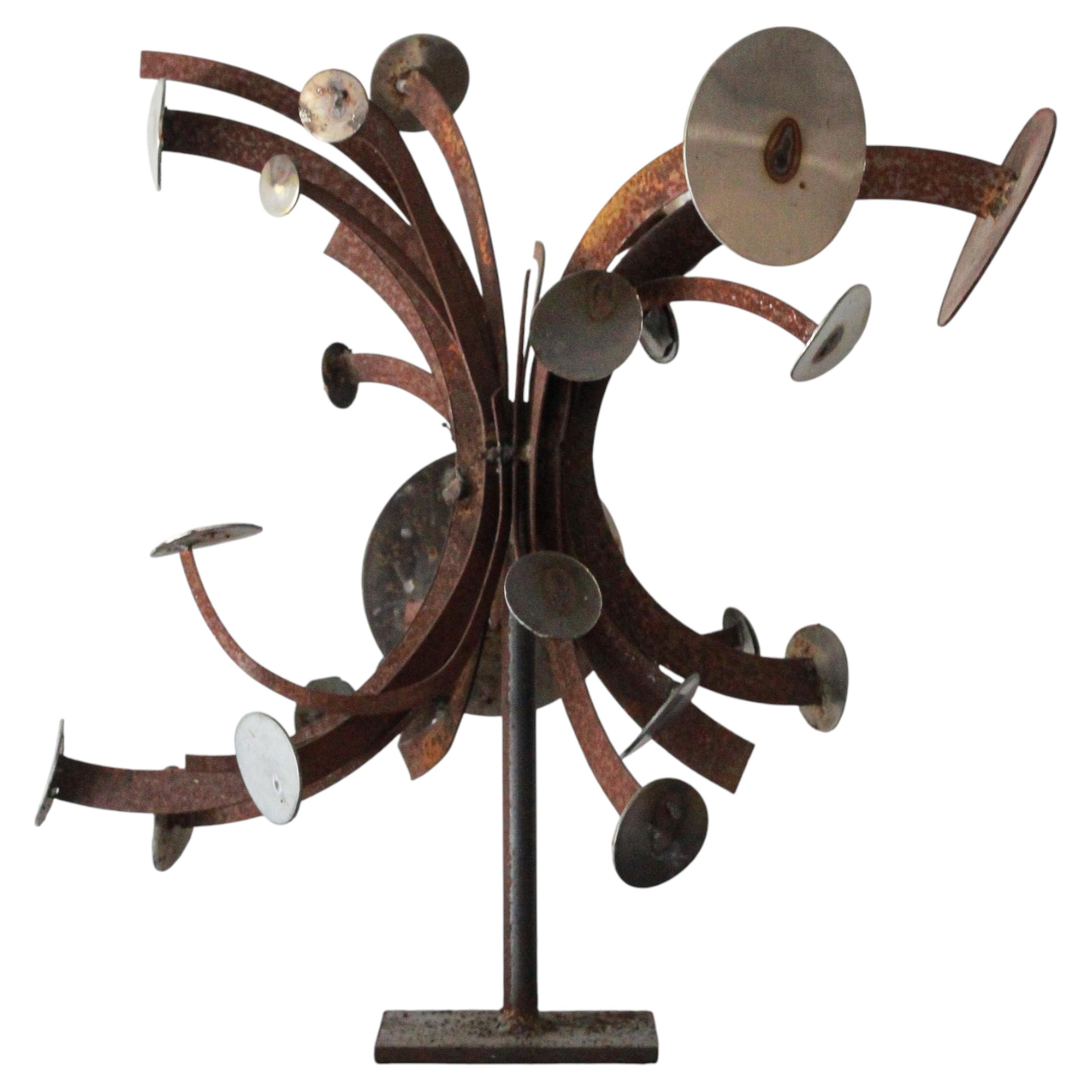
Angelo Di Benedetto Signed Mid-Century Abstract Metal Sculpture, Colorado Modern

$3,750
£2,863.45
€3,431.60
CA$5,398.41
A$5,566.07
CHF 3,138.29
MX$71,241.93
NOK 36,184.12
SEK 37,846.46
DKK 25,660.01

About the Item

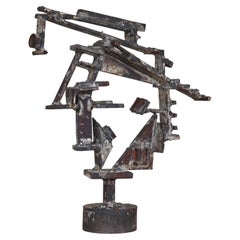
Angelo Di Benedetto (American, 1913–1992) Untitled, Mid-20th Century Welded industrial metal Signed Dimensions: 13¼ × 11¼ × 7½ inches A rare and compelling example of mid-century American abstract sculpture, this original welded metal work by Angelo Di Benedetto exemplifies the artist's lifelong exploration of geometry, symbolism, and spiritual abstraction. Constructed from industrial steel, the sculpture transforms simple geometric forms into a sophisticated three-dimensional composition that balances strength, movement, and negative space. A central circular element—one of Di Benedetto's most enduring visual motifs—is intersected by sweeping linear forms that create a dynamic dialogue between structure and motion. The sculpture's open composition encourages changing perspectives, revealing new relationships of light, shadow, and form as the viewer moves around it. Its refined balance and architectural presence make it equally effective on a pedestal, bookshelf, or contemporary interior setting. Throughout his career, Di Benedetto was fascinated by the symbolic power of the circle, viewing it as a universal form representing continuity, unity, and spiritual reflection. This sculpture embodies those ideas while demonstrating his mastery of industrial materials and modernist design. The raw metal surface enhances its sculptural presence, placing the work within the tradition of American Modernism, Brutalist sculpture, and postwar abstract metalwork. Born in New Jersey to Italian immigrant parents, Angelo Di Benedetto studied at Cooper Union and the School of the Museum of Fine Arts, Boston before establishing himself in New York. After settling in Colorado following World War II, he became one of the state's most influential modernists, co-founding the Denver Art Center and helping shape Colorado's postwar artistic identity. In 1977, the University of Colorado awarded him an honorary doctorate in recognition of his outstanding contributions to American art. His work spans painting, printmaking, sculpture, and environmental art, and today is increasingly sought after by collectors of postwar American Modernism. This sculpture comes directly from the Estate of Angelo Di Benedetto, providing exceptional provenance and authenticity. As one of the relatively few surviving sculptural works by the artist, it represents an outstanding opportunity to acquire an important example of Colorado Modernism and American abstract sculpture. Its intimate scale, strong architectural form, and timeless modernist aesthetic make it ideal for collectors of mid-century modern design, Brutalist sculpture, American abstract art, and Colorado regional modernism. Provenance: Estate of Angelo Di Benedetto. Condition: Very good to excellent vintage condition. Detailed condition report available upon request.
  • Creator:
    Angelo Di Benedetto (1913 - 1992, American)
  • Dimensions:
    Height: 13.25 in (33.66 cm)Width: 11.25 in (28.58 cm)Depth: 7.5 in (19.05 cm)
  • Medium:
  • Movement & Style:
  • Period:
  • Condition:
    very good to excellent condition.
  • Gallery Location:
    Denver, CO
  • Reference Number:
    Seller: 247611stDibs: LU27311320242

More From This Seller

View All
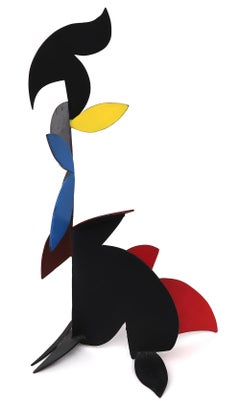
Eduardo Chavez Mid-Century Modern Abstract Painted Metal Tabletop Sculpture Art

Eduardo Chavez Mid-Century Modern Abstract Painted Metal Tabletop Sculpture Art

By Edward Arcenio Chavez

Located in Denver, CO

A dynamic mid-century abstract painted metal sculpture by acclaimed American Modernist Eduardo (Edward Arcenio) Chavez (1917–1995). Constructed from intersecting steel planes and fin...

Category

20th Century Abstract Abstract Sculptures

Materials

Metal

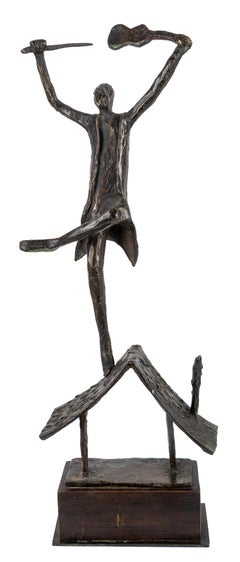
Eduardo Chavez “Chama” Abstract Bronze Sculpture, 1966

Eduardo Chavez “Chama” Abstract Bronze Sculpture, 1966

By Edward Arcenio Chavez

Located in Denver, CO

A refined mid-century abstract bronze sculpture by Eduardo (Edward Arcenio) Chavez (1917–1995), titled Chama and created circa 1966. Cast in bronze and presented on its original wooden base, the sculpture demonstrates Chavez’s sophisticated approach to organic form, abstraction and modernist design. The fluid, sculptural composition combines gently curved and angular forms into a balanced arrangement that changes character from every viewpoint. Its warm bronze surface and compact scale give the work an intimate yet commanding presence, making it particularly effective as a tabletop sculpture, desk sculpture or small-scale modernist centerpiece. Born in Wagon Mound, New Mexico, Chavez was a versatile American artist whose career encompassed sculpture, mural painting, illustration, lithography and painting. He studied at the Colorado Springs Fine Arts Center, where he worked with influential artists including Boardman Robinson and Frank Mechau. His early career included mural commissions throughout the American West before his service during World War II. After the war, Chavez and his wife, painter Jenne Magafan, became part of the vibrant postwar art community in Woodstock, New York. He went on to receive a Tiffany Grant in 1948, a Fulbright Award in 1951 and the Childe Hassam Award in 1953. He was also a member of the Woodstock Art Association, the National Academy of Design and the National Society of Mural Painters, and taught at the Art Students League of New York, Colorado College and Syracuse University. Chama is an especially appealing example of Chavez’s American modernist sculpture, bringing together his Southwestern background with the formal experimentation of mid-century American abstraction. Details: Bronze Original wooden base Titled Chama By Eduardo (Edward Arcenio) Chavez American, 1917–1995 Circa 1966 Height: 7 ¼ in. Width: 10 in. Depth: 3 ¼ in. Condition: Good An exceptional choice for collectors of Eduardo Chavez...

Category

1960s Abstract Abstract Sculptures

Materials

Bronze

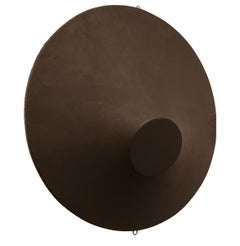
Rare 1950s Mid-Century Abstract Shaped Mobile Painting by Angelo Di Benedetto

Rare 1950s Mid-Century Abstract Shaped Mobile Painting by Angelo Di Benedetto

By Angelo Di Benedetto

Located in Denver, CO

This rare and visually arresting mid-century modern abstract painting was created circa 1950 by celebrated Denver modernist Angelo Di Benedetto (1913–1992). Executed in acrylic on a ...

Category

Mid-20th Century Abstract Abstract Paintings

Materials

Canvas, Acrylic

You May Also Like

Scandinavian Abstract Modernism Iron Sculpture by Erik Aalykke, Denmark, 1960s

Scandinavian Abstract Modernism Iron Sculpture by Erik Aalykke, Denmark, 1960s

Located in Odense, DK

Unique sculpture handmade by Danish artist Erik Aalykke in his own studio in the 1960s. The piece is made from acid treated iron with a beautiful patina. Erik Aalykke (1923-83) used...

Category

Vintage 1960s Danish Scandinavian Modern Abstract Sculptures

Materials

Iron

Iron and steel Bertoia Style Sculpture

Iron and steel Bertoia Style Sculpture

Located in Pound Ridge, NY

Mid century weathered steel and iron atomic age sculpture. In the style of Bertoia. Can be used indoor or outdoor.

Category

Vintage 1960s Danish Mid-Century Modern Sculptures

Materials

Iron

Claude Viseux, Abstract Sculpture, Late 20th Century, Steel

Claude Viseux, Abstract Sculpture, Late 20th Century, Steel

By Claude Viseux

Located in SAINT-SEVER, FR

Claude Viseux est un peintre, sculpteur et graveur aquafortiste et lithographe français né le 3 juillet 1927 à Champagne-sur-Oise et mort le 9 novembre 2008 à Anglet. 'est dans les années 1959-1960 que la sculpture de Claude Viseux, qualifiée de « protéiforme, onirique, fantastique » — ami de Max Ernst, Man Ray, Francis Ponge et Henri Michaux, il ne désavoue pas une parenté avec le Surréalisme9 — se substitue à la peinture, ses premières réalisations étant les objets trouvés en bord de mer qu'il pétrifie dans la cire10 d'une part, les empreintes de pierres et d'algues coulées en bronze d'autre part. En 1960, il signe le Manifeste des 121 titré « Déclaration sur le droit à l’insoumission dans la guerre d’Algérie ». En 1961, ses expérimentations s'orientent vers les corps organiques, notamment avec sa série Ostéales constituée d'assemblages d'os fossilisés qu'il patine ou au contraire décape, qu'il visse, scie, assemble et plastifie. Les Concrétudes ou Coulées directes qui suivent en 1961-1962 sont obtenues à partir de coulées de métal en fusion dans le sable, générant des reliefs qu'il soude sur des plaques d'acier. Il va cependant adopter rapidement l'acier inoxydable — qu'il est avec Pol Bury parmi les premiers à employer en sculpture — comme matériau de prédilection. « Il assemble divers rebus industriels — tuyaux, écrous, boulons, cuves… — pour créer des sculptures à mi-chemin du mécanique et du biologique » restitue ainsi Sophie Serra11. Claude Viseux, qui fréquente alors Jean Tinguely, Piotr Kowalski, Michel Guino, Takis et César, confirme : « Ma récupération de l'élément industriel s'élargit vers les aciers spéciaux, avec un essai de vocabulaire formel : des barres, des profilés, des sphères, des rotules, des fonds de cuves, des chambres à combustion de Boeing, des tubulures, des soupapes de navire »9. « L'artiste entre au cœur de la réalité industrielle, prospecte dans les chaînes de montage de Renault et rôde dans les terrains vaques autour des usines », restitue donc l'encyclopédie Les Muses : « il récupère ferrailles, pièces détachées, débris de voitures, vieux châssis, toute une série d'éléments devenus inutiles. Ils les assemblent, tels quels, sans les modifier. Des créatures agressives ou pathétiques vont surgir de ce combat physique et dialectique que l'artiste livre avec la matière et entrer dans le domaine d'une poétique étrange, surnaturelle5 ». Dans les années 1967-1970, Les « structures actives » en acier inoxydable procèdent ainsi de la production industrielle de série. Elles se répartissent en familles de formes combinatoires composées par addition, soustraction, multiplication, division. Il confirme : « le monde industriel est ma nature, mon bouillon de culture, où je cherche des corps, des familles de corps, des genres, des espèces, dans un aller-retour de l'artificiel au naturel pour confondre les règnes, pour en inventer d'autres selon une géométrie organique qui féconde les différents types de structures, qui aménage la forme concernée par la forme à venir »9. En 1968, Claude Viseux s'installe à la villa Baudran à Arcueil, atelier qu'il conservera jusqu'en 1992. Si des corps imaginaires naissent ainsi des pièces mécaniques que Claude Viseux emprunte à l'automobile, à l'avion et au bateau, en 1972, « la symétrie de ces formes pures en inox », constate Lydia Harambourg, « l'amène à s'interroger sur la notion d'équilibre instable »12. Ses Instables sont de la sorte exposés à la Biennale de Venise en 1972 où, rappelle encore Lydia Harambourg, une salle entière est consacrée « aux dessins qui reprennent son vocabulaire mécanique identitaire de sphères, toupies, hélices, anneaux, astrolabes et balanciers »12. Les Instables sont de même, en 1973, présentés à la galerie Le Point cardinal à Paris où Claude Viseux avait déjà exposé en 1968 avec Henri Michaux et Joaquin Ferrer...

Category

Vintage 1960s French Abstract Sculptures

Materials

Stainless Steel

Joseph Wesner Industrial Modern Welded Steel Abstract Tabletop Sculpture

Joseph Wesner Industrial Modern Welded Steel Abstract Tabletop Sculpture

Located in Troy, MI

Abstract modernist sculpture by Detroit artist Joseph Wesner circa 1990s Welded steel composition with contrasting patinas embody Wesner's signature style of refined industrial 5....

Category

20th Century American Modern Abstract Sculptures

Materials

Steel

1991 Daniel Stolpe Abstract Iron Sculpture

1991 Daniel Stolpe Abstract Iron Sculpture

Located in Palm Springs, CA

A Torch cut iron sculpture signed and dated Stolpe 1991. We believe it to be the work of Daniel Owen Stolpe. I have included a picture from his obituary of him standing next to a ver...

Category

1990s American Abstract Sculptures

Materials

Marble, Iron

Mid-Century Modern Brutalist Steel Sculpture, USA, 20th Century

Mid-Century Modern Brutalist Steel Sculpture, USA, 20th Century

Located in Queens, NY

American Mid-Century Modern Brutalist sculpture of tortured and burnt welded steel.

Category

Mid-20th Century American Brutalist Abstract Sculptures

Materials

Steel