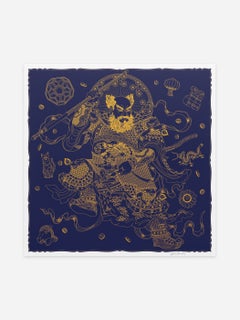
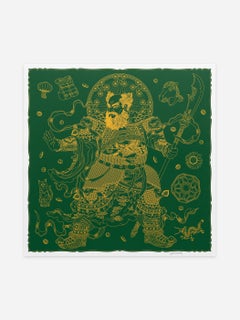
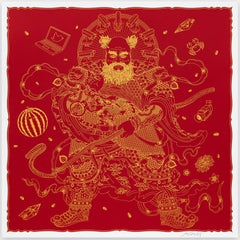
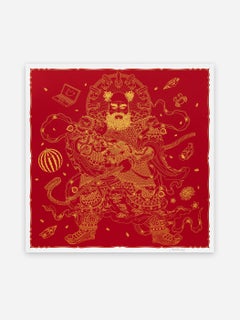
Ai Weiwei was born in northwest China but was sent to a labor camp in Beidahuang, Heilongjiang, when he was only a year old. There he was raised for the early years of his life. His father Aì Qīng’s involvement in the Anti-Rightist Movement led to the family's exile shortly afterward to Shihezi, Xinjiang, where Ai spent the duration of his childhood. Upon Mao Zedong’s death, the family returned to Beijing in 1976.
Following the family’s return home, Ai enrolled in the Beijing Film Academy to study animation in 1978. He was one of the founders of the avant-garde art group the Stars alongside contemporaries Ma Desheng, Wang Keping, Mao Lizi, Huang Rui, Li Shuang, Ah Cheng and Qu Leilei. The Stars disbanded in the 1980s, but Ai participated in regular shows that recalled the ten years that the group had been together, including at the Hanart Gallery in 1989 and the retrospective 2007 exhibition at Beijing's Origin Point.
Ai moved to the USA in 1981, among the earliest of students to study abroad following China’s reform in 1980, which afforded him the opportunity to take the TOEFL in 1981. He lived in Philadelphia and then in San Francisco, studying English at the University of California, Berkeley. Afteward, Ai studied at Parsons School of Design in New York City and attended the Art Students League of New York from 1983 to 1986. He initially made a living by drawing street portraits.
Immersing himself in the Pop art scene, which was rapidly gaining popularity, Ai began creating conceptual art and photography. Ai returned to China after his father became ill in 1993, and while there he helped to establish the experimental art scene called Beijing East Village. In 1999, Ai built a studio house in Beijing — his first architectural project. Ai founded the architecture studio FAKE Design in 2003, and co-curated the art exhibition "Fuck Off" with Feng Boyi in Shanghai.
In 2011, Ai was arrested and jailed. Released after 81 days, the government confiscated his passport. His release was in part due to the uproar of the art world against his charges of tax evasion; the Solomon R. Guggenheim Foundation and the International Council of Museums both organized petitions, collecting almost 100,000 signatures calling for his release. When he reclaimed his passport in 2015, Ai moved to Berlin and lived in a studio. It became a base for him to create his international work.
Ai is the artistic director of China Art Archives & Warehouse. The experimental gallery and archive, co-founded by Ai in 1997, concentrates on experimental art from the People’s Republic of China, initiating and facilitating exhibitions both in China and internationally.
Ai's work is in the collections of museums worldwide, including the Tate, London; Arken, London; Brooklyn Museum, New York; and the RA, London. His international architectural collaborations, including the Beijing National Stadium and the Serpentine Gallery Pavilion, have consistently been met with critical acclaim.
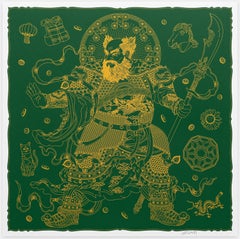
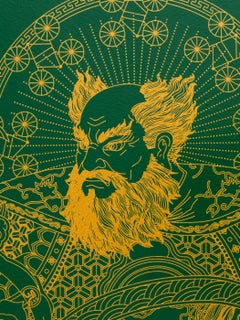
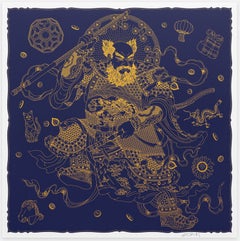
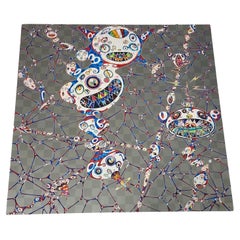
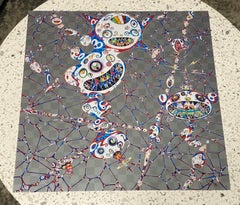
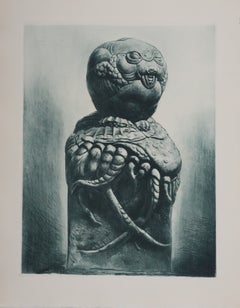
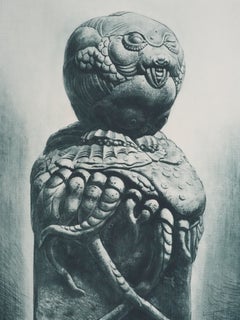
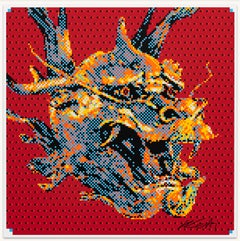
Find a variety of authentic Ai Weiwei prints, paintings and other art today on 1stDibs.
Bring energy and an array of welcome colors and textures into your space by decorating with figurative fine-art prints and works on paper.
Figurative art stands in contrast to abstract art, which is more expressive than representational. The oldest-known work of figurative art is a figurative painting — specifically, a rock painting of an animal made over 40,000 years ago in Borneo. This remnant of a remote past has long faded, but its depiction of a cattle-like creature in elegant ocher markings endures.
Since then, figurative art has evolved significantly as it continues to represent the world, including a breadth of works on paper, including printmaking. This includes woodcuts, which are a type of relief print with perennial popularity among collectors. The artist carves into a block and applies ink to the raised surface, which is then pressed onto paper. There are also planographic prints, which use metal plates, stones or other flat surfaces as their base. The artist will often draw on the surface with grease crayon and then apply ink to those markings. Lithographs are a common version of planographic prints.
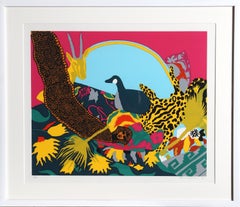
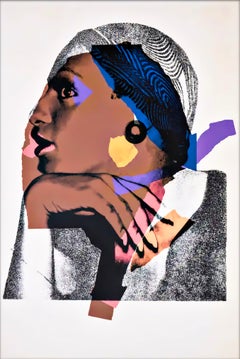
Figurative art printmaking was especially popular during the height of the Pop art movement, and this kind of work can be seen in artist Andy Warhol’s extensive use of photographic silkscreen printing. Everyday objects, logos and scenes were given a unique twist, whether in the style of a comic strip or in the use of neon colors.
Explore an impressive collection of figurative art prints for sale on 1stDibs and read about how to arrange your wall art.