Want more images or videos?
Request additional images or videos from the seller.

Antique Japanese Iron Stirrups with Silver Inlay Signed

$5,000per set
£3,846.15per set
€4,603.83per set
CA$7,272.58per set
A$7,456.81per set
CHF 4,248.62per set
MX$94,918.83per set
NOK 48,801.77per set
SEK 50,917.84per set
DKK 34,414.57per set

About the Item

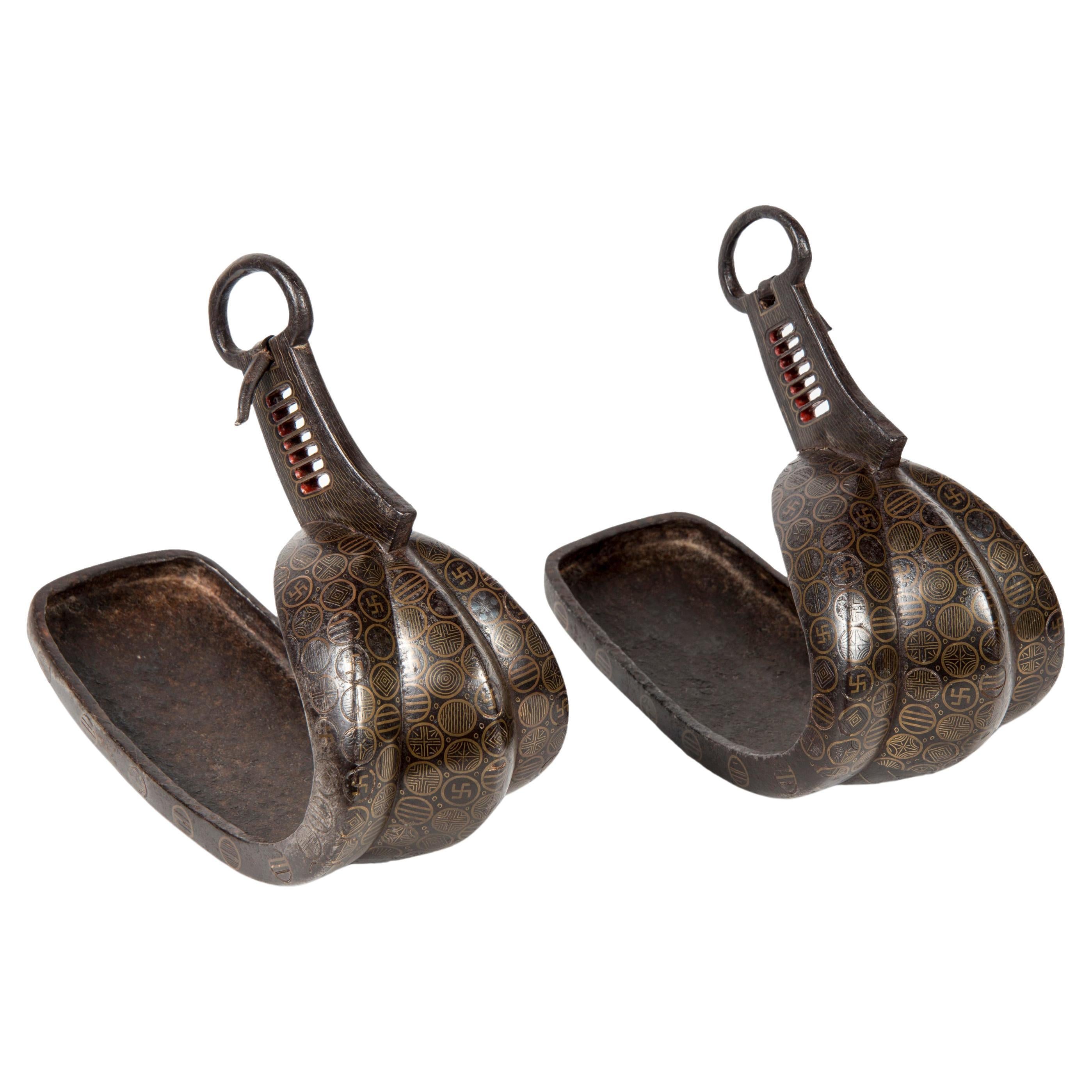
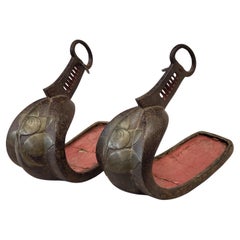
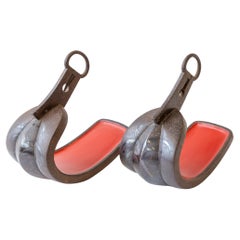
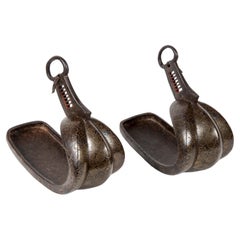
A pair of antique Japanese Abumis, stirrup for horse-riding, in cast iron with elaborate silver inlay, circa 16th century Muramachi to Momoyama period. The prototype of Japanese abumi of this "swan" shape became established in Heian period (710-794 AD). This pair features silver very detailed inlay design of vines and grapes among the linear cloud pattern. While grapes were recorded in Japan as early as the 8th century, it wasn't until 16th century that they became widely consumed as well as being used for wine-making under the influence of Portuguese. This particular and uncommon design may correlate with their age. Unlike some ceremonial pieces used by Samurai in later periods Edo and Meiji, the patina and wear on these pair indicate a history of heavy use. There are historical iron patches present inside the soles to cover the holes as well as holes that were left un-repaired. Furthermore, on the stems of both pieces, Kanji inscriptions are found but could not be clearly discerned due to the age and wear. They appear to read as "a certain year and for a certain government bureau". Wonderful historical piece for serious Japanese art collector.
  • Dimensions:
    Height: 9 in (22.86 cm)Width: 11 in (27.94 cm)Depth: 5.5 in (13.97 cm)
  • Sold As:
    Set of 2
  • Style:
    Japonisme (Of the Period)
  • Materials and Techniques:
  • Place of Origin:
  • Period:
  • Date of Manufacture:
    16th Century
  • Condition:
    Wear consistent with age and use. Minor losses. Antique condition as described, heavy patina all through, significant wear on the bottom due to the age and contact, historical repairs evident as well, all as shown.
  • Seller Location:
    Atlanta, GA
  • Reference Number:
    1stDibs: LU945016109011

More From This Seller

View All
Near Pair of Japanese Jizai Kagi Wood Koi Folk Art Sculptures

Near Pair of Japanese Jizai Kagi Wood Koi Folk Art Sculptures

Located in Atlanta, GA

A near pair of wood koi fish from Japan circa 1860-90s of late Meiji Period. Hand-carved from solid wood, these sculptures are known as Jizai Kagi in Japane...

Category

Antique Late 19th Century Japanese Folk Art Sculptures and Carvings

Materials

Iron

Matching Pair of Korean Brass Candlesticks with Shields and Snuffers Joseon

Matching Pair of Korean Brass Candlesticks with Shields and Snuffers Joseon

Located in Atlanta, GA

A pair of tall matching candlesticks fashioned out of heavy solid brass from Korea circa 1900s (end of Joseon Dynasty). The candlestick consists of three sections: a large base tray ...

Category

Antique Early 1900s Korean Other Metalwork

Materials

Brass

Fine Korean Iron Box with Silver Inlay Joseon Dynasty

Fine Korean Iron Box with Silver Inlay Joseon Dynasty

Located in Atlanta, GA

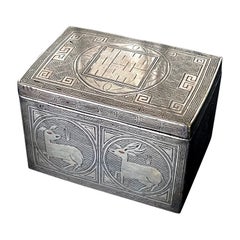
A fine Korean iron box that was traditionally used to store tobacco leaves dated to the late Joseon Dynasty circa 19th century. The box is made from iron and has a heavy weight, although the wears along the edges of the lid and base exposes a bronze metal color underneath, indicating the iron metal may contains a high level of copper. The surface was beautifully decorated with elaborate silver inlay that covers the entire surface except the base. The extraordinary workmanship depicts a pair of deer within the circled square (shape of heaven and earth) and a lined background on the long sides and a crane with spread wings on the shorter sides. Both animals were associated with longevity. Their eyes were highlighted with copper inlay, adding a lively touch to the animation. The lid is centered with a Chinese character "Xi" (Paired-Hui in Korean), which means double happiness. (In Chinese culture, it is often used in a wedding ceremony). The large symbol was set on geometrical background of tightly scrolling diamond pattern surrounded by stylized Ruyi mushroom heads, another floral longevity symbol. Archaic fret cloud band borders the entire perimeters of the lid and the container. Tobacco was introduced to Korean in the first half of the 17th century and gradually gained popularity. When the tobacco was started being smoked in shredded form instead of rolled leaves, there rose the production of the smoking accessories, with some in fine quality as luxury items for the elite. The accoutrement such as this box is a fine example made in late Joseon dynasty, using extensive silver inlay, a technique called "jjoeum-ipsa", in which the silver wires were hammered into the scorched iron surface to create the elaborate design. Similar boxes with variation of shape and motifs are in the collection of several major museums. Compare the box with item Gu 754 in the National Museum of Korea; item 22.78 in MET NYC and M.240:1, 2-1926 in V& A Museum in London. The most closely related example we found is item C232 in the collection of the Museum of East Asian Art...

Category

Antique 19th Century Korean Other Metalwork

Materials

Silver, Copper, Iron

Pair of Large Japanese Carved Wood Temple Candleholders Edo Period

Pair of Large Japanese Carved Wood Temple Candleholders Edo Period

Located in Atlanta, GA

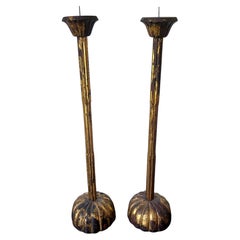
A tall pair of Japanese carved wood candle holders circa early 19th century (late Edo Period). The pair is carved in the typical form with a block base in the shape of stylized chrysanthemums and long fluted stem with changes in diameter that supports a grooved holder fitted with metal pricket. These types of oversized candle holders were traditionally used in Buddhist temples or Samurai's resident where they were placed on the altar table for worshiping. What is extraordinary of these candle stickers is that they feature a wonderfully conserved surface with lacquered gold leaf. The sparkling gold on the well weathered surface is visually striking. The professional conservation was performed in 2007 and as a result, the pieces display a wonderful aged Wabi-Sabi patina. The piece retains an original invoice from Far Eastern Antiques...

Category

Antique Early 19th Century Japanese Japonisme Lacquer

Materials

Gold Leaf

Pair of Antique Korean Brass Candlesticks with Reflector Shields

Pair of Antique Korean Brass Candlesticks with Reflector Shields

Located in Atlanta, GA

A pair of tall candlesticks fashioned out of solid brass from Korea circa 1900s (end of Joseon Dynasty to Korean Empire period). The candlestick consists of three sections: a large, ...

Category

Early 20th Century Korean Other Metalwork

Materials

Brass

You May Also Like

Antique Edo Period Japanese Samurai Iron Stirrups with Brass or Bronze Inlay

Antique Edo Period Japanese Samurai Iron Stirrups with Brass or Bronze Inlay

Located in Centennial, CO

A pair of antique Edo period (1603–1867) Japanese Samurai Abumis (stirrups for horseback-riding) expertly crafted out of cast iron with brass or bronze inlay in the form of a stylize...

Category

Antique 18th Century Japanese Edo Metalwork

Materials

Brass, Bronze, Iron

Pair of Japanese Edo Period 18th/19th century Iron Samurai Abumi Stirrups

Pair of Japanese Edo Period 18th/19th century Iron Samurai Abumi Stirrups

Located in New York, NY

A pair of antique Japanese samurai Abumi (horse riding stirrups) from the Edo period (1615-1868) Abumi often have a distinctive shape, curving up and backward at the front to achiev...

Category

Antique Mid-19th Century Japanese Edo Antiquities

Materials

Silver, Iron

Rare Pair of Japanese Samurai Abumi (Stirrups) from the Edo Period

Rare Pair of Japanese Samurai Abumi (Stirrups) from the Edo Period

Located in San Diego, CA

A rare and evocative pair of antique Japanese samurai abumi (horse-riding stirrups) dating to the Edo period (1603–1868). Expertly forged in iron, with a silver inlay decorative desi...

Category

Antique 18th Century Japanese Edo Mounted Objects

Materials

Silver, Iron

Pair of Japanese Abumi Stirrups

Pair of Japanese Abumi Stirrups

Located in PARIS, FR

Pair of stamped brass stirrups decorated with Hashizuka, Ito and Manabe Mons. Japan - Edo (1615-1868), 18th century. Height: 10.24 in. (26 cm), length: 12.6 in. (32 cm), width 4.72 in. (12 cm) As in Western culture, the culture Japanese stirrups were part of traditional accessories...

Category

Antique Late 18th Century Japanese Metalwork

Materials

Brass

18th Century Spanish Colonial Carved Wood and Iron Stirrups

18th Century Spanish Colonial Carved Wood and Iron Stirrups

Located in Stamford, CT

Pair of late 18th early 19th century South American carved wooden stirrups. Known as estribos, each are carved from a solid block of wood. Decorated with wonderful carvings of horse heads and grape vines, these are truly charming pieces. With wrought iron stirrup rings and the original leather straps. Rich chocolate patina that only comes from age and use. Worn by Chilean huasos, highly skilled horsemen akin to America's cowboys. Prized by collectors of horse memorabilia...

Category

Antique 1790s Chilean Spanish Colonial Sculptures and Carvings

Materials

Wood