Want more images or videos?
Request additional images or videos from the seller.

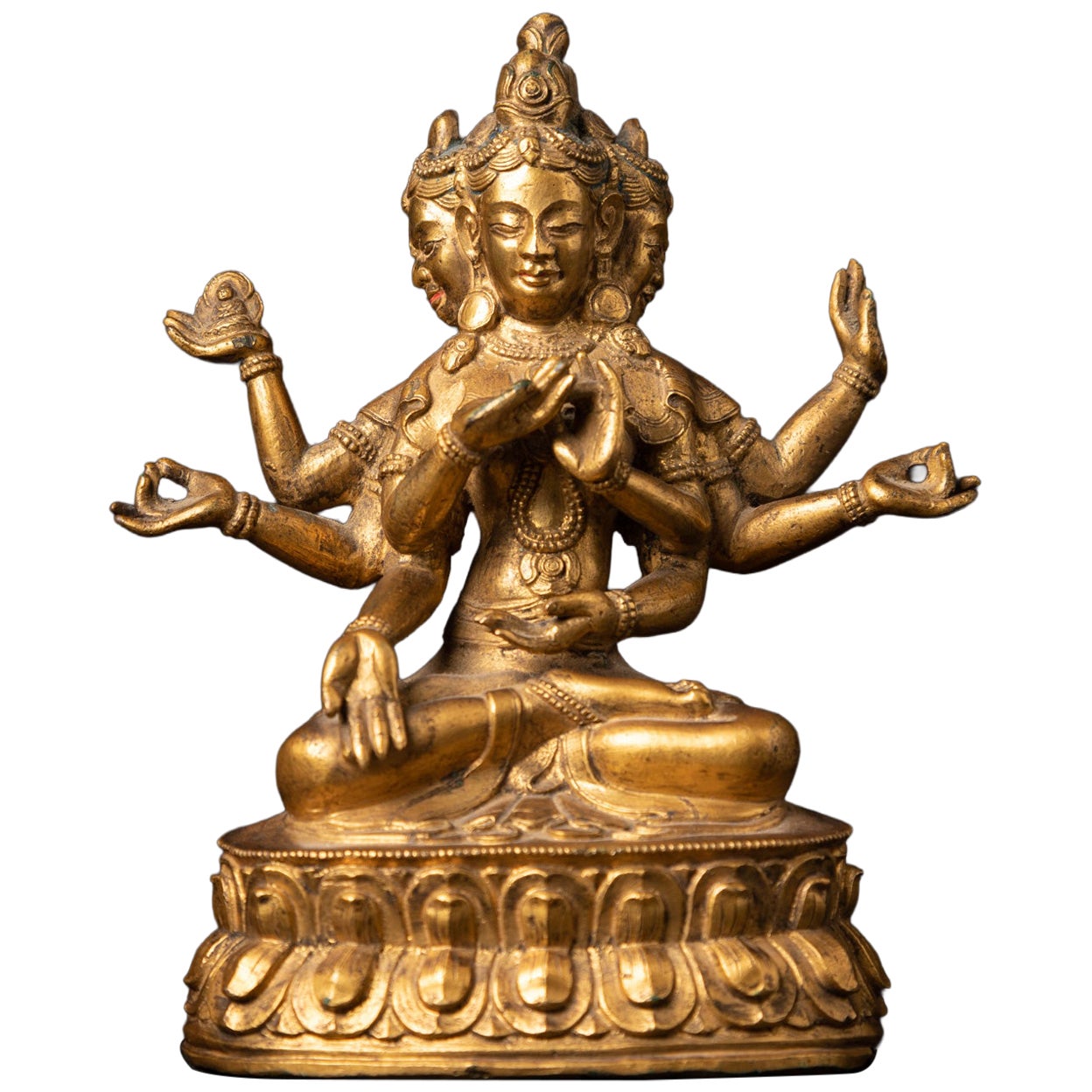
Sino-Tibetan Gilt Bronze Hayagriva with Consort Vajravarahi, circa 1800, Tibet

$7,800
£6,012.36
€7,192.03
CA$11,343.31
A$11,694.08
CHF 6,644.48
MX$148,025.72
NOK 76,088.60
SEK 79,712.23
DKK 53,764.79

About the Item

A fantastic and powerful Sino-Tibetan gilt bronze figure of Hayagriva and his consort Vajravarahi, created in Tibet for the Chinese market, 18th/19th century, Tibet. The wrathful deity Hayagriva can be identified by the small horse head rising from the top of his central face. In this rare form, he has four faces (three wrathful faces, plus the horse face), eight arms, four legs, and a large and dramatic pair of garuda wings which radiate outwards from his back. In front, he holds his consort Vajravarahi. The two joined in yab-yum. Hayagriva and Vajravarahi stand upon a louts pedestal. They trample human figures underfoot. The human figures represent the base desires of the ego, which give rise to suffering, which fuels the cycle of samsara. Hayagriva wears multiple protective elements, including a crown of skulls, a necklace of human heads, an elephant skin cloak and a tiger skin skirt. Both he and his consort hold implements in each hand. His consort is festooned in garlands of jewels and wears a necklace of human skulls. A halo of flames surrounds them. Hayagriva is an important and powerful figure in Buddhism. Known as "The Horse Headed One", Haygriva is considered a wrathful embodiment of compassion, and an emanation of both Amitabha and Avalokiteshvara. The sculpture is richly gilt and cast in bronze in three parts: Hayagriva and his consort, the flame mandorla, the lotus base. The lotus base sealed to the underside with a copper base plate inscribed with a double vajra (visvajra). Provenance: Paul B. Dombrowski (1935 - 2021), WI
  • Dimensions:
    Height: 6.38 in (16.21 cm)Width: 5 in (12.7 cm)Depth: 2.5 in (6.35 cm)
  • Style:
    Tibetan (Of the Period)
  • Materials and Techniques:
  • Place of Origin:
  • Period:
  • Date of Manufacture:
    circa 1800
  • Condition:
    Replacements made: The base possibly re-sealed. Wear consistent with age and use. In good overall condition. Some staining and discoloration to the gilding. The base possibly re-sealed.
  • Seller Location:
    Austin, TX
  • Reference Number:
    1stDibs: LU894730504012

More From This Seller

View All
Large 20th Century Nepalese Gilt Bronze Figure of Yama and Yami

Large 20th Century Nepalese Gilt Bronze Figure of Yama and Yami

Located in Austin, TX

A large and impressive Nepalese tantric gilt bronze figure of the dikpala Yama and his sister, Yami, early to mid-20th century (1920s-1940s). Well cast and richly gilt, the buffalo headed dikpala (directional guardian) of the South stands upon the back of a bull trampling a prostate figure. Yama is portrayed here in his four armed form. His primary arms hold a flaming kapala (skull cup...

Category

Mid-20th Century Tibetan Tibetan Sculptures and Carvings

Materials

Coral, Bronze

Nepalese Gilt Bronze Bodhisattva 'Amoghapasha?', Early to Mid-20th Century

Nepalese Gilt Bronze Bodhisattva 'Amoghapasha?', Early to Mid-20th Century

Located in Austin, TX

A beautiful and unusual gilt bronze figure of a Bodhisattva, possibly Amoghapasha, Nepal, early to mid-20th century, circa 1930s or 1940s. The regal figure possibly depicting the bodhisattva Amoghapasha, the Unfailing Lasso. The enlightened being is portrayed seated upon a high double lotus pedestal. He is dressed as an Indian prince, wearing a luxurious foliate patterned dhoti around his waist and a billowing scarf around his shoulders. . His torso bare save for the jeweled necklaces and the sacred thread. A five pointed crown with an image of Amitabha Buddha in the central point graces his head. His princely face cold painted with beautiful detail, his hair colored blue with crushed lapis lazuli, indicating his peaceful nature. Amoghapasha holds a lasso in one hand, an axe in the other. He is considered an emanation of Avalokiteshvara. A bodhisattva of compassion, Amoghapasha is so named because of the lasso he holds in his hand. The lasso represents his vast compassion which is thought to extend to encompass all beings, bringing them into a state of perfection and enlightenment. The copper base plate, seemingly a later replacement, has been inscribed with a visvajra (double vajra...

Category

Mid-20th Century Nepalese Tibetan Sculptures and Carvings

Materials

Lapis Lazuli, Bronze

Nepalese Gilt Bronze Figure of Bodhisattva Chenrezig, Mid-20th Century

Nepalese Gilt Bronze Figure of Bodhisattva Chenrezig, Mid-20th Century

Located in Austin, TX

A nice vintage early to mid-20th century gilt bronze sculpture of the Buddhist deity Avalokiteshvara in his four armed form, known as Chaturbuhja, or Chenrezig in Tibet. Chenrezig, a form of Avalokiteshvara, the bodhisattva of compassion (known as Guan Yin or Kwan Yin in Chinese), sits in vajrasana upon a high double lotus pedestal. One pair of hands is clasped in prayer at heart level, the other pair of hands raised upwards at shoulder lever and holding discreet attributes, a mala (prayer beads) in one hand, a lotus blossom in the other. Chenrezig is dressed in an elaborately patterned floral dhoti that covers his lower half. His torso bare, shoulders covered with a shawl and scarves that billow out around him. He is festooned with jewels, necklaces, bracelets, armlets, earrings, belt and a five pointed crown. The earrings studded with coral. The crown studded with turquoise. His face is cold painted with beautiful details. The hair has been pigmented blue with crushed lapis, indicating his peaceful nature. The copper base plate is inscribed with a visvajra (double vajra...

Category

Late 20th Century Nepalese Tibetan Sculptures and Carvings

Materials

Coral, Lapis Lazuli, Bronze

Large Vintage Nepalese Gilt Bronze Vajrasattva Buddha, Mid 20th Century

Large Vintage Nepalese Gilt Bronze Vajrasattva Buddha, Mid 20th Century

Located in Austin, TX

A large and impressive vintage gilt bronze figure of the tantric Buddha Vajrasattva, the Diamond Thunderbolt, mid 20th century, Nepal. Crafted of cast and richly gilt bronze, Vajrasattva sits in vajrasana, or full lotus position, his torso slightly bent at the waist. He holds an upright vajra scepter in one hand, raised at heart level. His other hand, resting on his hip, would originally have held a a ghanta, or bell, which is now missing. He is festooned in jewelry, including a five pointed crown, earrings, necklaces and armlets, all studded with coral and turquoise beads. His long hair falling in elegant tresses around his shoulders, the rest tied up in a high chignon topped by a vajra. Vajrasattva wears a dhoti covering his lower half. The dhoti intricately cast and carved with a scrolling vegetal design, and featuring images from the Ashtamangala, or Eight Auspicious Emblems, including the conch, endless knot, and double fish. Scarves billow out around his arms. The tantric Buddha sits upon a tall double lotus throne, the back with more intricately cast decorations of dragons and lotus blossoms against dense vegetal scrolls. The base sealed with a dented copper plate inscribed with a visvajra, or double vajra...

Category

Mid-20th Century Nepalese Tibetan Sculptures and Carvings

Materials

Coral, Bronze

Burmese Arakan Lacquered and Gilt Bronze Healing Buddha, 18th Century

Burmese Arakan Lacquered and Gilt Bronze Healing Buddha, 18th Century

Located in Austin, TX

An unusual 18th century Burmese Arakan style red lacquered and richly gilt cast bronze figure of the Crowned Medicine Buddha, commonly referred to as Bhaishajyaguru. The Supreme Healer is portrayed seated in vajrasana (full lotus position) upon a throne of nine elephants, symbolizing the practice of samatha, or calming the mind (mindfulness) - specifically the nine stages of calm abiding. The hand in his lap holds a jar of healing salve. His other hand rests gently on his knee in varada mudra, the gesture of wish fulfilling, offering a myrobalan seed, a fruit said to be capable of healing emotional ills. The Healing Buddha...

Category

Antique Mid-18th Century Burmese Sculptures and Carvings

Materials

Bronze

You May Also Like

Large Tibetan Vajrabhairava Gilt Bronze Statue

Large Tibetan Vajrabhairava Gilt Bronze Statue

Located in Bradenton, FL

19th Century Gilt Bronze Statue in Yab-Yum, a representation of the primordial union of wisdom and compassion. Yab-Yum represents the union of male and female principles with Vajrabh...

Category

Antique 19th Century Nepalese Tibetan Figurative Sculptures

Materials

Bronze

Tibetan Vajrasattva Gilt Bronze Statue, 12-Inch, 20th Century

Tibetan Vajrasattva Gilt Bronze Statue, 12-Inch, 20th Century

Located in Somis, CA

A beautiful gilt bronze Tibetan Vajrasattva statue. The serene face with large downcast eyes under arched eyebrows above pursed lips, flanked by long earlobes, under hair tied in dou...

Category

20th Century Tibetan Sculptures and Carvings
Materials

Bronze

17-18th century Special bronze Tibetan statue of Namgyälma from Tibet

17-18th century Special bronze Tibetan statue of Namgyälma from Tibet

Located in DEVENTER, NL

This exquisite bronze statue of Namgyälma, also known as Usnisavijaya, originates from Tibet and dates back to the 17th-18th century. Standing at a height of 14.9 cm, this fire-gilded piece features a stunning 24-karat gold finish, enhancing its intricate details and spiritual significance. The statue is notable for containing original mantra rolls, a characteristic that adds to its uniqueness and historical value. Namgyälma is revered in Tibetan Buddhism as a deity of longevity and protection, embodying the healing qualities sought by practitioners. The statue’s multiple arms symbolize her ability to reach out and aid devotees, while the serene expression reflects compassion and tranquility. Each hand gesture conveys a specific aspect of her divine powers. The craftsmanship reflects the rich cultural heritage of Tibetan art, which has flourished through centuries of Buddhist practice. Artisans skillfully employed traditional techniques to create this remarkable piece, serving both as an object of devotion and a symbol of the spiritual journey. Acquired from a Dutch private collection, this special statue is not only an artistic treasure but also a meaningful addition to any collection focused on sacred artifacts. Weighing 555 grams and with dimensions of 12.4 cm wide and 7.8 cm deep, it presents an opportunity to own a piece of Tibetan history. Special bronze Tibetan statue...

Category

Antique 17th Century Tibetan Sculptures and Carvings
Materials

Bronze

19th Century Tibetan Gilt Bronze figure of the Manjushri Bodhisattva

19th Century Tibetan Gilt Bronze figure of the Manjushri Bodhisattva

Located in West Palm Beach, FL

19th Century Tibetan Gilt Bronze figure of the Manjushri Bodhisattva An exquisite 19th Century Tibetan gilt bronze sculpture depicting the Manjushri Bodhisattva, the embodiment of W...

Category

Antique 19th Century Tibetan Metalwork

Materials

Bronze

Mid-20th CTibetan Gilt Bronze Samantabhadra and Samantabhadri Yab-Yum Statue

Mid-20th CTibetan Gilt Bronze Samantabhadra and Samantabhadri Yab-Yum Statue

Located in Nottingham, GB

A striking mid-20th century Tibetan gilt-bronze devotional sculpture, traditionally identified as Samantabhadra (Kuntuzangpo) in sacred union with his consort Samantabhadri, an impor...

Category

Mid-20th Century Sculptures and Carvings

Materials

Bronze

Antique A Sino-Tibetan Gilt Bronze Figure on Hardwood Stand, 18th Century

Antique A Sino-Tibetan Gilt Bronze Figure on Hardwood Stand, 18th Century

Located in Norton, MA

A SINO-TIBETAN GILT BRONZE FIGURE ON HARDWOOD STAND, heavily composing a finely sculpted gilt bronze figure of a deity resting on a horse with chased detailing and turquoise and cor...

Category

Antique 19th Century Sculptures and Carvings
Materials

Bronze