Want more images or videos?
Request additional images or videos from the seller.

Micromosaic Gold Mounted Jasper Snuff Box Early 19th Century Italian Gioacchino

$33,633.28
£25,725VAT Included
€29,942.30
CA$46,989.16
A$48,250.41
CHF 27,448.53
MX$633,717.98
NOK 311,944.02
SEK 328,317.68
DKK 223,785.67

About the Item

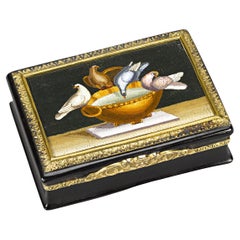
An Exceptional and Highly Important Micromosaic Gold Mounted Jasper Snuff Box, most probably by Gioacchino Barberi with the box likely by Moulinié, Bautte & Moynier. Rome & Possibly Geneva circa. 1810 Of green-coloured jasper, mounted in gold, the cover inserted with a micro mosaic panel of the finest quality, worked with a composition of the Capitoline Doves, having a later leather carrying box. This fine box features a micro mosaic panel of exquisite quality, probably by Gioacchino Barberi of the Barberi workshop in Rome. The panel shows the Capitoline doves, also known as the doves of Pliny. The original Roman mosaic was re-discovered in Hadrian's Villa as part of excavations there in 1737. This is one of the more commonly-encountered panels seen on boxes and other micro mosaic objects but there are several aspects to our panel that make it very rare indeed. As pointed out in Micromosaics: The Gilbert Collection, a summary of the pre-eminent Rosalinde and Sir Arthur Gilbert collection of such pieces currently housed in the Victoria and Albert Museum, it is very rare to find a micro mosaic of this subject that features the reflection of the central dove drinking from the water. Sir Arthur had six versions of this panel mounted on boxes in his collection and even with his exacting standards, only three of these pieces feature the reflection. When looking at micro mosaics in collections more generally, those without Sir Arthur's enormous bank balance behind them, the contrast in numbers is much more marked. Most of the examples that do show the dove's reflection fail to show the ripples in the water caused by the dove's beak breaking the surface and again this fine detail is present in our piece. A comparison with this box in the Gilbert collection is instructive. It is always difficult to reproduce curves effectively in this medium and the box in the Gilbert collection is much more blocky-see for example the execution of the mouldings on the base of the bowl from which the doves drink. The Gilbert box features silver gilt mounts and an opaque glass body whereas our piece features gold mounts and a jasper body, further proof that our piece was destined for a truly elite client as the price would have been extremely steep indeed when new. The Attribution to the Barberi Workshop Several members of the Barberi family in Rome were involved in the production of micro mosaics. Michaelangelo Barberi seems to have concentrated on large tops produced for furnishing purposes, particularly table tops, but his uncle Gioacchino Leone Ulisse (1782-1857) is recorded as a leading producer of miniature micro mosaic items. The Barberis enjoyed the patronage of an elite clientele of tourists and native consumers, clients including Emperor Napoleon III and countless members of Britain's aristocracy throughout the 19th century. A rare example of a table top made by Gioacchino Barberi was sold at Sotheby's New York 12 April 2011, lot 254. The piece was originally made for Prince Anatole Demidoff. Gioacchino's workshop was located at 99 Piazza di Spagna and he is believed to have pioneered the use of black enamel smalti, utilised by his firm when reproducing wall paintings from Herculaneum in the micro mosaic technique. A very fine animal subject snuff box by Barberi is illustrated in Jeanette Gabriel, The Gilbert Collection, Micromosaics, 2000, cat. 18. This piece was mounted in a box by A. J. Strachan of London and hallmarked for 1807-1808. Barberi is known to have entered in to a partnership with the Geneva-based firm of box makers Moulinié, Bautte and Moynier and a small number of boxes by the firm with Barberi micro mosaic plaques survive (see for example one which sold at Sotheby’s London, 10 May 2016, lot 254). Given the outstanding quality of our piece, it is likely to have been one of the joint productions of these two wonderful firms of artisans
  • Dimensions:
    Height: 0.99 in (2.5 cm)Width: 3.35 in (8.5 cm)Depth: 2.56 in (6.5 cm)
  • Materials and Techniques:
  • Place of Origin:
  • Period:
  • Date of Manufacture:
    circa. 1810
  • Condition:
    Wear consistent with age and use. A later leather carrying box.
  • Seller Location:
    Benington, GB
  • Reference Number:
    Seller: 29321stDibs: LU1183235270992

More From This Seller

View All
Late 17th Century Leather And Brass Travelling Box

Late 17th Century Leather And Brass Travelling Box

Located in Benington, Herts

A very fine and interesting late 17th century English work box or travelling case English Circa 1680 Of conventional form with slightly domed lid, this piece has acquired a magnifi...

Category

Antique 1680s English Decorative Boxes

Materials

Brass

Outstanding Italian Carved Wood Polychrome Centre Table Onyx Top Amleto Bertoni

Outstanding Italian Carved Wood Polychrome Centre Table Onyx Top Amleto Bertoni

Located in Benington, Herts

A one off masterpiece by Amleto Berton (1875 - 1967). Italian carved wood faux bois vine branch polychrome centre table parcel gilt with onyx top in the Venetian style. Italy circ...

Category

Early 20th Century Italian Center Tables

Materials

Onyx

Late 19th Century Gilt Bronze Mounted Tulipwood and Kingwood Marble Topped Comm

Late 19th Century Gilt Bronze Mounted Tulipwood and Kingwood Marble Topped Comm

Located in Benington, Herts

An outstanding gilt bronze-mounted tulipwood, kingwood and sycamore parquetry breakfronted breche violet marble topped commode, in French Transitional style dating to the late 19th-e...

Category

Antique Late 19th Century French Neoclassical Commodes and Chests of Dra...

Materials

Marble

A Fine Pair of Early 19th Century French Grand Tour Bronze & Siena Marble Tazzas

A Fine Pair of Early 19th Century French Grand Tour Bronze & Siena Marble Tazzas

Located in Benington, Herts

A Fine Pair of Early 19th Century French Grand Tour Bronze and Siena Marble Tazzas of Interesting Design French Circa 1830 These beautiful tazzas stand on round bronze bases, cast...

Category

Antique 1830s French Urns

Materials

Siena Marble, Bronze

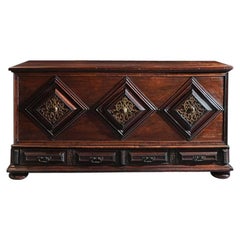
Imposing 17th Century Portuguese Colonial Mahogany and Brass Chest

Imposing 17th Century Portuguese Colonial Mahogany and Brass Chest

Located in Benington, Herts

An imposing 17th century mahogany Portuguese colonial trunk / chest, of grand proportions, decorated with pierced brass panels. Probably Brazil, circa 1670. This rare chest...

Category

Antique Late 17th Century Brazilian Trunks and Luggage

Materials

Brass, Iron

You May Also Like

Micromosaic Snuff Box

Micromosaic Snuff Box

Located in New Orleans, LA

This exceptional micromosaic snuff box represents the heights of this ancient art form. Depicting four doves sitting atop a bronze dish, the inse...

Category

Antique 19th Century Neoclassical Snuff Boxes and Tobacco Boxes

Materials

Bronze

Antique Gold & Enamel Micromosaic Snuff Box

Antique Gold & Enamel Micromosaic Snuff Box

Located in New York, NY

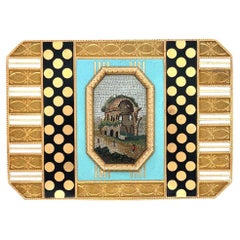
Antique Gold & Enamel Micromosaic Snuff Box An antique snuff box, decorated with a central micro­mosaic panel depicting ruins. The scene is framed by turquoise enamel, with gold-dot...

Category

Antique 19th Century Swiss Boxes and Cases

Materials

Gold, Enamel

Micro Mosaic Gold Snuff Box

Micro Mosaic Gold Snuff Box

Located in New York, NY

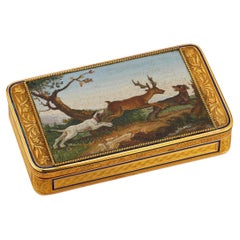
Micro Mosaic Gold Snuff Box An 18 karat gold snuff box accented with blue enamel set with a micro mosaic of dogs hunting a deer Circa 1850's Dimensi...

Category

Antique 1850s Boxes and Cases

Materials

Gold, 18k Gold, Yellow Gold, Enamel

19th Century Restauration Snuff Box with Micromosaic

19th Century Restauration Snuff Box with Micromosaic

Located in Peyraud, Auvergne-Rhône-Alpes

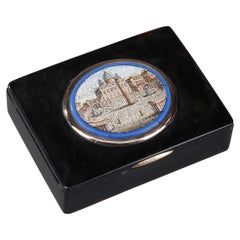
Small rectangular Restauration snuff box crafted in gold. The hinged lid is decorated with an oval micromosaic representing St. Peter's Square in Rome. Micromosaic is set in a gold s...

Category

Antique Early 19th Century French Charles X Tobacco Accessories

Materials

Gold

Antique Grand Tour Micro Mosaic Jewelry Box by Cesare Roccheggiani, Rome c. 1875

Antique Grand Tour Micro Mosaic Jewelry Box by Cesare Roccheggiani, Rome c. 1875

By Cesare Roccheggiani

Located in London, GB

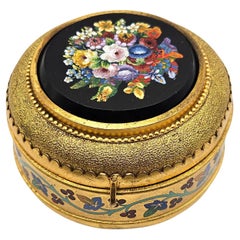
A highly attractive and rare floral Grand Tour micromosaic jewelry or trinket box made by Cesare Roccheggiani in Rome, Italy, c. 1875. This is a beautifully detailed micro-mosaic box. The panel in the lid depicts a lush bouquet of spring flowers, including roses, forget-me-nots, daffodils, buttercups and crocus, amongst others. These are described in brightly coloured stone micromosaic inlaid into a black surround, lending the piece wonderful contrast. The more common subjects for similar micro mosaic boxes are architectural views of Rome; floral examples such as this are much harder to find. The panel is mounted in a box gilded in 24 carat gold. Another distinctive feature is the granulated finish around the lid and to the underside of the box: it is most unusual and lends the piece a lovely texture. A hand-painted champlevé enamel frieze wraps around the central body of the gilt metal box, depicting scrolling turquoise vines blooming with red berries along with blue, green and yellow vine leaves. The interior is lined in the original silk and in very good original condition. The maker’s name ‘C. ROCCHEGGIANI ROMA’ is emblazoned in gold to the interior of the lid beneath the motif of a cross surmounted by a crown. The lining of both the lid and body are bordered with a ropetwist detail. The lid closes with hooked clasp, and the hinge is in good condition. Cesare Roccheggiani was one of the most successful mosaicists in the late 19th century in Rome. He probably worked in Michelangelo Barberi’s workshop, and was in all likelihood related to Lorenzo Roccheggiani, a late eighteenth-century master mosaicist at the Vatican whose work included the altarpiece, Crucifixion of St. Peter after Guido Reni, and Nicolo Roccheggiani who worked on the Achilles Shield tabletop commissioned by Napoleon Bonaparte, and later gifted to Charles X of France, now in the collection of the Louvre. Cesare Roccheggiani opened his premises on Via Condotti in Rome in 1874, and ran a production workshop including mosaicists, goldsmiths and other craftsmen. He was renowned as a source for fine quality Grand Tour mosaics...

Category

Antique Mid-19th Century Italian Grand Tour Jewelry Boxes

Materials

Stone, Metal

Italian Gold-Mounted Micromosaic Snuff Box

Italian Gold-Mounted Micromosaic Snuff Box

Located in New York, NY

Italian micro mosaic plaque mounted within snuff box, depicting white and brown hound seated on grass. Circle of Giacomo Raffaelli (1753-1836). R...

Category

Antique Early 19th Century Italian Snuff Boxes and Tobacco Boxes

Materials

Glass