Located in Nottingham, GB
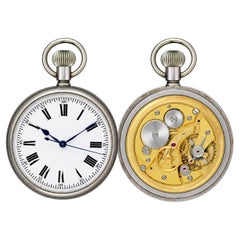
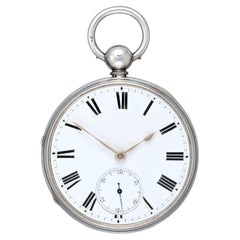
Constructed with the robust precision of a nineteenth-century marine timekeeper, this substantial open-face pocket chronometer is housed in a heavy plain silver case measuring 58 mm in diameter. The crisp white enamel dial features bold Roman hour numerals, an outer minute track, and an inset subsidiary seconds register at six o'clock, complemented by original gold hour and minute hands and a delicate blued steel seconds hand.
Beneath the hinged back rests a gilt-finished full-plate fusee movement wound by key. Built to the highest standards of precision chronometry, the calibre features Harrison's maintaining power to ensure continuous drive during winding, four turned cylindrical pillars retained by blued steel screws, and six-spoke train wheels. Winding control is maintained via a blued steel ratchet wheel paired with a double-toothed click mounted upon the barrel bridge.
The escapement employs an Earnshaw-type spring detent mechanism with jewelled escape pivots running beneath endstones. A plain balance cock holds a diamond endstone mounted within a blued steel setting. The large two-arm bimetallic compensation balance carries two wedge-shaped brass weights alongside four quarter-timing nuts. In an unusual technical arrangement, the stud for the free-sprung blued steel helical hairspring is fixed to the right of the balance, causing the blued coils to spiral in a left-handed orientation.
Assayed in London in 1859, the silver case carries the punch mark 'TH' for the Goswell Road casemaker Thomas Holliday. The backplate is finely engraved with the maker's legend, 'John Archer from the late E. J. Dent Chronometer...
Category
Antique Mid-19th Century Scientific Instruments