Want more images or videos?
Request additional images or videos from the seller
1 of 19

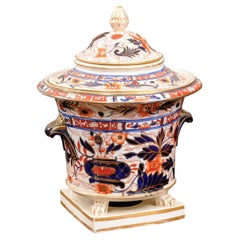
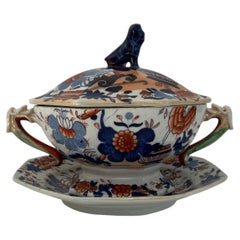
Rare Georgian Masons Ironstone Bread Bin in Vase and Jardinière Ptn, Circa 1815

Price:$500.88
$767.28List Price

You May Also Like

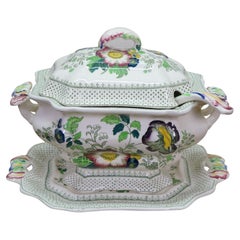
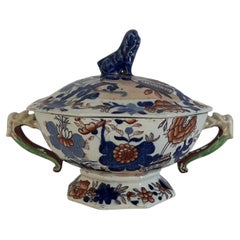
Antique English John and William Ridgway Ironstone Soup Tureen and Stand

Antique English John and William Ridgway Ironstone Soup Tureen and Stand

$2,140Sale Price|34% Off

H 11 in W 13.5 in D 13.5 in

Antique English John and William Ridgway Ironstone Soup Tureen and Stand

By J & W Ridgway

Located in CHARLESTON, SC

Very fine and rare illustrated antique English John and William Ridgway hand painted ironstone "Fancy Stone China, Pattern 1289" Soup Tureen, lid and stand...

Category

Antique Early 19th Century English Soup Tureens

Materials

Ironstone

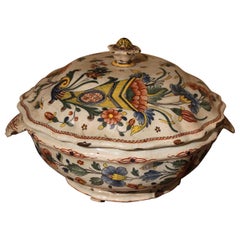
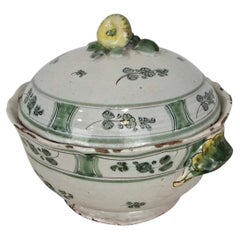
Antique French Faience Lidded Bowl Tureen Hand Painted with Flowers and Insects

Antique French Faience Lidded Bowl Tureen Hand Painted with Flowers and Insects

By Rouen

Located in Firenze, IT

A French 18th century large polychrome Faience lidded soup toureen or entree dish with scallop-shaped edges attributable to Rouen manufacture. This lovely...

Category

Antique 18th Century French Rococo Decorative Bowls

Materials

Maiolica, Porcelain, Pottery, Faience

French Faience Biscuit Barrel Desvres Circa 1900

French Faience Biscuit Barrel Desvres Circa 1900

By Desvres

Located in Austin, TX

French Faience Biscuit Barrel Desvres Circa 1900. 8 inches with handle. 7 inches height.

Category

Antique Early 1900s French Rustic Serving Pieces

Materials

Faience

Richard Ginori Porcelain Soup Tureen, Corean Decor, Italy, Circa 1760

Richard Ginori Porcelain Soup Tureen, Corean Decor, Italy, Circa 1760

By Richard Ginori

Located in Brescia, IT

This is a beautiful piece made in Italy by Richard Ginori in the late 18th Century. The elegant and iconic handmade decor in red and blue is called ‘Co...

Category

Antique Mid-18th Century Italian Baroque Porcelain

Materials

Porcelain

Large Antique 18th Century Moustiers Style French Faience Soup Tureen

Large Antique 18th Century Moustiers Style French Faience Soup Tureen

By Moustier

Located in Philadelphia, PA

A wonderful antique Soupière et son Couvercle en Faience (French faience Tureen and Cover). Dating to the early 18th century, this very rare form is decorated in the Moustiers sty...

Category

Antique 18th Century French Baroque Delft and Faience

Materials

Faience

A Mason's Ironstone Soup Tureen with Cover, Stand, and Ladle

A Mason's Ironstone Soup Tureen with Cover, Stand, and Ladle

By Mason's Ironstone

Located in Harrodsburg, KY

A Mason's Ironstone soup tureen with cover and stand in double landscape pattern. In vibrant blues, golds, and reds. With dolphin handles on the tureen, stand, and at the top of the ...

Category

Early 20th Century English Soup Tureens

Materials

Ironstone

Antique Masons Ironstone Paynsley Soup Serving Tureen W/ Ladle & Underplate 13"

Antique Masons Ironstone Paynsley Soup Serving Tureen W/ Ladle & Underplate 13"

By Mason's Ironstone

Located in Dayton, OH

Antique Mason's Ironstone large soup tureen in the Paynsley pattern, featuring a white body with green geometric borders and vibrant, multicolor floral bouquets. The set includes th...

Category

Antique 19th Century English Victorian Soup Tureens

Materials

Ironstone

Antique Maiolica Sugar Bowl by Antonio Ferretti, Lodi, Circa 1770-1780

Antique Maiolica Sugar Bowl by Antonio Ferretti, Lodi, Circa 1770-1780

By Antonio Ferretti

Located in Milano, IT

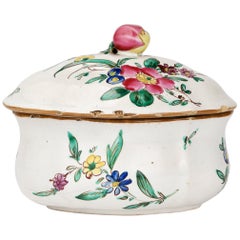
Maiolica sugar bowl Antonio Ferretti Manufacture Lodi, Circa 1770-1780 Maiolica polychrome decorated “a piccolo fuoco” (third fire). It measures 3.54 x 4.52 x 3.54 in (9 x 11,5 x 9 cm) Weight: 0.394 lb (0.179 kg) State of conservation: small and slight chips on the edges. The small sugar bowl has a swollen and ribbed body resting on a flat base. The cap-shaped lid follows the rib of the container and is topped with a small knob in the shape of a two-colored fruit. The sugar bowl is painted “a piccolo fuoco” (third fire) with the characteristic floral motif of bunches and isolated semis. An example which closely corresponds to this one is kept at the Civic Museum in Lodi (G. Gregorietti, Maioliche di Lodi, Milano e Pavia, Catalogo della Mostra, Milano, 1964 n. 137). This decorative style represented a strong point of the Lodi factory, which established itself thanks to the vivid nature of the colors made possible by the introduction of a new technique perfected by Paul Hannong in Strasbourg and later introduced by Antonio Ferretti to Italy. The production process, called “piccolo fuoco” (third fire), allowed the use of a greater number of colors than in the past; in particular, the purple of Cassius, a red made from gold chloride, was introduced. Its use allowed for many more tones and shades, from pink to purple. The Ferretti family started their maiolica manufacturing business in Lodi in 1725. The forefather Simpliciano started the business by purchasing an ancient furnace in 1725 and, indeed, we have evidence of the full activity of the furnaces starting from April of the same year (Novasconi-Ferrari-Corvi, 1964, p. 26 n. 4). Simpliciano started a production of excellence also thanks to the ownership of clay quarries in Stradella, not far from Pavia. The production was so successful that in 1726 a decree of the Turin Chamber came to prohibit the importation of foreign ceramics, especially from Lodi, to protect internal production (G. Lise, La ceramica a Lodi, Lodi 1981, p. 59). In its initial stages, the manufacture produced maolicas painted with the “a gran fuoco” (double fire) technique, often in turquoise monochrome, with ornamentation derived from compositional modules in vogue in Rouen in France. This was also thanks to the collaboration of painters like Giorgio Giacinto Rossetti, who placed his name on the best specimens next to the initials of the factory. In 1748 Simpliciano made his will (Gelmini, 1995, p. 30) appointing his son Giuseppe Antonio (known as Antonio) as universal heir. After 1750, when Simpliciano passed away, Antonio was directly involved in the maiolica factory, increasing its fortunes and achieving a reputation on a European level. Particularly important was the aforementioned introduction in 1760 of the innovative “a piccolo fuoco” (third fire) processing, which, expanding the ornamental repertoire with Saxon-inspired floral themes, was able to commercially compete with the German porcelains that had one of its most renowned offerings in the naturalistic Deutsche Blumen. Antonio Ferretti understood and promoted this technique and this decoration, proposing it in a fresher and more corrective version, less linked to botanical tables, both with or without contour lines, as well as in purple or green monochrome. After efforts to introduce more industrial production techniques to the sector succeeded, even the Ferretti manufacture, in the last decade of the eighteenth century, started heading towards decline despite its attempts to adapt production to neoclassical tastes. In 1796 the Napoleonic battle for the conquest of the Lodi bridge over the Adda definitively compromised the furnaces. Production resumed, albeit in a rather stunted manner, until Antonio's death on 29 December 1810. (M. L. Gelmini, pp. 28-30, 38, 43 sgg., 130-136 (for Simpliciano); pp. 31 sgg., 45-47, 142-192 (for Antonio). Bibliography G. Gregorietti, Maioliche di Lodi Milano e Pavia Catalogo della Mostra, Milano, 1964 n. 137; C. Baroni, Storia delle ceramiche nel Lodigiano, in Archivio storico per la città e i comuni del circondario e della diocesi di Lodi, XXXIV (1915), pp. 118, 124, 142; XXXV (1916), pp. 5-8; C. Baroni, La maiolica antica di Lodi, in Archivio storico lombardo, LVIII (1931), pp. 453-455; L. Ciboldi, La maiolica lodigiana, in Archivio storico lodigiano, LXXX (1953), pp. 25 sgg.; S. Levy, Maioliche settecentesche lombarde e venete, Milano 1962, pp. 17 sgg.; A. Novasconi - S. Ferrari - S. Corvi, La ceramica lodigiana, Lodi 1964, ad Indicem; Maioliche di Lodi, Milano e Pavia (catal.), Milano 1964, p. 17; O. Ferrari - G. Scavizzi, Maioliche italiane del Seicento e del Settecento, Milano 1965, pp. 26 sgg.; G. C. Sciolla, Lodi. Museo civico, Bologna 1977, pp. 69-85 passim; G. Lise, La ceramica a Lodi, Lodi 1981; M. Vitali, in Storia dell'arte ceramica...

Category

Antique 1770s Italian Rococo Ceramics

Materials

Maiolica

Covered Majolica Tureen with Fruit Finial, Cerreto / Naples, circa 1780

Covered Majolica Tureen with Fruit Finial, Cerreto / Naples, circa 1780

Located in ALHAURÍN EL GRANDE, Malaga

A covered majolica tureen from the Cerreto / Naples region, dating to around 1780. The rounded body is raised on a short foot and fitted with two modelled side handles in the form of...

Category

Antique Late 18th Century Italian Baroque Soup Tureens

Materials

Porcelain

More From This Seller

View All
Georgian Mason's Ironstone Tureen and cover in Japan Basket Pattern, Circa 1820

Georgian Mason's Ironstone Tureen and cover in Japan Basket Pattern, Circa 1820

By Mason's Ironstone

Located in Lincoln, Lincolnshire

This is a good ironstone tureen, complete with lid / cover, in the Basket Japan pattern and made by Mason's of Lane Delph, Staffordshire, England, during the early part of the 19th c...

Category

Antique Early 19th Century English Georgian Ceramics

Materials

Ironstone

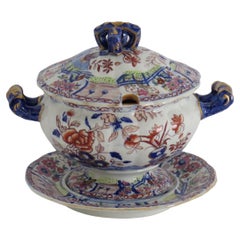
Georgian Masons Ironstone Sauce Tureen & Base Plate Vase & Rock Ptn, circa 1818

Georgian Masons Ironstone Sauce Tureen & Base Plate Vase & Rock Ptn, circa 1818

By Mason's Ironstone

Located in Lincoln, Lincolnshire

This is a very decorative ironstone pottery Sauce Tureen complete with cover lid and base plate, produced by the Mason's factory at Lane Delph, Staffordshi...

Category

Antique Early 19th Century English Chinoiserie Serving Pieces

Materials

Ironstone

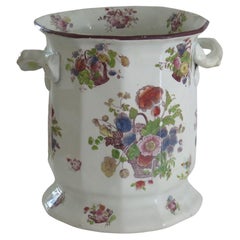
Mason's Ironstone Ice Pail, Two-Handled Wine Cooler, Circa 1818

Mason's Ironstone Ice Pail, Two-Handled Wine Cooler, Circa 1818

By Mason's Ironstone

Located in Lincoln, Lincolnshire

This is a very rare, ironstone Two Handled, Ice Pail or Wine Cooler Pot, made by Mason's Patent Ironstone China Company, of Lane Delph, Staffordshire, England, circa 1818. This piece is substantial and heavily potted, weighing about 2.2 Kg un-packed. The pot is circular with 12 vertical sections, sitting on a low foot with an everted rim. The two side handles are strongly potted and this piece is quite suitable for use or display, as an ice bucket, wine bottle cooler or perhaps as a vase or centre piece. The piece is decorated in the Mason's recorded pattern called "Basket of Flowers" which is a vibrant floral pattern, hand polychrome enamelled over a sepia print on a white glaze. This pattern is illustrated on Page 30...

Category

Antique Early 19th Century English Georgian Ceramics

Materials

Ironstone

Georgian Masons Ironstone Sauce Tureen & Lid Gilded Water Lily Pattern, Ca 1820

Georgian Masons Ironstone Sauce Tureen & Lid Gilded Water Lily Pattern, Ca 1820

By Mason's Ironstone

Located in Lincoln, Lincolnshire

This is a superb Ironstone Sauce Tureen, complete with lid , made by Mason's of Lane Delph, Staffordshire, England, during the early part of the 19th century, circa 1820. This tureen is well potted and is hexagonal in shape with moulded animal head handles to the base and a flower head knob to the lid. The pattern is called "Water Lily" and is a well known Mason's pattern, as illustrated on pages 136 in The Mason's collectors Club book " A Guide to Mason's patent Ironstone patterns, c 1813 to c 1848" . This particular piece is the gilded version of the pattern and has heavily applied hand gilded highlights. Tureens of the same shape and period are illustrated on Pages 145 and 155 of Godden's Guide to Mason's China and the Ironstone Wares published by the Antique Collectors' Club. The pattern is beautifully hand painted over a printed pattern with bold enamels of Cobalt Blue, burnt orange, green, puce all in various shades with much additional hand gilding. The pieces are unmarked as was often the case if the item had formed part of a large dinner or desert service...

Category

Antique Early 19th Century English Chinoiserie Ceramics

Materials

Ironstone

Georgian Mason's Ironstone Tureen Set, Japan Basket Pattern, Circa 1820

Georgian Mason's Ironstone Tureen Set, Japan Basket Pattern, Circa 1820

By Mason's Ironstone

Located in Lincoln, Lincolnshire

This is a very good ironstone tureen, complete with lid and base stand or under-plate, all in the Basket Japan pattern and made by Mason's of Lane Delph, Staffordshire, England, duri...

Category

Antique Early 19th Century English Chinoiserie Ceramics

Materials

Ironstone

Late Georgian Mason's Ironstone Sauce Tureen, Gilded Tree Peony, Circa 1830

Late Georgian Mason's Ironstone Sauce Tureen, Gilded Tree Peony, Circa 1830

By Mason's Ironstone

Located in Lincoln, Lincolnshire

This is a very decorative Ironstone Sauce Tureen, complete with lid , made by Mason's of Lane Delph, Staffordshire, England, during the late Georgian period of the early part of the 19th century, circa 1830. This tureen is well potted with a circular shape having two side ring...

Category

Antique Early 19th Century English Georgian Ceramics

Materials

Ironstone