Neale & Co. Creamware Sauce Tureen, Stand and Ladle, Puce Ruins,
Hanley, Staffordshire, Circa 1780–1785
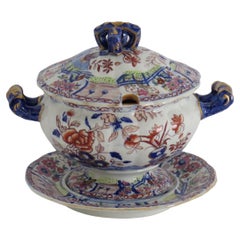
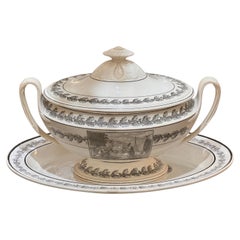
The tureen is of lobed ovoid form, molded with spiral fluting and raised on a spreading fluted foot, with a pair of scrolled feather-molded handles at the ends. Each side is transfer-printed in puce with a view of ruins, a broken arch on two columns beneath an overhanging tree, a crenellated wall at the left and further columns and a smaller arch at the right, the print set within a shaped reserve edged with puce feathering and a gilt line. The domed cover is fluted to match, printed with the same ruin on either side above a feather-edged band, and rises to a finial in the form of a twisted bud within an applied garland of flowers and leaves picked out in puce and gilt.
The stand is of shaped oval outline with molded fluting and scrolled shell ends, the rim with a molded feather edge enameled in puce and gilded, and is printed at the center with the larger capriccio of the service: a vine-hung arch on Corinthian columns before a crenellated wall, a colonnade and a second arch beyond, a distant spire, and fallen column drums and blocks in the foreground with two small figures resting among them. The ladle is printed with ruins inside its bowl and has a feather-molded terminal to the handle edged in puce and gilt. Strong remnants of the original gilding survive throughout. The picturesque ruin views, with broken colonnades and arches in an Italianate landscape, reflect the taste for Grand Tour imagery and the romantic vision of ancient Rome that ran through the decorative arts of the period, and the survival of all four elements, tureen, cover, stand and ladle, makes this a rare and complete example.
Dimensions:
Tureen height: 7 inches (17.8 cm)
Tureen width across handles: 8½ inches (21.6 cm)
Tureen depth: 6 inches (15.2 cm)
Stand length: 10½ inches (26.7 cm)
Stand width: 7¼ inches (18.4 cm)
Marks:
Script numeral 3 inside the cover and 4 to the base of the tureen; otherwise unmarked. The attribution to Neale & Co. rests on the large stand from the same service illustrated by Diana Edwards and now in the Smithsonian Institution (see References), and on the set of ten plates from the same service handled by this gallery, each of which bears the impressed Neale & Co. mark. Old collector’s paper labels inscribed in ink Neale & Co. 1778–1788, Chaffers page 704 are attached to the underside of the stand and inside the tureen, in the same hand as the labels on those plates.
Provenance:
Earle D. Vandekar of Knightsbridge
Condition:
In good antique condition, retaining strong remnants of the original gilding. A very small chip to the inside of the cover has been invisibly repaired.
References:
Diana Edwards, Neale Pottery and Porcelain: Its Predecessors and Successors 1763–1820 (London: Barrie & Jenkins, 1987), p. 126, no. 100, for a large stand from the same service, now in the Division of Ceramics and Glass, National Museum of American History, Smithsonian Institution, Washington, D.C., acc. no. 65.48; p. 133, where the author notes that shell-edged and other enameled rim-decorated wares in turquoise, puce or black, often centered with a transfer-printed panel, constituted a sizable portion of the decoration on creamware; and pp. 124–133 for the factory’s transfer-printed wares generally.
William Chaffers, Marks and Monograms on European and Oriental Pottery and Porcelain, the Neale & Co. entry cited on the old collector’s labels (edition unspecified).
Historical Context:
Neale & Co. was among the most accomplished of the Staffordshire potteries of the later eighteenth century. The business grew from the London china business of James Neale, who from the 1770s took control of Humphrey Palmer’s Church Works at Hanley; trading as Neale & Co. from about 1778, the factory produced creamware, black basalt, jasper and other refined bodies of a quality to rival Wedgwood, whose fashionable Neoclassical wares it closely followed. The firm used its impressed Neale & Co. mark only between 1778 and 1795, and the present service, though itself unmarked, corresponds closely in body, palette and decoration to documented marked examples of those years.
Creamware, the refined cream-colored earthenware perfected in Staffordshire in the mid-eighteenth century, became the dominant tableware of Georgian Britain, admired for its clean glaze and light weight and exported across Europe and America. Overglaze printing in puce, as here, is far less often met with than the black and red of the Liverpool printers. On this service the combination of a crisply molded feather-edge rim, a delicate puce palette and finely engraved ruin views unites the rustic texture of the molding with the high-art imagery of the Grand Tour, and shows the elegance that made Neale’s wares so sought after for the affluent Georgian table.