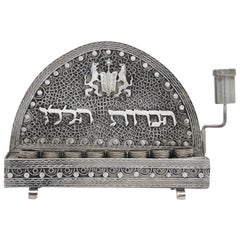
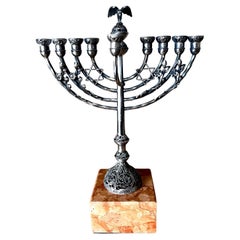
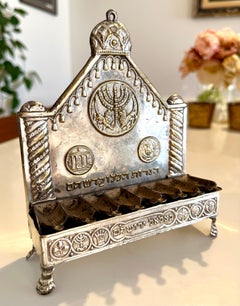
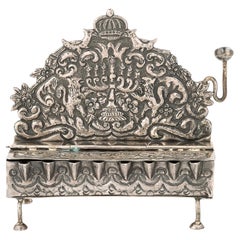
An exceptional early 20th-century silver Hanukkah lamp produced by the Bezalel School of Arts and Crafts in Jerusalem, circa 1920, richly worked in repoussé and incorporating many of the visual and symbolic elements that came to define the distinctive Bezalel style of Jewish ceremonial art.
The lamp is conceived as a compact architectural composition, with a rectangular oil reservoir surmounted by a high, shaped backplate. Across the front are eight cylindrical oil fonts, arranged in a single row for the eight nights of Hanukkah. A separate, elevated shamash projects from the side of the backplate on an angular silver arm, clearly distinguishing the servant light from the principal row of eight flames. The substantial rectangular reservoir beneath would have served both as a stable base and as a receptacle for excess oil.
The repoussé backplate is particularly elaborate. At its center appears a prominent seven-branched menorah, flanked below by a pair of confronted birds and guarded on either side by two dramatically modeled Lions of Judah. The lions are rendered with unusually fierce expressions, their open mouths, pronounced features, and heavy manes giving the composition a vigorous, almost heraldic quality. Above the menorah appears the Hebrew word חנוכה (Hanukkah).
Beneath the principal imagery is the Hebrew inscription:
"הנרות הללו קודש הם"
—“These lights are holy,” a phrase from HaNerot Hallalu, traditionally recited following the lighting of the Hanukkah lamps. Its placement immediately above the row of eight oil fonts directly connects the lamp's ornament with its ritual function.
The lower portion is equally richly decorated. The front of the rectangular reservoir is covered with a continuous sequence of circular medallions containing stylized scrolling foliate forms, surrounded by densely worked punched and chased ornament. Similar decoration continues around the sides, creating a richly textured surface whose darkened recesses contrast strongly with the raised and polished silver.
Stylistically, the lamp is characteristic of the Bezalel School's distinctive synthesis of European Arts and Crafts and Art Nouveau principles with Near Eastern ornament and explicitly Jewish and Zionist imagery. Rather than adopting a single historical style, Bezalel craftsmen developed a recognizable visual vocabulary combining biblical symbols, Hebrew inscriptions, animals, architectural forms, and densely patterned repoussé metalwork. The strongly outlined figures, symmetrical arrangement, flattened pictorial space, and almost heraldic treatment of the lions and menorah are particularly characteristic of this approach.
An especially noteworthy aspect of the lamp's construction is visible from the reverse. The elaborate repoussé decoration of the front backplate is backed by a separate flat sheet of silver, effectively enclosing and concealing the hollow reverse of the raised repoussé work. This gives the back of the lamp an unusually clean and finished appearance while also strengthening and protecting the extensively worked decorative panel. A substantial suspension loop mounted high on the reverse allows the lamp to be hung against a wall, reflecting the traditional form of many European Hanukkah lamps while translating that form into the new artistic language being developed in Jerusalem.
The reverse bears the characteristic Bezalel marks in Hebrew together with “925,” identifying the work as sterling silver and associating it with the Bezalel workshops. The presence of these marks, combined with the construction, iconography, Hebrew inscriptions, and distinctive repoussé technique, firmly places the lamp within the tradition of early Bezalel silverwork.
Founded in Jerusalem in 1906 by Boris Schatz, the Bezalel School sought to establish a new Jewish artistic tradition in the Land of Israel. Its artists and craftsmen drew upon biblical imagery, the visual traditions of Jewish communities throughout the Diaspora, European decorative arts, and Middle Eastern ornament to create objects that were at once recognizably Jewish and representative of a developing modern artistic identity in Jerusalem. Ceremonial silver was among the school's most distinctive productions, and Hanukkah lamps provided an especially appropriate vehicle for this combination of traditional ritual function and newly formulated Jewish imagery.
Dating to circa 1920, this lamp is a particularly expressive example of that aesthetic. The fierce Lions of Judah, central menorah, Hebrew inscriptions, dense repoussé ornament, architectural construction, eight projecting oil fonts, elevated shamash, and fully backed silver backplate combine to create an object of considerable sculptural presence. More than simply a functional ritual object, it embodies the Bezalel School's early attempt to formulate a distinctly Jewish decorative art rooted simultaneously in ancient symbolism, traditional ceremonial practice, and the artistic culture of early 20th-century Jerusalem.
4.32ozt