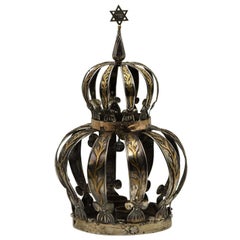
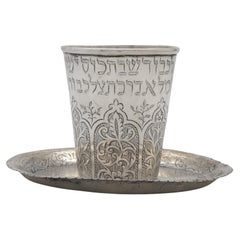
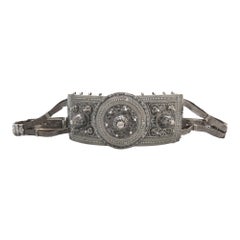
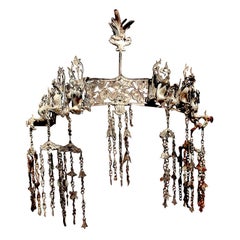
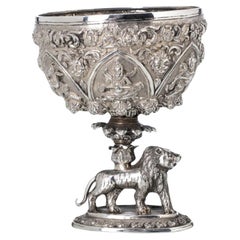
An exceptionally large and majestic Torah Crown (Keter Torah), created in North Africa in the mid-19th century, distinguished by its monumental form and exquisitely detailed repoussé and chased silverwork. The crown is composed of four broad convex panels, each lavishly adorned with intricate floral and foliate scrolls executed with great precision and rhythmic elegance. The decoration is characterized by elongated C-scrolls, floral garlands, and floral swags that intertwine fluidly across the surface, creating a rich ornamental tapestry emblematic of North African Judaic silverwork.
At the center of each of the four main panels stands a large, repoussé vase overflowing with flowers, symbolizing abundance and divine blessing. The upper edges of the crown rise to four pointed arches (one now missing), each surmounted by a floral bouquet or teardrop-shaped motif encircled by delicate petals — all finely chased by hand, demonstrating both technical mastery and stylistic refinement.
Encircling the lower rim runs a lengthy dedicatory inscription in bold square Sephardic script, sanctifying the Torah crown to several distinguished community members:
“...לגבאי ר׳ יצחק, ר׳ דוד בן ר׳ מסעוד גיאן, ר׳ דוד בן שמעון, ר׳ משה בן ר׳ יצחק שש, ור׳ שלמה בן ר׳ יצחק מועטי...”
Beneath this appears a second inscription, in slightly smaller Sephardic script, partially worn, seemingly identifying the artisans:
“מעשה ידי ר׳ יצחק בן יוסף צרת [או צראת] ור׳ שלום אמרה בשנת [1845]...”
The date 1845 is explicitly inscribed, attesting to the crown’s early origin.
The structure of the crown includes a long rear hinge, allowing both halves to swing open so that the crown may be placed securely atop a Torah scroll. At the opposite end, a hooked clasp fastens it in place. The interior is fitted with two horizontal support bars, each with oval openings to fit upon the Atzei Chaim (Torah staves), ensuring stability and balance during ceremonial use.
While the overall form closely resembles Torah crowns produced in Libya, the family names Gian, Shaish, and Moatti are strongly associated with Algeria, leaving its precise provenance intriguingly situated between the two North African centers. Silversmiths bearing the name Zeratt/Tserrat are recorded by Paul Eudel in his classic study L’Orfèvrerie Algérienne et Tunisienne (Algiers, 1902, pp. 134, 138–140).
Comparable examples include:
Algerian finials, Center for Jewish Art (CJA), item no. 37133.
Libyan Torah crowns, CJA, item no. 19556; Israel Museum, Jerusalem, item B23.0008 (146/084).
This remarkable Torah crown, rich in both decorative beauty and historical inscription, stands as a rare testament to the North African Jewish silversmithing tradition, blending artistic grandeur with communal devotion.
45.82ozt