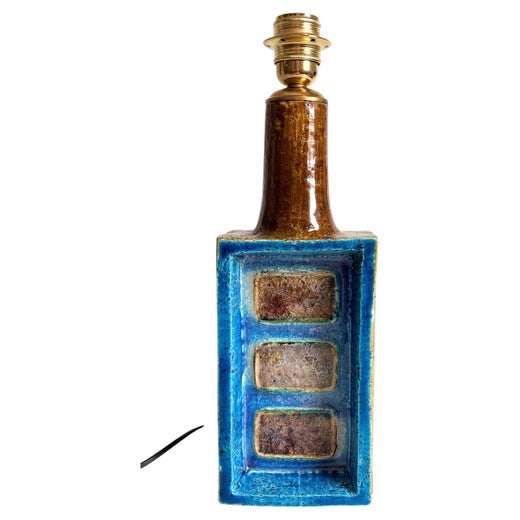
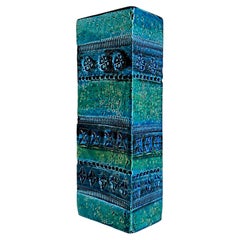
Rare Mid-Century Modern table lamp from the Fritte series by Aldo Londi for Bitossi, produced in Montelupo Fiorentino, Italy, during the 1960s.
The lamp is formed as a compact architectural volume in chamotte stoneware, with a strongly geometric frontal composition articulated a by three recessed rectangular forms. The surface combines intense Bitossi blue with olive-green and earthy neutral tones, while the irregular, granular areas of the decoration reveal the material experimentation that distinguishes Londi's Fritte production.
The Fritte technique takes its name from "frit," the glass component incorporated into the ceramic glaze. During firing, the material produces areas of depth, translucency, and irregular crystallization, giving the surface a quality closer to an excavated or weathered material than to conventional decorative ceramics. Londi was particularly interested in the expressive possibilities of combining different materials, glazes, and firing effects; the Fritte series is one of the results of this sustained experimentation.
Aldo Londi and the archaeological imagination
There is a distinctly archaeological quality to this particular group of Londi ceramics. The rough chamotte body, fragmented geometry, mineral colors, and uneven surfaces suggest the appearance of fragments recovered from the earth, rather than an object conceived as a uniformly finished decorative surface.
This is consistent with a broader aspect of Londi's artistic language. His work repeatedly drew upon Etruscan and primitive art, looking to historical ceramic traditions not as styles to reproduce literally, but as sources for a modern vocabulary of form, color, and material.
This approach is particularly significant within the cultural context of post-war European ceramics. The decades after the Second World War saw an increasing dialogue between archaeology, modern art, architecture, and the decorative arts. Ancient forms, excavated surfaces, and the visual language of fragments became important points of reference for artists and designers seeking alternatives to the polished rationalism of earlier modernism.
Bitossi in Montelupo became one of the most important laboratories for this exchange. Under Londi's artistic direction, the manufactory moved decisively beyond traditional production and became an experimental environment in which ceramicists, artists, architects, and designers could work alongside skilled craftsmen. The company itself describes Londi's contribution as fundamental in bringing design into ceramics, while the Montelupo Museum specifically places the Fritte series alongside Londi's other major experimental collections.
The collaboration with Ettore Sottsass, which began at Bitossi in 1955, is perhaps the clearest expression of this new relationship between industrial craft and contemporary design. Sottsass's early ceramic experiments developed under Londi's guidance, and the Bitossi workshops became a place where architectural thinking, modern art, and traditional Tuscan ceramic expertise could be brought together.
The present lamp belongs to that particular moment in European design history when the ceramic workshop was no longer simply a place of manufacture but a site of artistic research.
Condition:
In good vintage condition, with signs of age and wear consistent with its period, and a beautiful natural patina. Recently rewired with new brass fittings and a vintage-style cord, switch, and plug.
Marked/signed on the base.
Dimensions
- Total height, including brass lamp holder: 44 cm / 17.32 in
- Ceramic height: 37 cm / 14.57 in
- Width: 14.5 cm / 5.71 in
- Depth: 10 cm / 3.94 in
Materials: Chamotte stoneware, colored glazes, glass frit, brass
Origin: Italy
Designer: Aldo Londi
Manufacturer: Bitossi
Series: Fritte
Period: 1960s
Style: Italian Mid-Century Modern, Modernist, Studio Ceramics
Some of the interior photographs accompanying this listing have been created using artificial intelligence for illustrative purposes only. They are intended to show possible architectural settings, furniture combinations, and approaches to styling the lamp.
The AI-generated environments should not be interpreted as photographs of the actual object in situ. Proportions, scale, architectural details, furniture dimensions, and spatial relationships may vary from the real environment. Please refer exclusively to the measurements provided in this listing when assessing the actual dimensions of the lamp.
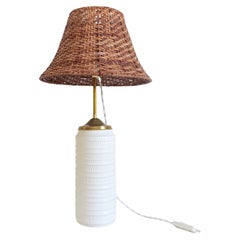
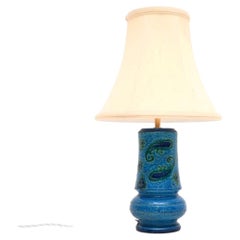
The white conical and woven wicker shades are real optional shades; any other shades appearing in the AI-generated interiors are visual styling suggestions only.