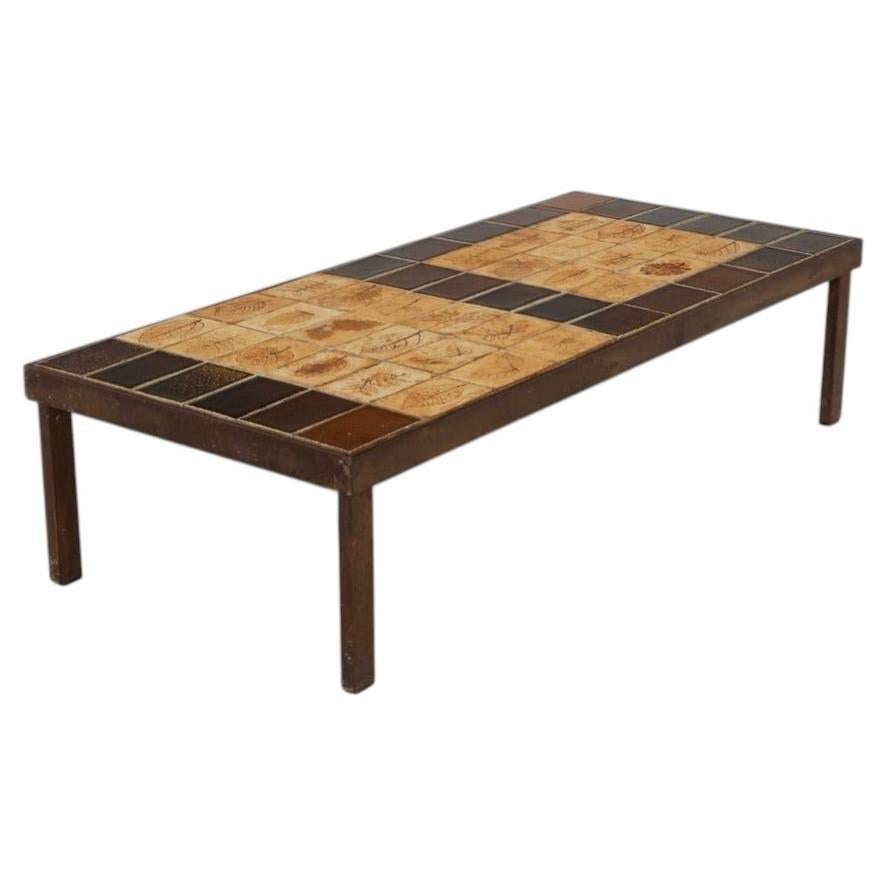
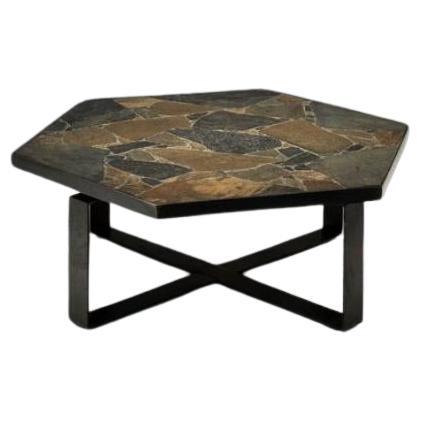
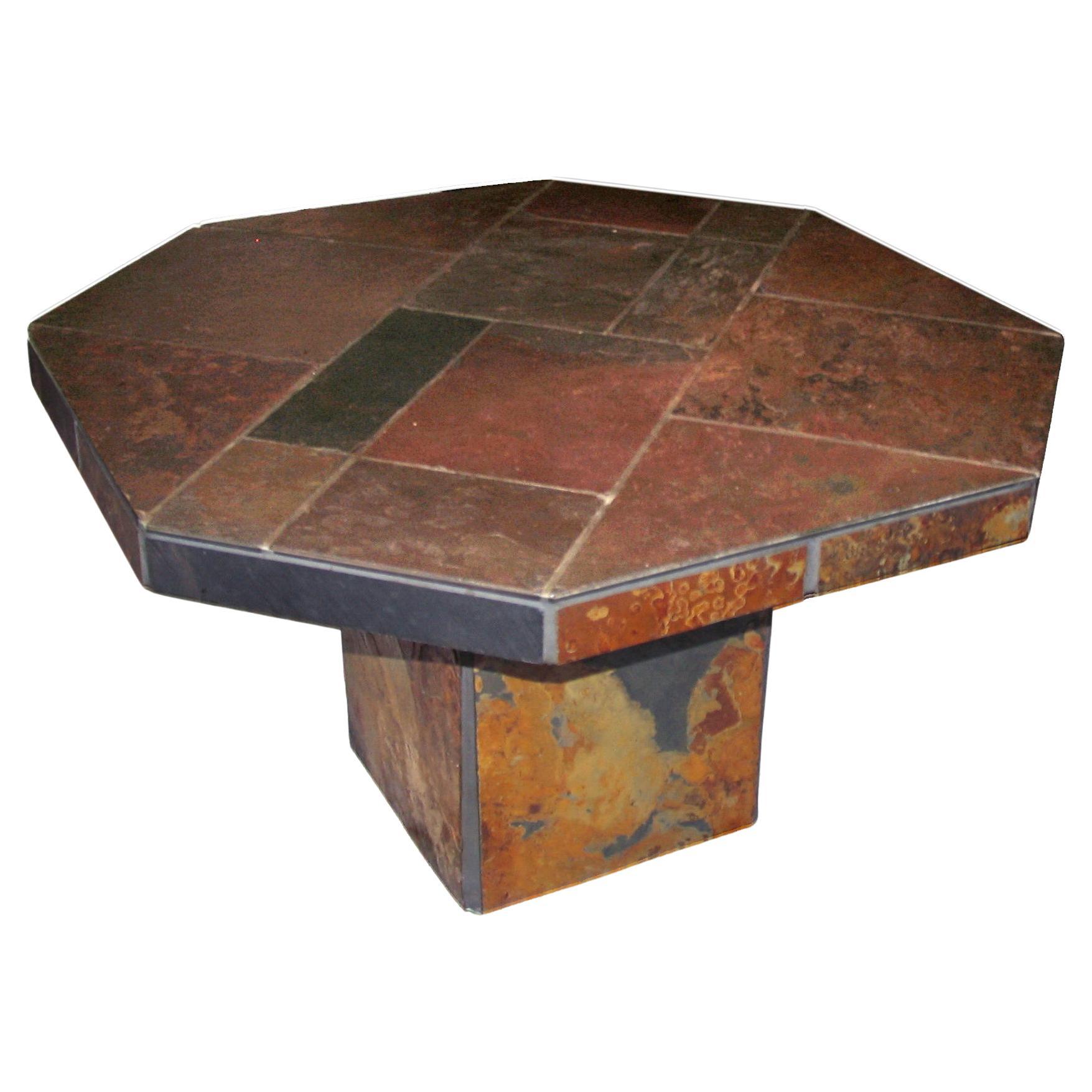
Artist Jesse Ormond Sanderson Jr. for Straw Valley Pottery of Chapel Hill, NC. Possibly one of a kind geometric / cubist coffee table with offset squares. Signed Straw Valley '61 JOS for J. Ormond Sanderson. Modernist form iron base with carefully planned mosaic of patterned and textured tile fragments placed on top and grouted. Loss to paint on iron base, tiles are in excellent condition. Organic natural glazes on tiles, reminds me of Danish Modern of the era, of who Sanderson and his partner Black were followers and dealers of such modernism in the period. Contemporaries of Roger Capron and Gordon & Jane Martz .
See Bio and Exhibit info below.
Also available single pieces of pottery from from this design duo. All from one owner estate of prominent St. Louisian Robert S. Weinberg.
Straw Valley Craft House : Chapel Hill , NC.
Bio courtesy of Gregg Museum of Art & Design
DESIGN DUET
The creative lives of Robert Black and Ormond Sanderson Jr.
On display in the Robert K. Black and J. Ormond Sanderson Gallery
March 15 – September 9, 2018
North Carolina’s celebrated art, across mediums, is often the marriage of tradition and innovation, craft and contemporary. At the Gregg Museum of Art & Design, one current exhibition showcases a compendium of work by two pioneers and anchors of this marriage, Robert Keith Black and Jesse Ormond Sanderson, Jr. DESIGN DUET includes pieces by the two acclaimed artists, known for their modern design work – abstract collage paintings, contemporary etched and glazed enamels – as well as furniture, stoneware, and jewelry. Accessory and necessity commingle. “This represents a lifestyle over the years,” Sanderson says.
The couple’s styles are both distinct for many reasons, including the clear respect for North Carolina craftsmanship. Sanderson says modernism and nature share an essence of simplicity. “Robert and I closely associate ourselves with the natural world. That’s where most of our inspiration comes from.” Throughout the ’60s, ’70s, and early ’80s, Black and Sanderson cultivated a community of creatives: they operated a crafts shop stocked with their own wares as well as pottery from Seagrove and textiles made by local weavers in an on-site loom. The shop expanded to become Strawvalley, a complex of design-minded stores including a high-end boutique, an interior design shop, and an architectural firm. “We’ve always had an interest in trying to promote design and to educate people,” says Sanderson, referring to Straw Valley, the one-time dairy farm the two men lovingly converted into a gallery and arts community hub, and which they ran together for decades.
MORE :
Courtesy of Author Jessie Ammons Rumbley of Walter Magazine :
The Triangle’s mid-century cultural landscape was one of innovation: Research Triangle Park was first envisioned in the early 1950s, providing opportunities for industries apart from textiles, tobacco, and furniture. Meanwhile, Black studied at the Parsons School of Design in New York City, where he fell in love with the latter, but with contemporary flair – modern design. The Museum of Modern Art exposed him to Poul Kjærholm’s clean lines and Hans Wegner’s peacock chair. By 1958, he’d moved to North Carolina, met his partner, Ormond Sanderson, and they’d moved to a derelict family farm outside of Chapel Hill. While RTP broke ground, Black and Sanderson devoted their creative energies to celebrating and innovating the state’s traditional industries. For inspiration, they took a number of design magazines from Europe. “Domus Italian magazine, Mobile Design German magazine, Mobilia, a Danish publication – these were all important titles for us,” Sanderson says. “We were, and are, interested in the modernistic wave because we felt it was a refinement of styles. Less is more.”
In the early 1960s, while Research Triangle Park was turning central NC into a magnet for modern technology, Robert Black and Ormond Sanderson’s Strawvalley complex presented furniture, lighting, and design by such well known architect/designers as Mies van der Rohe, Harry Bertoia, Eero Saarinen, Marcel Breuer, and Le Corbusier. Black and Sanderson were not only among the first to introduce modern design to southern consumers, but also major artists in their own right. Design Duet includes striking collage-paintings and award-winning stonewares by Black, alongside the etched and glazed enamels that led the organizers of the 1964 New York World’s Fair to choose Sanderson to represent the best of American art in its United States Pavilion. Pieces by other major designers round out the exhibition.