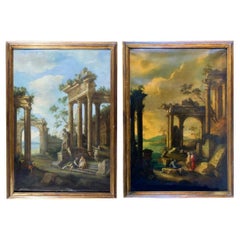
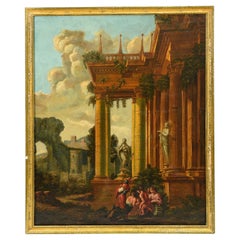
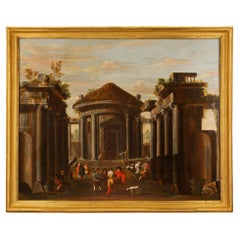
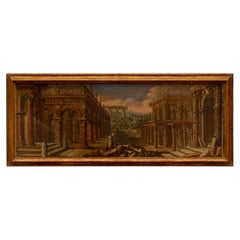
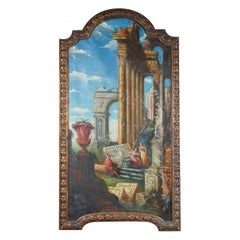
Alberto Carlieri (Rome 1672-1720)
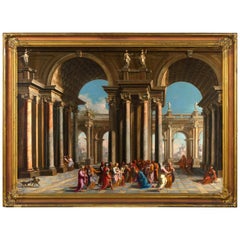
"Architectural capriccio with the preaching of Saint Paul in the Areopagus of Athens"
Oil on canvas, measures with frame W 172 x H 127 x D 10,5 (only canvas cm W 135 x H 99)
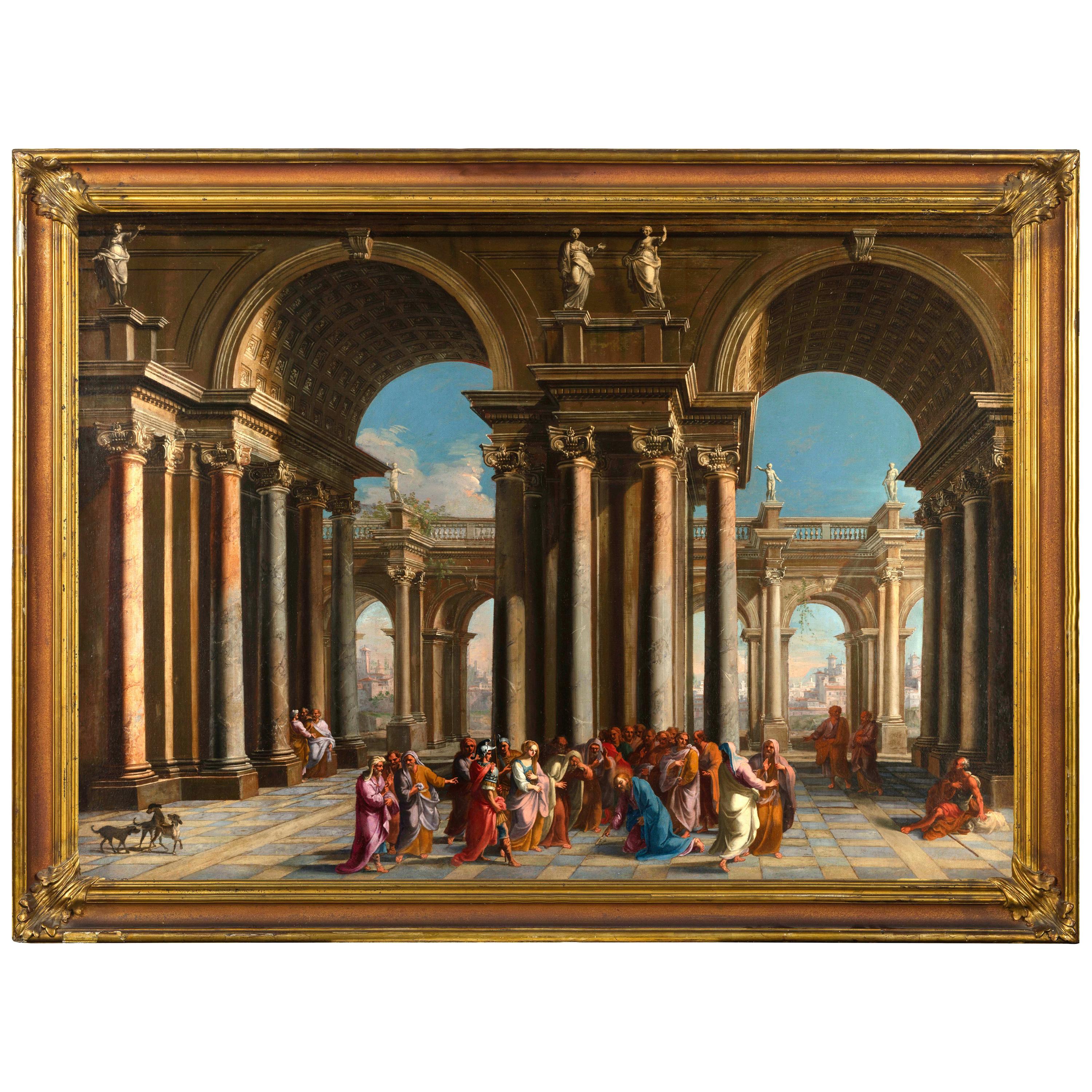
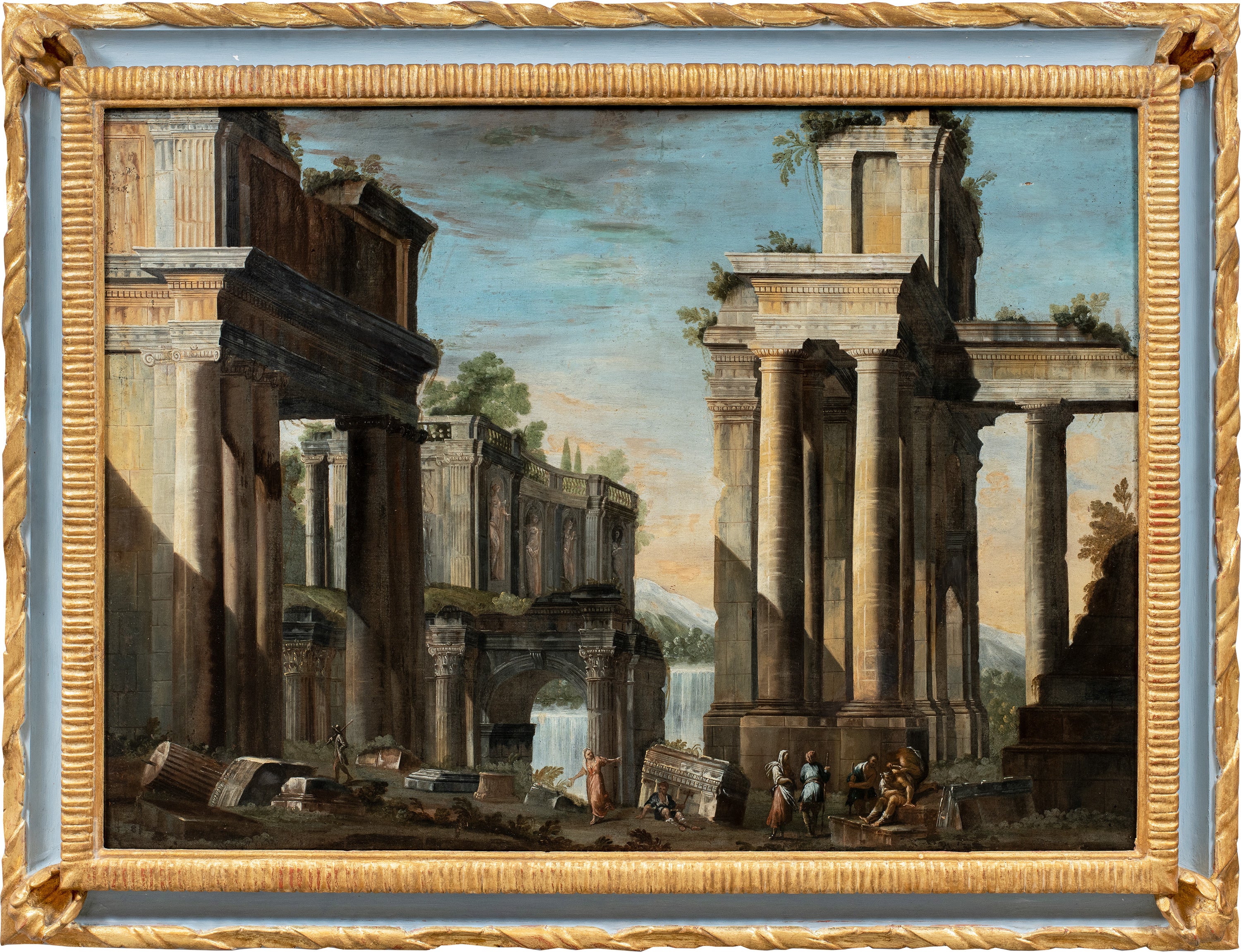
The large and very interesting oil on canvas painting depicts an architectural capriccio with the preaching of Saint Paul in the Areopagus of Athens. The work is attributable to the famous Italian painter Alberto Carlieri (Rome 1672-1720).
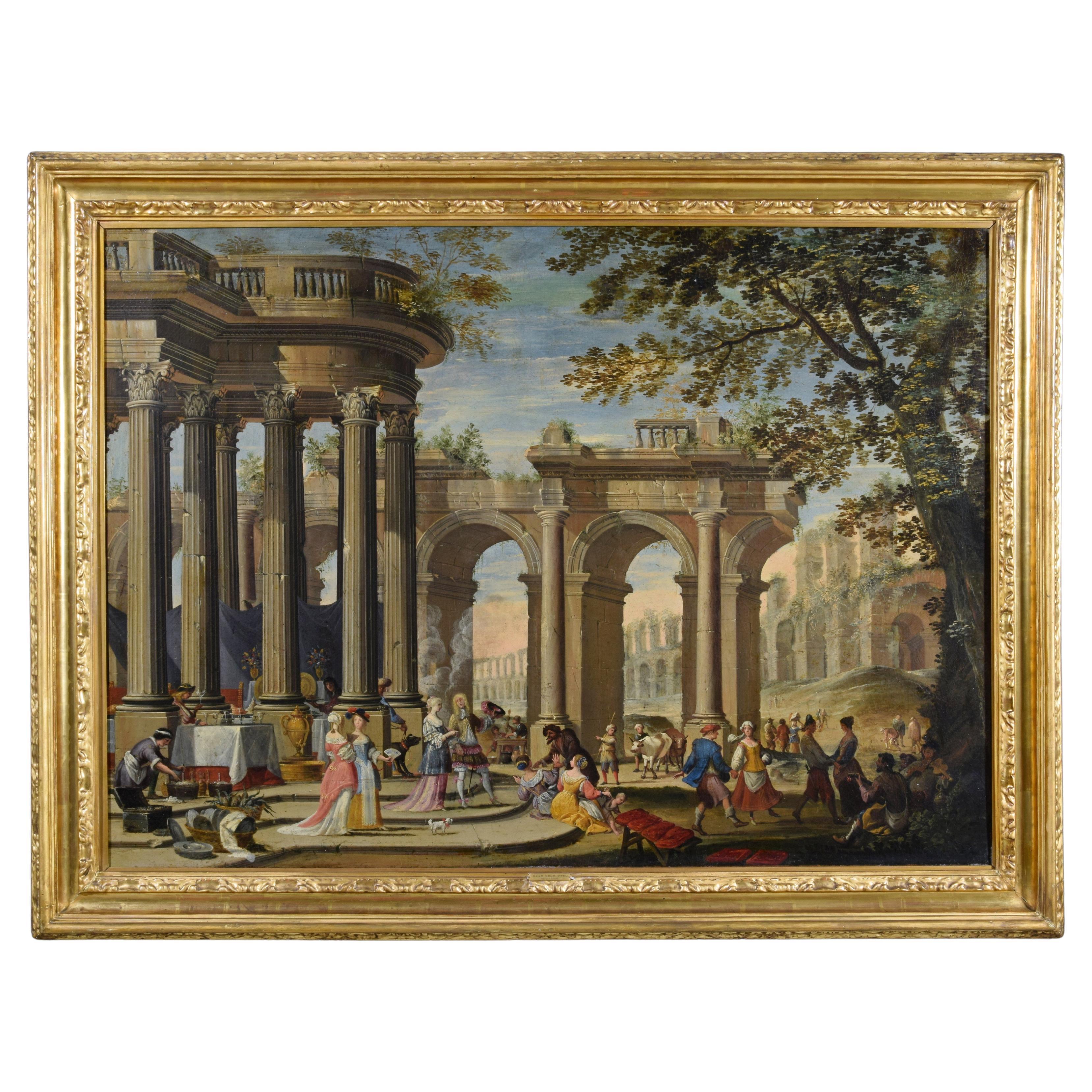
The composition is characteristic of Carlieri’s artistic expression. The subject depicted, or The sermon of Saint Paul, is set among powerful architectural remains of fantasy, called «Architectural Capriccio». The architectural capriccio, an artistic genre that has made its way into Italian painting since the 17th century, is characterized by the representation of fantastic architectures or inventions of perspective type, sometimes combined with elements drawn freely from reality.
The canvas in question has a considerable artistic interest and significant pictorial quality. The spectacular architecture of invention gives solemn classicism to the place, amplified by the play of light and shadow, acting as a theater and as a frame to the scene.
In the foreground, a partially collapsed colonnade emerges from the shadow on the right, while on the left, there are piled on the ground parts of columns including a capital of the Corinthian order. The characters are in the middle of the canvas, in the background.
All around are described the remains of classical buildings, characterized by composite style, smooth columns, Corinthian capitals, trabeation with metopes and Doric friezes. On the right is a sepulchre and even beyond a large carved marble vase with bas-reliefs. To close the architectural environment there is a powerful building with an arch and large arche, bas-relief with Roman soldiers, pilasters and composite columns. Some greenery has sprung to its peak, giving picturesque features to the canvas. The landscape fades to the horizon where you can see a bay, the sea and a promontory described with blue tones. The clear blue sky is marked by pink grey fluffy clouds.
The scene described is Saint Paul’s Sermon in the Areopagus of Athens. Saint Paul is clearly recognizable by some elements that belong to his traditional iconography: depicted bald, with a long beard and elongated shape, he wears a green tunic with a red cloak and grips, here with his left hand, A sword with a point on the ground. The sword, a symbol of power, has a double interpretation: it alludes both to the take-off, or the martyrdom of Saint Paul, and to the power of faith and the proclamation of the divine word. In fact, Paul spoke to the Gentiles, the peoples of Greek-Latin culture, considered pagans by the Jews, of «the sword of the Spirit, that is, the word of God» (Eph. 6:17). The sword is a part of the spiritual armor that Paul says he should wear to allow him to effectively fight evil.
The scene is inspired by the time Paul makes a speech in Athens at the Areopagus (in Acts 17:16-34). It is one of the most dramatic and detailed moments of St Paul’s missionary career.
The Apostle had encountered opposition in his preaching at Thessalonica and at Berea in northern Greece and, between the end of 49 and the beginning of 50, he went to Athens to be safe. Distressed to see Athens full of idols, Paul goes to the Areopagus, the high tribunal of Athens, to explain what he claimed. " Areopagus" literally means "Rock of Ares"; it was a place where there were temples, cultural structures and it was the high court of the city. Paul’s speech is based on five main points: the ignorance of pagan worship; the object of worship is the one Creator God; God’s relationship with humanity; idols of gold, silver, and stone as objects of false worship; and in conclusion, it is time to put an end to ignorance. This discourse is one of the first attempts to explain the nature of Christ and is a first step in the path leading to the development of Christology.
The work, painted with great finesse also in the details and in the small figurines, is certainly attributable to the important Roman painter Alberto Carlieri (Rome, 1672 - 1720) because you can find common stylistic reasons of his works. Characteristic elements are the suggestive compositional arrangements and the remarkable mastery in the direction of the lights, as well as the richness of the architecture and the refined, as well as meticulous, descriptive details. Peculiar to the author is also the lively attitude of the figures, resolved with ease in the use of color, and inserted harmoniously in the architecture.
Carlieri was born in Rome in 1672 and began studying the painting of architecture under the guidance of Giuseppe de Marchis. He became a pupil and later collaborator of Andrea Pozzo. Present in the most illustrious Roman paintings, from the collection of Filippo II Colonna, Rospigliosi and Cardinal Valenti Gonzaga, Carlieri elaborates compositional models well recognizable, influenced, as well as by the painting of the master also that of Viviano and Nicolò Codazzi. His pictorial activity can be traced through the signed works, around which it was possible to build a not small catalogue of canvases. News of the Carlieri and his signed or dated works are between 1690 and 1720. Nothing is known about the life of the painter, who should have died in Rome shortly after 1720.
Among the studies on the Carlieri is significant what investigated by Marshall, and later reiterated by Giancarlo Sestieri, about the influence that Giovanni Ghisolfi (Milan 1623-1683) and Giovanni Paolo Panini (Piacenza 1691 - Rome 1765) had on the architecture of our painter. There are some attributive perplexities for certain works, historically given to Panini or Ghisolfi, which could instead be returned to Carlieri or vice versa. At the center of an attributive diatribe is the Capriccio with the preaching of an apostle preserved as Panini autograph at the Christian Museum of Esztergom in Hungary but which was also attributed to Ghisolfi or Carlieri himself, as proposed by Sestieri. Certainly our painter, especially in the paintings developed vertically, proposes numerous elements taken from the "Esztergom composizion", as is defined this compositional module in all its variants
These are compositions in which the great architectures are fragmentary; picturesque greenery partially cover them; architectural remains are piled on the ground; there is always an architectural detail with the trabeation of the colonnade interrupted; the perspective has a lateral escape from the composition; it is often set a scene depicting the preaching of Christ or a saint.
Carlieri uses this compositional scheme assiduously. We can also partially find it in the painting in question though it is developed horizontally.
In these paintings, and in general in the works of this artist, are often found some figures or objects that the author likes to insert with some small variations. Among these is the classic stone vase with female figures in bas-relief.
The same is true of the half-stretched character who holds his arm on the ground. This particular, very frequent and also depicted in a mirror way, can almost be considered a signature of Carlieri.
The author depicts several times the preaching of an apostle. As Sestieri points out, they had to be the subjects to lead the commissions of Carlieri. To some, therefore, it was more successful, according to their numerous versions, such as the «Parables» or the «Sermons» of Christ or the Apostles.
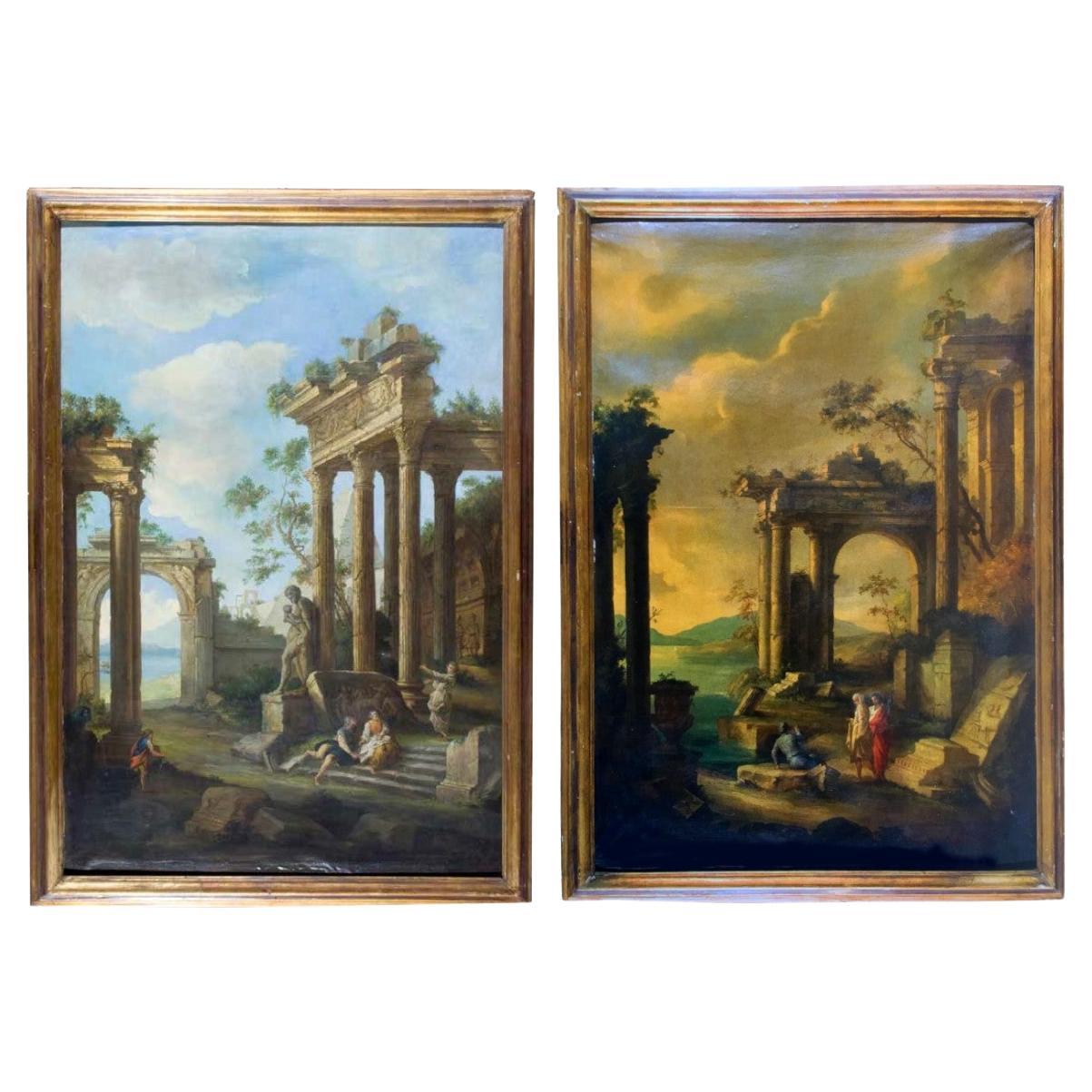
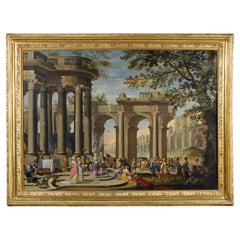
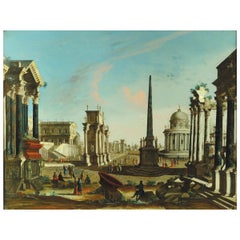
Some of the most significant examples have been compared in this study.
We apologize for any errors in translation from Italian.
Please, contact us to have the expertise in Italian.