Want more images or videos?
Request additional images or videos from the seller.

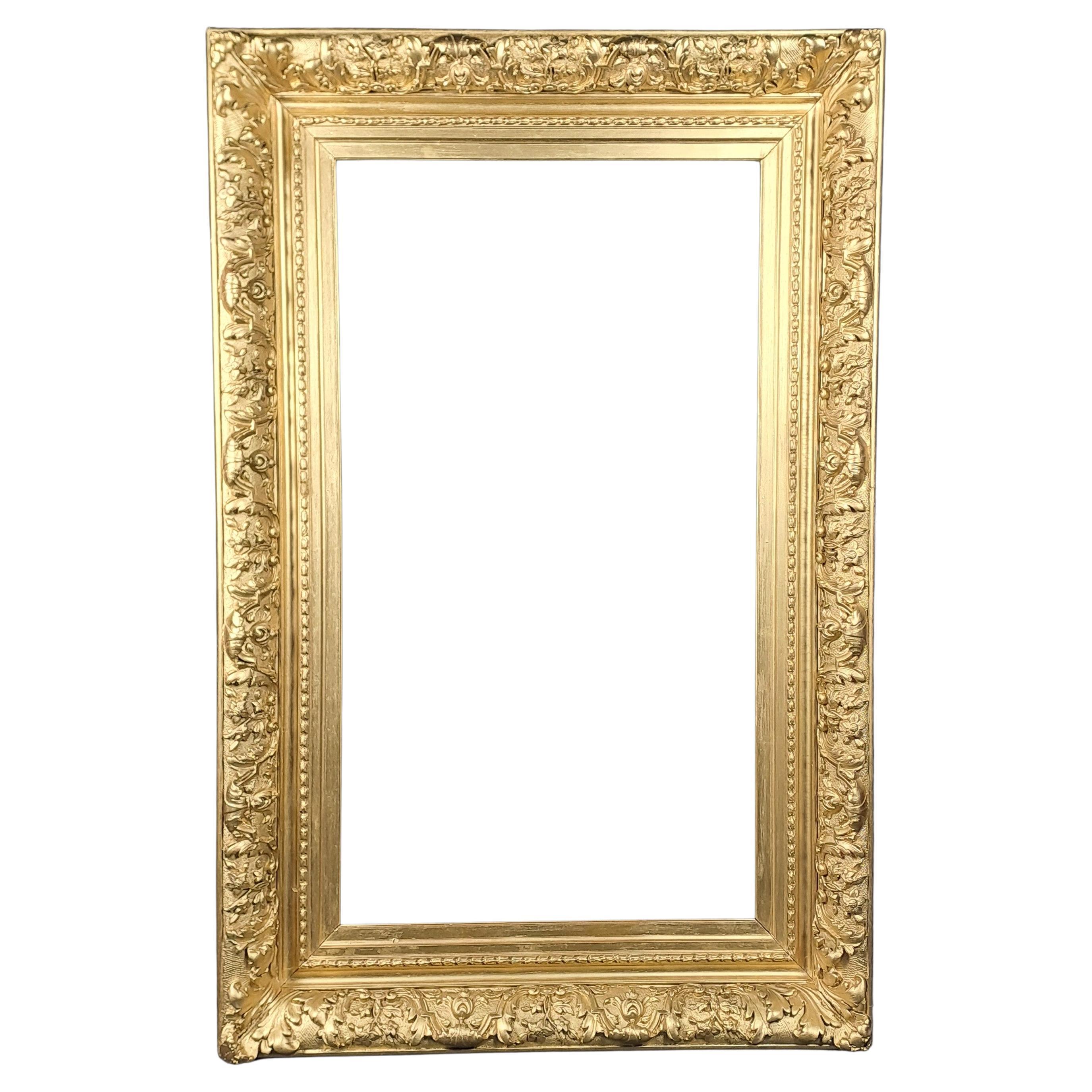
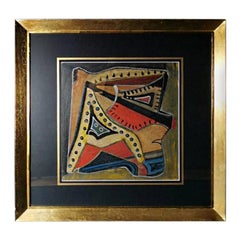
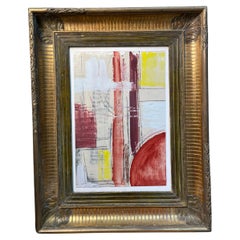
Empire Frame Gold Leaf France with Russian Constructivism Painting

$1,432.17
£1,064.12
€1,250VAT Included
CA$2,000.89
A$2,054.59
CHF 1,168.81
MX$26,984.92
NOK 13,283.17
SEK 13,980.39
DKK 9,529.22

About the Item

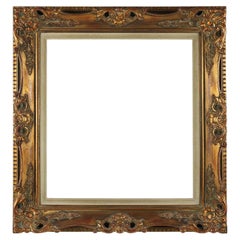
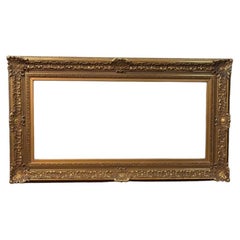
We kindly suggest you read the whole description, because with it we try to give you detailed technical and historical information to guarantee the authenticity of our objects. Our owner Beatrice Tronci, passionate art collector and established interior design, wanted to propose an article with a daring but engaging temporal contrast; a French gold leaf frame of 1855 and inside a painting of Russian Constructivism of 1925; two antithetical eras that in this case come together in an elegant object of great aesthetic effect, original and involving. The frame was treated with the technique of "leaf gilding": the "bolo Armeno" (red pigmented clay powder, mixed with glue) was spread, once dried, we proceeded with the application of very thin gold leaves; particular and elaborate workings present on the rest of the frame are obtained with the procedure called “pastiglia". The "pastiglia" processing, was born in Italy in the late 15th century. The "pastiglia" consisted of a mixture of gypsum, vegetable-gluey resins, honey, linseed oil, and often marble dust. On the wooden support a veil of cloth was glued and subsequently various states of "pastiglia" were spread, this was then imprinted or engraved or finely modeled, then the whole was allowed to harden and in the end, it was applied the gilding. After these processes, a light layer of purpurin was applied to the frame to uniform the surface of the wood. Handcrafted in France in 1855 during the reign of Napoleon III. Russian Constructivism painting painted with mixed media on paper; executed in Russia between 1925 and 1930. The artistic current of Constructivism is a cultural movement born in Russia in 1913, shortly before the revolution of 1917 and its strengths are optimism towards technological progress, machine, and industry. Constructivism proposes the evolution of art to exalt the new social class founded on the proletariat, in the need to realize a direct comparison between art and revolution. The works of the artists of this period are based on a strictly geometric composition and therefore devoid of objects. In Russia, Constructivism declines in Rationalism, while in the rest of Europe, it gradually falls back to classical positions to become extinct from 1933. Important exponents of Constructivism were Vladimir Tatlin, El Lissitskij, Aleksandr Rodcenko, and Lajos Kassak. Measures width cm.58, depth cm.5, height cm.68.For all our shipments we use special packaging materials (wooden crates, styrofoam, etc.) for maximum protection and safety of the objects.
  • Dimensions:
    Height: 26.78 in (68 cm)Width: 22.84 in (58 cm)Depth: 1.97 in (5 cm)
  • Style:
    Napoleon III (Of the Period)
  • Materials and Techniques:
  • Place of Origin:
  • Period:
  • Date of Manufacture:
    1855
  • Condition:
    Wear consistent with age and use. The article is in good condition.
  • Seller Location:
    Prato, IT
  • Reference Number:
    Seller: 28251stDibs: LU4632224469792

More From This Seller

View All
20th Century Constructivist Mixed Technique Russian Painting

20th Century Constructivist Mixed Technique Russian Painting

Located in Prato, Tuscany

We kindly suggest you read the whole description, because with it we try to give you detailed technical and historical information to guarantee the authenticity of our objects. 20th-century constructivist mixed technique Russian painting...

Category

Vintage 1920s Russian Modern Paintings

Materials

Paper

French Symbolic Expressionism Oil Painting Depicting French Revolution

French Symbolic Expressionism Oil Painting Depicting French Revolution

Located in Prato, Tuscany

We kindly suggest that you read the entire description, as with it we try to give you detailed technical and historical information to ensure the authenticity of our objects. Painting oil painting on canvas is made with mixed technique brush and spatula; the author used traditional brushes for a first draft giving shape to the whole drawing with an expert, loose wrist play and with sure and decisive brushstrokes; the representation, in this case, is not a pure exercise of virtuosity, in fact, the author communicates us his intimate essence manifesting it through the language of colors, shapes, and composition. The artist finished his work with the technique of spatula painting, named after the protagonist's instrument, redistributing the colors densely and consistently, making the painting take on a special body and depth. The painting is signed but we are unable to give definite information about the author, however, we confirm its extraordinary aesthetic and engaging vividness; the painting was made in 1989 in the author's studio in Paris whose intentions were to celebrate the 200th anniversary of the French Revolution (1789). The painter was inspired by both French Expressionism and Symbolism; Expressionism exalts the emotional value of art; it is the artist's desire to communicate inner feelings, while with Symbolism, painters tend to go beyond the objective representation of reality to focus instead on the subjective vision, in which inner feelings, emotions, and experiences are evoked above all. Our painting is overflowing with the symbolism of the French Revolution; it is practically an evocative essence of it. This important and overwhelming historical event is powerfully present in the soul of the artist who wanted to overbearingly communicate to us his deepest emotions by transposing them entirely in the painting with strong and vivid colors, he did not want to simply allude or hint but to express, indeed "shout" his own deep interiority. In his intentions, the painting schematically and symbolically represents a standard-bearer of the French Revolution wearing the classic "Phrygian" hat. The author used only the three colors white, red, and blue that characterized the flags of the French Revolution; they were the new banners, which opposed the traditional emblem of the monarchy, the lilies on a white field. Three were the colors because three were the goals of the Revolution: liberty, equality, and fraternity, and they represented the three classes into which French society of the time was divided: the clergy (blue), the nobility (white), and the third state (red). The "Phrygian" cap (Latin for pileus) painted in red in the painting also has a high symbolic value, In Roman times it was worn by the " freedmen" to show that they were now freed slaves but in the French Revolution it became the very symbol of Liberty; a similar cap was worn by the freed Marseilles convicts in 1792, and was the symbol of the Jacobins during the French Revolution. Due to this fact, in addition to its historical meaning of freedom, it was later adopted as a symbol of the revolution itself, a symbol immortalized on the "Marianne," the very emblem of France, in Eugène Delacroix's famous painting "Liberty Leading the People...

Category

Late 20th Century French Modern Paintings

Materials

Canvas, Wood

Napoleon III Style Large Oil On Canvas French Subject Calliope Gold Background

Napoleon III Style Large Oil On Canvas French Subject Calliope Gold Background

Located in Prato, Tuscany

We kindly suggest that you read the entire description, as with it we try to give you detailed technical and historical information to ensure the authenticity of our objects. The fol...

Category

Antique Late 19th Century French Napoleon III Paintings

Materials

Canvas, Wood

Simon Thomassin French Print " La Gloire De La France" Etched with Wooden Frame

Simon Thomassin French Print " La Gloire De La France" Etched with Wooden Frame

By Simon Thomassin

Located in Prato, Tuscany

We kindly suggest you read the whole description, because with it we try to give you detailed technical and historical information to guarantee the authenticity of our objects. Beautiful and meticulously detailed etching with sober wooden frame; the paper work, "La Gloire de la France", was made by the famous French engraver Simon Thomassin (Troyes 1665-Paris 1733) in 1724, he made the drawing inspired by an elaborate and particular sculpture, made for the gardens of Versailles, between 1681 and 1683 by Pierre Mazeline (1632-1708) important French neoclassical artist; In the inventory of the Garden in 1706-1708, the statuary group is described as follows: "A figure representing Glory seated on a cloud placed on a celestial globe, surrounded by trophies of arms, with the right arm half raised, holding a laurel wreath, and, with the left, a pyramid. The names of the two artists are imprinted on the print itself. Pierre Mazeline was a very prolific and refined sculptor of recognized talent, he is also the author of other statues in the gardens of Versailles as the "Apollo of Belvedere and "Europe"; he also executed the equestrian statue of Louis XIV...

Category

Antique 1720s French Neoclassical Prints

Materials

Wood, Paper

Mixed Technique Russian Constructivism Picture on Cardboard

Mixed Technique Russian Constructivism Picture on Cardboard

Located in Prato, Tuscany

We kindly suggest you read the whole description, because with it we try to give you detailed technical and historical information to guarantee the authenticity of our objects. Russian Constructivism...

Category

Mid-20th Century Russian Modern Paintings

Materials

Other

Painting Cutout Oil On Canvas Framed With Faux-Bamboo Wood -03

Painting Cutout Oil On Canvas Framed With Faux-Bamboo Wood -03

Located in Prato, Tuscany

We kindly ask that you read the entire description, as we strive to provide comprehensive technical and historical details to ensure the authenticity of our items. This frame encloses a canvas cutout from an antique oil painting and is particularly unique and distinctive. It was recently crafted by a Florentine Master cabinetmaker whose workshop is located in the most charming and vibrant district of Florence, San Frediano, renowned for its artisan shops that produce entirely handmade works. The Master used carved and shaped wood to replicate the appearance of bamboo, employing a technique known as "faux bamboo." This process involves using durable woods, such as maple or oak, that are intricately carved and then painted to achieve the desired effect. The "faux bamboo" technique has a history that dates back several centuries and gained significant popularity during the 18th and 19th centuries in Europe and America, eras marked by a fascination with exotic and Oriental design influences. This technique was particularly associated with the Chinoiserie style, an artistic movement inspired by Chinese art and aesthetics. At the time, real bamboo furniture...

Category

Antique Late 18th Century French Rococo Paintings

Materials

Canvas, Paper

You May Also Like

Antique Pinewood Baroque Style Frame Painting Gold Leaf 101cm

Antique Pinewood Baroque Style Frame Painting Gold Leaf 101cm

Located in Poperinge, BE

Beautiful large antique baroque style frame made of pine wood and gesso acanthus decoration in relief, the whole is gilded with gold leaf, the frame is a beautiful example of how ele...

Category

Vintage 1930s Belgian Baroque Picture Frames

Materials

Gold Leaf

Italian Contemporary Hand-Carved Wood Frame with Gold Leaf Cover

Italian Contemporary Hand-Carved Wood Frame with Gold Leaf Cover

Located in Prato, IT

Italian contemporary hand-carved wood frame with gold leaf cover. Available in custom sizes. Measures: cm. 41 x 8 x 42.5 (internal cm.22 x 23).  

Category

2010s Italian Baroque Picture Frames

Materials

Giltwood

Wooden frame with stucco and gold from around 1900

Wooden frame with stucco and gold from around 1900

Located in Honnelles, WHT

Wood frame with stucco and gold finish, around 1900 view: 103 x 46 cm rebate: 107 x 49.8 cm

Category

20th Century Italian Louis XIV Decorative Art

Materials

Wood