



Indian Brahmin Penitents and Pilgrim – Rare 18th Century Ritual Engraving, 1734
Located in Langweer, NL
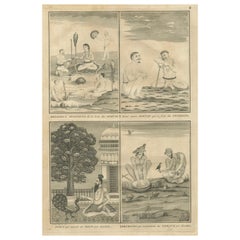
Title: Indian Brahmin Penitents and Pilgrim – Rare 18th Century Ritual Engraving Description: This compelling copperplate engraving from the 18th century offers a rare visual study of Indian religious asceticism and devotion as interpreted through a European lens. It likely originates from the later volumes of *The Ceremonies and Religious Customs of Various Nations of the Known World*, the monumental multi-volume series published in Amsterdam and Paris during the early to mid-1700s, with illustrations attributed to Bernard Picart and his collaborators. The sheet is divided into four separately framed scenes, each depicting a unique figure engaged in acts of penance or pilgrimage. The upper left panel shows a seated female "Pénitente Bramine" (Brahmin penitent) under a flowering tree, joined by other women in a meditative or devotional posture. The details, such as the tiger skin mat and ceremonial tools, signal both religious symbolism and ritual practice. The upper right image presents a solitary ascetic woman seated in rigid meditation on what appears to be a stretched animal hide floating in water, holding a prayer bead mala. The caption explains she must never change position, emphasizing the extremity of her discipline. The lower left quadrant is the most dramatic: a male penitent with wild hair stands before a temple with both arms raised straight in the air, said to remain that way until death. Another figure lies prostrate in the grass, illustrating the prescribed sleeping posture for certain penitents—lying flat without ever bending their legs. These powerful visual representations underscore the physical trials undertaken by devout individuals in pursuit of spiritual transcendence. In the lower right, a "Pélerine Bramine" (Brahmin female pilgrim) stands quietly, dressed simply, with a bowl in hand, perhaps engaged in ritual begging or...
Antique 1730s Prints
Paper