Want more images or videos?
Request additional images or videos from the seller.

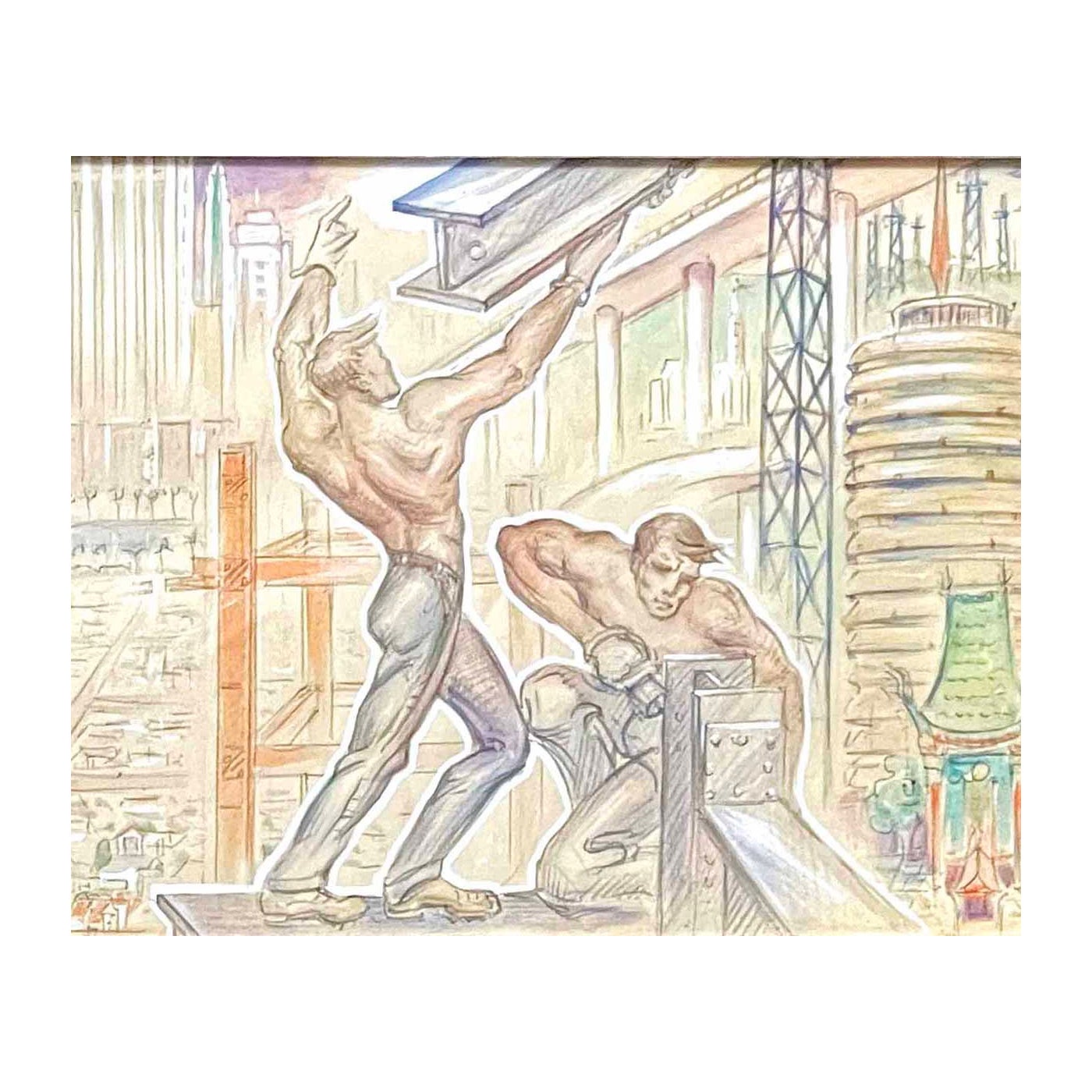
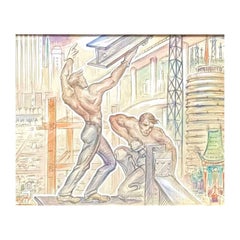
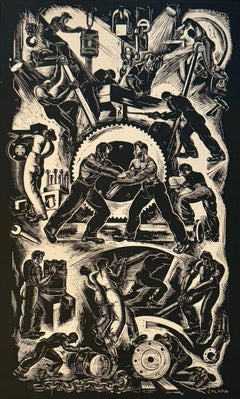
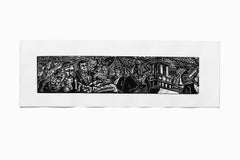
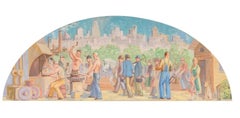
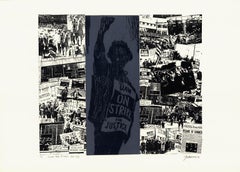
"Labor is Life", Impressive Pair of Prints Depicting Massive AFL-CIO Mosaics

$3,500
£2,646.06
€3,169.51
CA$4,980.92
A$5,090.42
CHF 2,906.83
MX$66,238.05
NOK 33,213.67
SEK 34,618.12
DKK 23,691.58

About the Item

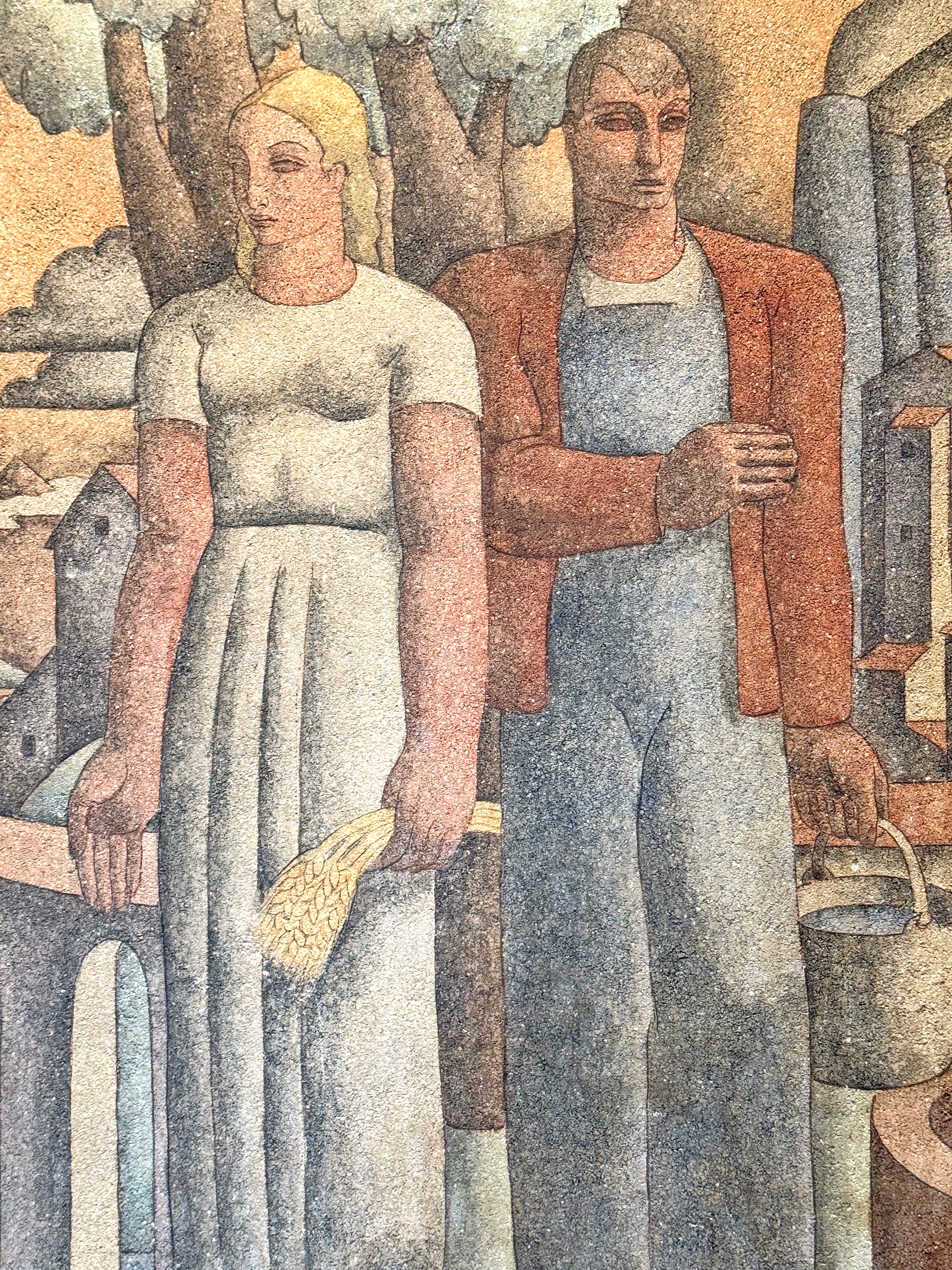
This pair of prints was issued by Lumen Martin Winter, the mosaic artist, to illustrate two enormous murals -- each 15 feet tall and over 40 feet long -- that he made for the new AFL-CIO headquarters on 16th St. NW in Washington, D.C. Each mosaic mural is composed of marble and Italian glass, some backed with gold leaf. One was installed in 1956 and the other in 1973. Although dating to the mid-1950s and later, they are superb examples of Art Deco mural design, rich with allegory and symbolism, including -- naturally -- working men and women making television circuitry, fabrics and railroad locomotives, or working in scientific laboratories, fisheries or coal mines. Winter assisted in the painting of enormous murals in the lobby of Radio City Music Hall, made mosaic murals and bas-relief sculptures for the U.S. Air Force Academy chapel in Colorado Springs, Colorado, and paintings and murals for the 1964 World’s Fair in New York.
  • Dimensions:
    Height: 12 in (30.48 cm)Width: 32 in (81.28 cm)Depth: 0.75 in (1.91 cm)
  • Style:
    Art Deco (Of the Period)
  • Materials and Techniques:
  • Place of Origin:
  • Period:
  • Date of Manufacture:
    1956, 1972
  • Condition:
  • Seller Location:
    Philadelphia, PA
  • Reference Number:
    1stDibs: LU865141366982

More From This Seller

View All
"Labor Dulcis, " Important Painting by Muralist Milton Bancroft

"Labor Dulcis, " Important Painting by Muralist Milton Bancroft

By Milton Bancroft

Located in Philadelphia, PA

The rich Impressionistic brushwork and bright palette of this painting makes it a vivid find. No doubt painted in preparation for a mural, the text in Latin – translated as “Work is Sweet and Conquers All” – would have been a noble sentiment for a public space at the time. The painter, Milton Bancroft...

Category

Vintage 1930s American Paintings

Materials

Canvas

"Industry and Agriculture", Allegorical Art Deco Fresco, 1934 Chicago Art Inst.

"Industry and Agriculture", Allegorical Art Deco Fresco, 1934 Chicago Art Inst.

Located in Philadelphia, PA

This superb example of WPA-period allegorical painting by Edwin Boyd Johnson is both classic and highly unusual. Unlike most WPA paintings and studies, which are oil on canvas or go...

Category

Vintage 1930s American Art Deco Paintings

Materials

Paint

"The History of Los Angeles", Important Art Deco Mural Study w/ Major Landmarks

"The History of Los Angeles", Important Art Deco Mural Study w/ Major Landmarks

By Alexander Rosenfeld

Located in Philadelphia, PA

A late entry in America's string of public murals painted in the 1930s, 40s and 50s telling the story of various towns and regions, this 1962 Art Deco study b...

Category

Vintage 1960s American Art Deco Paintings

Materials

Paint

"Children of the Crucible", Striking Art Deco Mural by Beck, T. Roosevelt quote

"Children of the Crucible", Striking Art Deco Mural by Beck, T. Roosevelt quote

Located in Philadelphia, PA

This important and very rare mural study, executed in oil on canvas, was painted by Dunbar Beck in the 1930s, evidently for a project that was never completed. The painting depicts i...

Category

Vintage 1930s American Art Deco Paintings

Materials

Paint

"Truth and the Seven Deadly Sins", Study for Queens Supreme Courthouse Mosaic

"Truth and the Seven Deadly Sins", Study for Queens Supreme Courthouse Mosaic

By Eugene Francis Savage

Located in Philadelphia, PA

Entitled "Truth and the Seven Deadly Sins" and teeming with allegory, this Art Deco study for a major mosaic was painted by Eugene Savage for the new Queens Supreme Courthouse -- a 1930s Works Progress Administration project in Queens, New York. The central figure with a hand mirror may represent Narcissus, who would personify "vanity," one of the sins, and at the bottom of the scene is a winged devil who seems to be opening a door to a fiery world below. To the right is a figure near a chest full of gold and coins, and the entire scene is surmounted by a reclining female nude. Savage is best known for a spectacular set of murals illustrating the history and lore of Hawaii commissioned by Matson Shipping Line for the S.S. Lurline, executed in the 1940s but not installed until the 1950s. The artist also painted other series of murals and paintings, include an enormous mural...

Category

Vintage 1930s American Art Deco Paintings

Materials

Paint

"Architecture & Construction, " Allegorical Mural Study for Rhode Island Capitol

"Architecture & Construction, " Allegorical Mural Study for Rhode Island Capitol

By Robert Charles Haun

Located in Philadelphia, PA

A superb example of allegorical mural painting, this circular study depicting a female figure in Grecian robes overlooking a child with a plumb line, surrounded by scenes of construc...

Category

Vintage 1940s American Art Deco Paintings

Materials

Paint

You May Also Like

Exceptional Mid-century ceramic tile Mural by Joseph Roelants for Gilliot & Cie

Exceptional Mid-century ceramic tile Mural by Joseph Roelants for Gilliot & Cie

By Jospeh Roelants

Located in Weesp, NL

Exceptional Mid-Century Ceramic Tile Mural by Joseph Roelants for Céramiques d’Hemixem (Gilliot & Cie), 1948 — Monumental & Unique A rare opportunity to acquire a monumental ceramic tile artwork...

Category

Vintage 1940s Belgian Mid-Century Modern Wall-mounted Sculptures

Materials

Ceramic, Wood

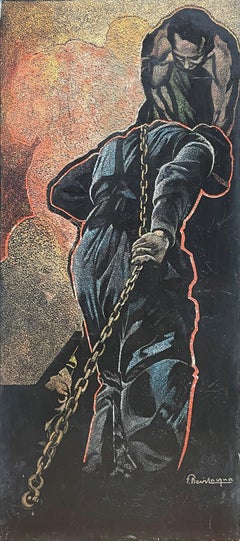
"Working Laborers, " Francis Bevilacqua, Soviet Cold War Art

"Working Laborers, " Francis Bevilacqua, Soviet Cold War Art

Located in New York, NY

Francis Bevilacqua (American, b. 1911) Working Laborers, n.d. Oil and pigment on black granite 44 x 21 inches Signed lower right Born in 1911, Francis Bevilacqua was predominantly influenced by the 1930s. The period of the 1930s is epitomized by the conflict between many political ideologies, including Marxist Socialism, Capitalist Democracy, and the Totalitarianism of both Communism and Fascism. In the Soviet Union, Stalin’s government needed urgent funds to implement the rapid industrialization demanded by the first Five Year Plan. It initiated a secret strategy to sell off treasures from the State Hermitage Museum in Leningrad (St. Petersburg), including a primary list of two hundred and fifty irreplaceable paintings by the Old Masters, a number of which ended up in the collection of Andrew Mellon...

Category

Mid-20th Century Realist Figurative Paintings

Materials

Granite

Industrial Mural Study, Veterans Memorial Building, Santa Barbara WPA American

Industrial Mural Study, Veterans Memorial Building, Santa Barbara WPA American

Located in New York, NY

Industrial Mural Study, Veterans Memorial Building, Santa Barbara WPA American Joseph Edward Knowles (1907-1980) "Study for Industry Mural, Veterans Memorial Building, Santa Barbara, CA" 19 1/2 x 50 1/2 inches Oil on board, c. 1930s. Estate stamp verso Framed: 27 x 60 inches The completed mural is currently hanging on the wall, part of the building actually, at the Veterans Memorial Building in Santa Barbara. A photo of the work insitu is included in the attached photos. BIO Joseph Edward Knowles was born in Kendall, Montana, on June 15, 1907. He grew up in San Diego, California. At age twenty, two years before the beginning of the Great Depression, he moved north to another town on the coast of California---Santa Barbara. There he began studying fine art at the Santa Barbara School of the Arts* (1927-1930), under the supervision of Frank Morley Fletcher, previously director of the Edinburgh College of Art. Fletcher, who was trained in portraiture, landscape painting, and woodblock* printing, was a great influence on young Knowles. It was there that Knowles learned the art of color woodblock printmaking, a medium in which he showed great skill. Not long after completing his studies with Fletcher, Knowles began teaching art. For a period of thirty years, from 1930 to1960, he taught at the Cate School in Carpinteria, California. In 1934-1935, Knowles traveled throughout Europe, further developing his artistic skills in England, France, and Italy. Upon his return, he continued to teach art at various schools and institutions: Cate School, Crane Country School, extension classes at the University of California at Santa Barbara (UCSB), and at the Santa Barbara Museum of Art (SBMA). Knowles also served as an art education consultant for the County of Santa Barbara. In addition, he was founding co-director and president of the Santa Barbara Fine Arts Institute (1969-1972), which later developed a specialization in photography and became the Brooks Institute of Photography. Knowles died at his home in Santa Barbara on September 8, 1980. Much of Knowles' watercolor work is associated with what has been termed the "California School*," a loose grouping of artists throughout the state that included such figures as Millard Sheets, Phil Dike, Dong Kingman, George Post, and the Santa Barbara painters Dan Lutz and Standish Backus, Jr. The California School artists, including Knowles, were known for their fresh, direct, spontaneous style of watercolor painting. Knowles and other members of the school found inspiration in nature and the built environment alike, emphasizing elements of design in their exuberant, boldly stated, colorful scenes from everyday life. While painting in a representational* manner, Knowles generally avoided photographic realism, preferring subjective interpretation of his subjects. In this, as well as in his experimental approach and vigorous brushwork, he displayed a strongly modern sensibility. Knowles often used the wet-on-wet watercolor technique as he painted seascapes and landscapes, mostly along the California coast. He also employed dry-brush* techniques in many of his paintings, often leaving some of the white of the watercolor paper exposed. Some of the latter depict trees and other forms in a broken and airy manner that recalls Cezanne. Knowles' colored woodblock prints are more reserved and exact in their draftsmanship than his paintings. Spare, clean, lyrical lines are drawn to illustrate floral motifs and boat scenes with a touch of asymmetry conjuring Japanese woodblock prints. His murals from the post-World War II period are considerably more modern in their approach and show an emphasis on design and color. PROFESSIONAL ORGANIZATIONS California Watercolor Society (1940 - 1955) Santa Barbara Art Association (Vice President - 1952) ONE-MAN EXHIBITIONS Golden Gate International Exposition (GGIE) - San Francisco, California San Diego Fine Arts Gallery (SDMA) - San Diego, California Santa Barbara Museum of Art (SBMA) - Santa Barbara, California Cowie Galleries - Los Angeles, California Gallery de Silva - Santa Barbara, California Bradley Galleries - Santa Barbara, California MURALS Westmont College - Ellen Porter Hall Mural - Santa Barbara, California Safeway Grocery (now Vons Grocery on West Victoria Street) - Exterior Tile Mosaic - Santa Barbara, California Santa Barbara Bank & Trust - Interior Mosaic Panels, Santa Barbara, California Santa Barbara Girls Club - Interior Mosaic Mural - Santa Barbara, California Ernest Righetti High School - Mosaic Mural - Santa Maria, California Shell Oil Company - Mosaic Panel - California Beckman Instruments, Corporate Headquarters - Mosaic - Fullerton, California STAINED GLASS WINDOWS, WALLS and PANELS Katherine Thayer Cate Memorial Chapel - Cate School, Carpinteria, California William S. Porter Memorial Chapel - Cottage Hospital, Santa Barbara, California La Rinconada Building - Santa Barbara, California ILLUSTRATIONS "California's Wonderful Corner: True Stories for Children from the History of the Santa Barbara Region," by Walter A. Tompkins (1962 & 1975) China Designs: Two sets of dinnerware for Winfield China...

Category

1930s American Realist Figurative Paintings
Materials

Oil, Board

United Auto Workers Woodcut Print, Signed, 1991, Edition 2/10

United Auto Workers Woodcut Print, Signed, 1991, Edition 2/10

By Antonio Frasconi

Located in New York, NY

Antonio Frasconi created this woodcut and offset lithograph entitled "United Auto Worker, 1936-1937" in 1991. It is signed, titled, dated and inscribed “2/10” in pencil. The paper ...

Category

1990s Contemporary More Prints

Materials

Lithograph, Woodcut