Want more images or videos?
Request additional images or videos from the seller.

Original Antique Botanical Print of Manna Ash and Sarsaparilla by Bertuch, 1805

$303.62
£225.59
€265VAT Included
CA$424.19
A$435.57
CHF 247.79
MX$5,720.80
NOK 2,816.03
SEK 2,963.84
DKK 2,020.19

About the Item

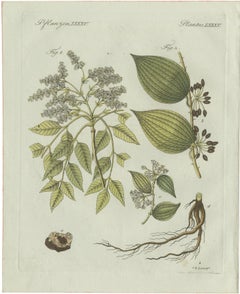
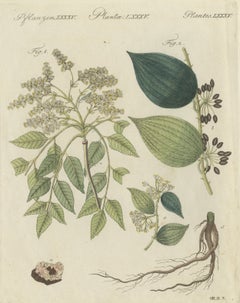
Original Antique Botanical Print of Manna Ash and Sarsaparilla by Bertuch, c. 1805 Original antique hand-colored copper engraving depicting the Manna Ash and Sarsaparilla, published in Friedrich Justin Bertuch’s celebrated “Bilderbuch für Kinder” in Weimar in the early 19th century. The plate is titled “Pflanzen LXXXV / Plantes LXXXV” and is devoted to two medicinal plants that were valued for their practical and pharmaceutical uses. Fig. 1 depicts the Manna Ash (*Fraxinus ornus*), also known as the flowering ash. The plant is shown with its elegant pinnate foliage and branching clusters of flowers. The manna obtained from this tree was historically collected from its sap and used medicinally, particularly as a mild laxative. Fig. 2 illustrates Sarsaparilla, traditionally associated with species of Smilax. Bertuch shows the plant in considerable botanical detail, including its strongly veined leaves, fruits, flowers and extensive root system. Sarsaparilla roots had a long history of use in European herbal medicine. Additional details illustrate parts of the plants separately, emphasizing the educational and scientific purpose of Bertuch’s publication. The engraving is delicately enhanced with original hand coloring in restrained shades of green, yellow, brown and pink and bears the signature “J. H. Schmuzer” at lower right. Friedrich Justin Bertuch (1747–1822) was a German publisher, writer and patron of the arts. His monumental “Bilderbuch für Kinder” (Picture Book for Children) was one of the great illustrated educational encyclopedias of the late 18th and early 19th centuries, containing hundreds of finely engraved plates covering natural history, geography, science, technology, antiquity and numerous other subjects. Creator: Friedrich Justin Bertuch (1747–1822) Engraver: J. H. Schmuzer Source: Bilderbuch für Kinder Plate: Pflanzen LXXXV / Plantes LXXXV Subjects: Manna Ash (*Fraxinus ornus*) and Sarsaparilla (*Smilax*) Place of Publication: Weimar, Germany Date of Manufacture: Circa 1802–1805 Period: Early 19th Century Style: Neoclassical – In the Period of Medium: Original hand-colored copper engraving on paper Condition: Good. Wear consistent with age and use. Light age-related toning and scattered minor spotting and marks. Minor marginal wear and edge irregularities. Original hand coloring remains attractive. Please refer to the photographs for further details of condition. Please note: This is an original antique print from the early 19th century, not a modern reproduction. The print is sold unframed. Framed images or interior views, if shown, are for presentation and inspiration only. Other companion botanical plates from Bertuch’s “Bilderbuch für Kinder” are also available separately. Keywords: Manna Ash, Fraxinus ornus, Sarsaparilla, Smilax, medicinal plants, herbal medicine, botanical engraving, antique botanical print, medicinal botanical print, pharmacy decor, apothecary print, natural history print, Bertuch print, Friedrich Justin Bertuch, J. H. Schmuzer, hand colored engraving, early 19th century botanical print
  • Dimensions:
    Height: 9.61 in (24.4 cm)Width: 7.68 in (19.5 cm)Depth: 0.01 in (0.2 mm)
  • Style:
    Neoclassical (Of the Period)
  • Materials and Techniques:
    Paper,Engraved
  • Place of Origin:
  • Period:
  • Date of Manufacture:
    1805
  • Condition:
    Wear consistent with age and use. Good. Wear consistent with age and use. Light age-related toning and scattered minor spotting and marks. Minor marginal wear and edge irregularities. Original hand coloring remains attractive. Please refer to the photographs for further details.
  • Seller Location:
    Langweer, NL
  • Reference Number:
    Seller: BG-14335-371stDibs: LU3054351383372

More From This Seller

View All
Original Antique Botanical Print of Rubber and Gum Arabic Trees by Bertuch, 1802

Original Antique Botanical Print of Rubber and Gum Arabic Trees by Bertuch, 1802

Located in Langweer, NL

Original Antique Botanical Print of Rubber and Gum Arabic Trees by Bertuch, 1802 Original antique hand-colored copper engraving depicting two economically important tropical trees, ...

Category

Antique Early 19th Century German Neoclassical Prints

Materials

Paper

Original Antique Botanical Print of Licorice and Carob by Bertuch, 1805

Original Antique Botanical Print of Licorice and Carob by Bertuch, 1805

Located in Langweer, NL

Original Antique Botanical Print of Licorice and Carob by Bertuch, 1805 Original antique hand-colored copper engraving depicting two historically important useful plants, Licorice a...

Category

Antique Early 19th Century German Neoclassical Prints

Materials

Paper

Manna Ash and Sarsaparilla Medicinal Plants, Antique Bertuch Print, circa 1805

Manna Ash and Sarsaparilla Medicinal Plants, Antique Bertuch Print, circa 1805

Located in Langweer, NL

This antique botanical print from Bertuch's Bilderbuch shows two medicinal plants of the old apothecary, the manna ash and sarsaparilla. The heading reads Pflanzen LXXXV and the plate carries the Vienna mark VIII.B.3 in the lower margin. Figure 1 is read as the manna ash, Fraxinus ornus, a branch with toothed pinnate leaves and dense sprays of creamy flowers, with a lump of the sweet dried sap, called manna, drawn at the foot as item a. Figure 2 is a sarsaparilla, Smilax, with a prickly climbing stem, broad heart shaped leaves with curved veins, clusters of dark berries, a flowering shoot and the long root used in medicine. Both drugs were imported in quantity around 1800, manna from Calabria and Sicily and sarsaparilla from Central and South America, and the plate shows children the living plants behind the jars on the apothecary shelf...

Category

Antique Early 19th Century Austrian Prints

Materials

Paper

Tamarind and Pistachio Nut Tree, Antique Bertuch Print, circa 1805

Tamarind and Pistachio Nut Tree, Antique Bertuch Print, circa 1805

Located in Langweer, NL

This antique botanical print from Bertuch's Bilderbuch shows the tamarind and the pistachio, two trees grown for their edible pods and nuts. The heading reads Pflanzen XVIII and the ...

Category

Antique Early 19th Century Austrian Prints

Materials

Paper

Original Antique Botanical Print of Tropical Fruits by Bertuch, c. 1800

Original Antique Botanical Print of Tropical Fruits by Bertuch, c. 1800

Located in Langweer, NL

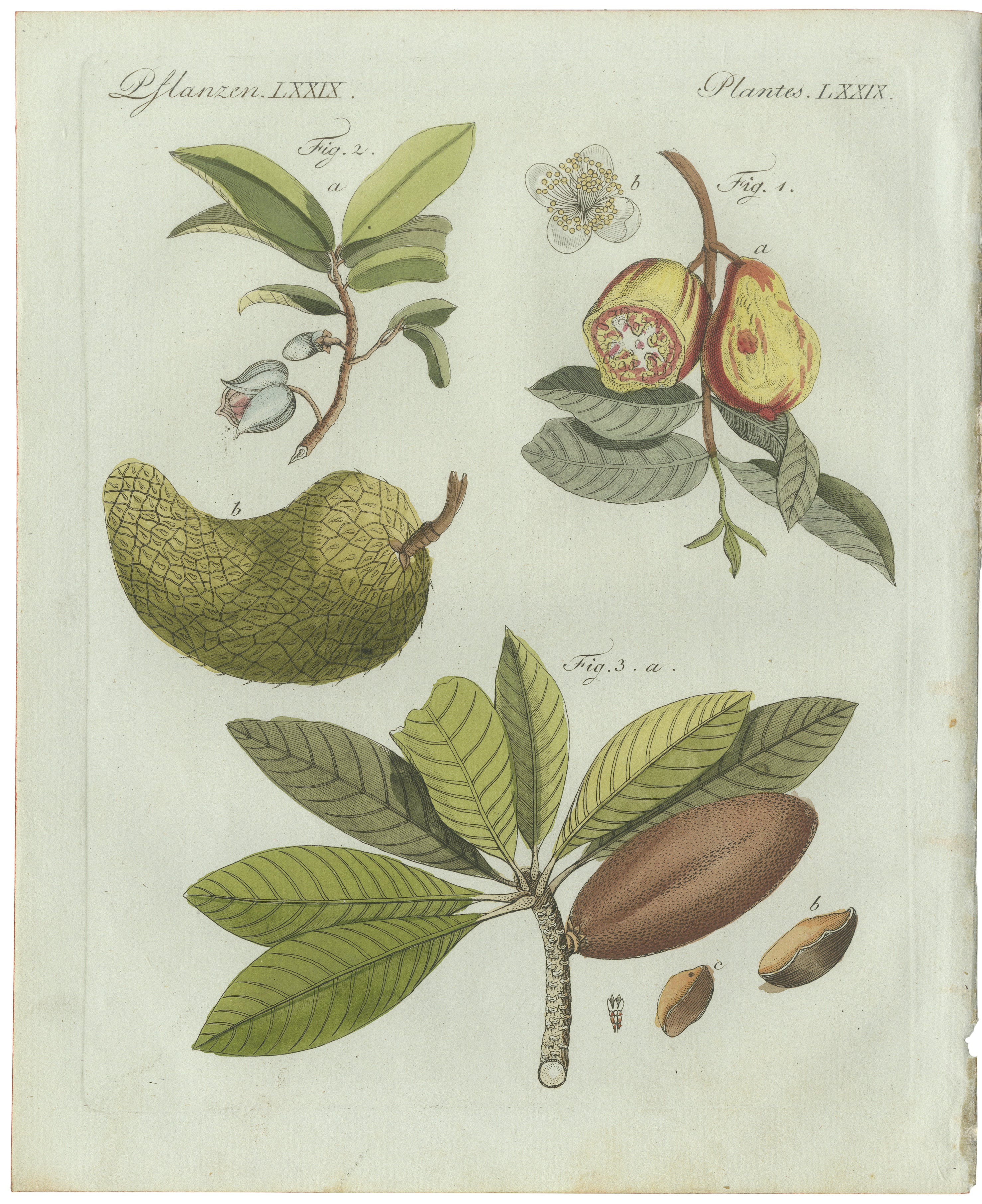
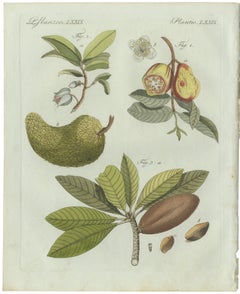
Original Antique Botanical Print of Tropical Fruits by Bertuch, c. 1800 Original antique hand-colored copper engraving depicting three exotic tropical fruit-bearing plants, published in Friedrich Justin Bertuch’s celebrated “Bilderbuch für Kinder” around the beginning of the 19th century. The plate is titled “Pflanzen LXXXIX / Plantes LXXXIX” and presents three different tropical plants together with detailed studies of their fruits, flowers, leaves and seeds. Fig. 1 depicts a guava-type fruit shown both whole and cut open to reveal its richly seeded interior. A separate botanical detail illustrates the delicate flower. Fig. 2 shows another exotic fruit-bearing plant, accompanied by an exceptionally large green fruit with a distinctive textured skin. Additional details illustrate its flower and developing fruit. Fig. 3 presents a tropical tree with broad evergreen leaves and a large elongated brown fruit. Separate illustrations of the seeds and internal structures provide further botanical detail. The plate reflects the intense European interest around 1800 in tropical plants and exotic fruits arriving through expanding scientific exploration and international trade. Such plants were still unfamiliar to most European readers, making illustrated natural-history publications such as Bertuch’s an important means of introducing them to a wider audience. The engraving is particularly decorative, with attractive original hand coloring in shades of green, yellow, red, brown and pink. The combination of foliage, whole fruits, cross-sections, flowers and seeds gives the plate both scientific interest and strong visual appeal. Friedrich Justin Bertuch (1747–1822) was a German publisher, writer and patron of the arts. His monumental “Bilderbuch für Kinder” (Picture Book for Children) was one of the great illustrated educational encyclopedias of the late 18th and early 19th centuries. Published in Weimar from 1790 onward, it contained hundreds of finely engraved and hand-colored plates covering natural history, geography, science, technology, antiquity, costumes and numerous other subjects. Creator: Friedrich Justin Bertuch (1747–1822) Source: Bilderbuch für Kinder Plate: Pflanzen LXXXIX / Plantes LXXXIX Subject: Tropical Fruits and Plants Place of Publication: Weimar, Germany Date of Manufacture: Circa 1800 Period: Early 19th Century Style: Neoclassical – In the Period of Medium: Original hand-colored copper engraving on paper Condition: Good. Wear consistent with age and use. Light age-related toning and scattered minor spotting and marks. Some marginal wear and irregularity, particularly along the right edge. Original hand coloring remains strong and attractive. Please refer to the photographs for further details of condition. Please note: This is an original antique print from around 1800, not a modern reproduction. The print is sold unframed. Framed images or interior views, if shown, are for presentation and inspiration only. Other companion botanical plates from Bertuch’s “Bilderbuch für Kinder” are also available separately. Keywords: tropical fruit print, exotic fruits, guava print, tropical plants, fruit botanical print, antique botanical print, exotic botanical engraving, tropical fruit engraving...

Category

Antique Early 19th Century German Neoclassical Prints

Materials

Paper

Original Antique Botanical Print of Carrion Flower and Mimosa by Bertuch, 1805

Original Antique Botanical Print of Carrion Flower and Mimosa by Bertuch, 1805

Located in Langweer, NL

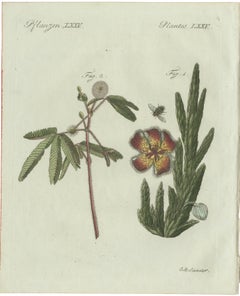
Original Antique Botanical Print of Carrion Flower and Mimosa by Bertuch, 1805 Original antique hand-colored copper engraving depicting two remarkable exotic plants, the Carrion Flo...

Category

Antique Early 19th Century German Neoclassical Prints
Materials

Paper

You May Also Like

Tamarin (Tamarind), French botanical herbal medicinal flower engraving, 1818

Tamarin (Tamarind), French botanical herbal medicinal flower engraving, 1818

By After Pierre Turpin

Located in Melbourne, Victoria

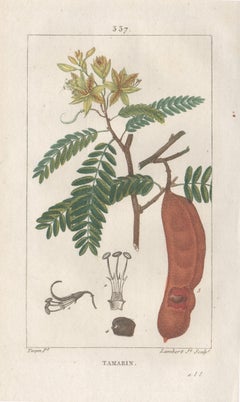
French botanical flower engraving, 1818. Colour-printed stipple engraving by J Lambert after Pierre Turpin (1775-1840) From Francois Pierre Chaumeton's 'Flore Medicale' which portrayed a variety of flowers, trees and herbs which could be used for treating illnesses. The engravings were produced during the great period of French colour printing using the stipple-engraving process pioneered by the great botanical artist Pierre-Jospeh Redoute. The artist is the celebrated Pierre Jean Francois Turpin...

Category

Early 19th Century Victorian More Prints

Materials

Engraving

Early 19th Century Botanical Engraving by John Curtis

Early 19th Century Botanical Engraving by John Curtis

Located in Seaford, GB

Early 19th Century Botanical Engraving by John Curtis – Hand Coloured Natural History Plate An original early 19th-century hand-coloured botanical engraving from the celebrated natural history publications of John Curtis (1791–1862), one of Britain’s most respected botanical and entomological illustrators. This beautifully detailed plate illustrates a flowering plant in scientific profile, showing bloom structure, leaves, buds, and root system with precision typical of early Victorian natural history illustration. Curtis’s work bridges science and art — created for study, yet prized today for its elegance and balance. These engravings formed part of the golden age of British botanical publishing, when artists collaborated with engravers and colourists to produce plates that were both accurate and visually refined. Each impression was printed from an engraved plate and then carefully coloured by hand, meaning no two examples are ever exactly identical. The composition has the clarity collectors seek: • Central botanical specimen • Naturalistic colour palette • Fine line engraving • Period scientific titling This makes it ideal as a single framed piece or as part of a gallery wall of antique botanical studies. About John Curtis John Curtis was a leading figure in British natural history illustration. He is best known for British Entomology and botanical works that combined taxonomic accuracy with graceful composition. His engravings are held in major museum collections and remain highly collectible in the decorative arts market. Period Early 19th century, circa 1820–1840. Technique Copperplate engraving with original hand colouring on laid paper. Condition Good antique condition consistent with age. Light toning and minor handling marks may be present, as expected with early 19th-century works on paper. Please see the images. Why Collect Curtis Botanical Prints...

Category

Antique Early 19th Century British George III Prints

Materials

Paper

Original Antique Botanical Print- Gloxina Rubra. 1841

Original Antique Botanical Print- Gloxina Rubra. 1841

Located in St Annes, Lancashire

Great image of Gloxina Rubra Lithograph with original hand colour Published 1841 Unframed. Free shipping

Category

Antique 1840s English Victorian Prints

Materials

Paper

The Thebebintaceae - Lithograph by Vincenzo Tenore - 1870s

The Thebebintaceae - Lithograph by Vincenzo Tenore - 1870s

By Vincenzo Tenore

Located in Roma, IT

Lithograph hand watercolored. Plate from "Atlante di Botanica popolare ossia Illustrazione di Piante Notevoli di ogni famiglia" (Atlas of popular botany or illustration of notable p...

Category

1870s Modern Figurative Prints

Materials

Lithograph

Cultivated Pea Plants: An 18th C. Hand-colored Botanical Engraving by Weinmann

Cultivated Pea Plants: An 18th C. Hand-colored Botanical Engraving by Weinmann

By Johann Wilhelm Weinmann

Located in Alamo, CA

This hand-colored botanical mezzotint and line engraving by Johann Wilhelm Weinmann (1683-1741) is entitled "a. Pisum Minus sine Putamine, b. Pisa Indicum". It is plate 819 in Weinma...

Category

Mid-18th Century Naturalistic Still-life Prints

Materials

Engraving, Mezzotint

Early 19th Century Botanical Engraving by John Curtis

Early 19th Century Botanical Engraving by John Curtis

Located in Seaford, GB

Early 19th Century Botanical Engraving by John Curtis – Hand Coloured Natural History Plate An original early 19th-century hand-coloured botanical engraving from the celebrated natural history publications of John Curtis (1791–1862), one of Britain’s most respected botanical and entomological illustrators. This beautifully detailed plate illustrates a flowering plant in scientific profile, showing bloom structure, leaves, buds, and root system with precision typical of early Victorian natural history illustration. Curtis’s work bridges science and art — created for study, yet prized today for its elegance and balance. These engravings formed part of the golden age of British botanical publishing, when artists collaborated with engravers and colourists to produce plates that were both accurate and visually refined. Each impression was printed from an engraved plate and then carefully coloured by hand, meaning no two examples are ever exactly identical. The composition has the clarity collectors seek: • Central botanical specimen • Naturalistic colour palette • Fine line engraving • Period scientific titling This makes it ideal as a single framed piece or as part of a gallery wall of antique botanical studies. About John Curtis John Curtis was a leading figure in British natural history illustration. He is best known for British Entomology and botanical works that combined taxonomic accuracy with graceful composition. His engravings are held in major museum collections and remain highly collectable in the decorative arts market. Period Early 19th century, circa 1820–1840. Technique Copperplate engraving with original hand colouring on laid paper. Condition Good antique condition consistent with age. Light toning and minor handling marks may be present, as expected with early 19th-century works on paper. Please see the images. Why Collect Curtis Botanical Prints...

Category

Antique Early 19th Century British George III Prints

Materials

Paper