Filippo Palizzi Art

1812-1888

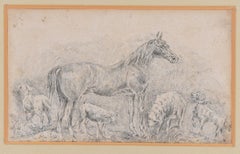
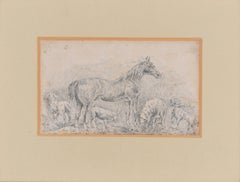
Filipppo Palizzi is remembered as the renovator of 19th-century Neapolitan painting, because he abandoned the academic style to devote himself to the study of truth, especially of landscapes and animals, in harmony with contemporary French experiences, directing his painting towards a realism of intimate poetic intonation. In 1837, Palizzi was in contact with the Posillipo school in Naples, which helped make him abandon academic painting. In 1855, he was traveling for studies in Holland, Belgium and France; he returned to Paris in 1865 and 1875. From 1878 to 1880, Palizzi directed the Academy of Fine Arts in Naples with the intention of making the teaching of the artistic disciplines in step with the times. Following the example of A. van Pitloo and G. Smargiassi, he devoted himself to the study of truth, in the most humble subjects such as small landscapes and squares of animals, referring back to the tradition of 17th-century Dutch animalists, but with more discovered, fully 19th-century naturalism. A research that matured in contact with contemporary French experiences, kept alive thanks to the relationships with his brother Giuseppe, also a painter and friend of De Nittis. The most conspicuous groups of works by Palizzi are found in the Gallery of Modern Art in Rome and in that of the Capodimonte Museum in Naples.

to
1
1
Overall Width
to
Overall Height
to
2
2
1
1
1
1
2

Use search to find more

2
12,000
2,898
2,541
1,647

Use search to find more

Artist: Filippo Palizzi
Related Items
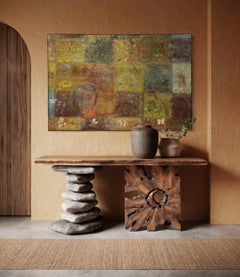
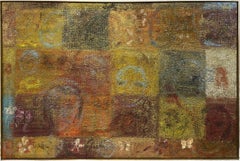
“Faces, Butterflies, and Birds" 1999 by Hunt Slonem Large Neo-Expressionist Oil

“Faces, Butterflies, and Birds" 1999 by Hunt Slonem Large Neo-Expressionist Oil

By Hunt Slonem

Located in Yardley, PA

About this work: “Faces, Butterflies, and Birds, 1999” by Hunt Slonem (b. 1951). This fantastic, monumental painting by Slonem brings together some of his most recognizable motifs i...

Category

1990s Neo-Expressionist Filippo Palizzi Art

Materials

Canvas, Oil

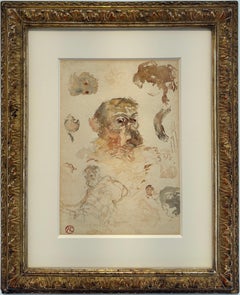
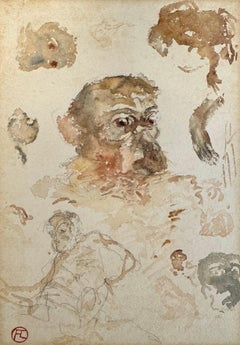
"Singes (Monkeys)" 1881 by Henri de Toulouse-Lautrec Watercolor & Graphite Study

"Singes (Monkeys)" 1881 by Henri de Toulouse-Lautrec Watercolor & Graphite Study

By Henri de Toulouse-Lautrec

Located in Yardley, PA

About this work: Before he became the celebrated chronicler of Montmartre’s nightlife, Lautrec was surrounded by a different kind of spectacle. At his family’s estates, the young art...

Category

1880s Naturalistic Filippo Palizzi Art

Materials

Paper, Watercolor, Graphite

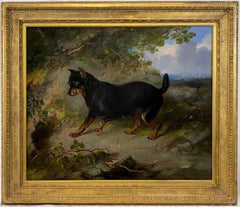
“Manchester Terrier, 1854” George Armfield Dog Portrait in Landscape Oil 19th C.

“Manchester Terrier, 1854” George Armfield Dog Portrait in Landscape Oil 19th C.

By George Armfield

Located in Yardley, PA

A fantastic example of George Armfield’s renowned portraits of dogs. This work depicts a Manchester Terrier excitedly standing outside a rabbit hole on the edge of a forest. The ter...

Category

1850s Realist Filippo Palizzi Art

Materials

Canvas, Oil

European 19th century animalist landscape oil painting - Cattle at Ford

European 19th century animalist landscape oil painting - Cattle at Ford

Located in Varmo, IT

European painter (19th century) - Landscape with Cattle at the Ford. 101 x 76 cm. Oil on canvas, unframed (not signed). An animal painting in the tradition of landscape and animal...

Category

Late 19th Century Naturalistic Filippo Palizzi Art

Materials

Canvas, Oil

Un Cuirassier (A Cavalryman)

Un Cuirassier (A Cavalryman)

Located in London, GB

A largely self-taught artist, Ernest Meissonier was best known for his exquisitely rendered genre scenes, which drew inspiration from the Dutch masters such as Gabriel Metsu and Gera...

Category

19th Century Realist Filippo Palizzi Art

Materials

Oil, Canvas

"Billy Burns" 1939 by Ludvik Vacatko, Equestrian Portrait Boy Chestnut Horse

"Billy Burns" 1939 by Ludvik Vacatko, Equestrian Portrait Boy Chestnut Horse

Located in Yardley, PA

About this work: “Billy Bruins” (1939) by Ludvík Vacátko (1873-1956). A grand, wonderfully theatrical equestrian portrait by the renowned horse painter, Ludvik Vacatko. This work sh...

Category

1930s Realist Filippo Palizzi Art

Materials

Canvas, Oil

Ploughing in the Nivernais

Rosa BonheurPloughing in the Nivernais, Circa 1850

$43,277

H 24.41 in W 47.25 in D 5.91 in

Ploughing in the Nivernais

By Rosa Bonheur

Located in BELEYMAS, FR

Studio of Rosa Bonheur (Bordeaux 1822 – Thomery 1899) Ploughing in the Nivernais Oil on canvas H. 62 cm; W. 120 cm (97 x 154 cm including frame) Unsigned Ploughing in the Nivernais ...

Category

1850s French School Filippo Palizzi Art

Materials

Canvas, Oil

European 19th century animalist landscape oil painting - Cattle at Ford

European 19th century animalist landscape oil painting - Cattle at Ford

Located in Varmo, IT

European painter (19th century) - Landscape with Cattle and Flock at Dusk. 101 x 76 cm. Oil on canvas, unframed (not signed). The scene depicts a mixed group of animals — two adul...

Category

Late 19th Century Naturalistic Filippo Palizzi Art

Materials

Canvas, Oil

Three Happy Friends - 21 Century Contemporary Landscape Painting with Dogs

Three Happy Friends - 21 Century Contemporary Landscape Painting with Dogs

By Bart Koning

Located in Nuenen, Noord Brabant

Bart Koning Three Happy Friends 140 x 210 cm Oil on linen We're proud to introduce Dutch/ German artist Bart Koning. Incredibly clever how the originally Dutch Bart Koning knows ho...

Category

2010s Contemporary Filippo Palizzi Art

Materials

Oil

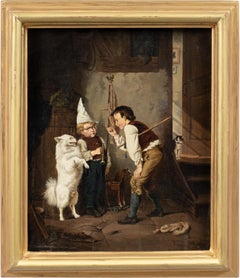
German Realist painter - 19th century children playing with a trained dog

German Realist painter - 19th century children playing with a trained dog

Located in Varmo, IT

German Realist painter (19th century) - Two children training a dog. 56.5 x 46.5 cm (without frame) - 69 x 59 cm (with frame). Oil on canvas, in a gilt wood frame. Signed indistin...

Category

Late 19th Century Naturalistic Filippo Palizzi Art

Materials

Canvas, Oil

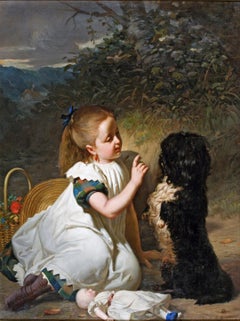
Teaching him a New Trick

Barend WijnveldTeaching him a New Trick

$48,500

H 46.25 in W 35.25 in

Teaching him a New Trick

Located in Mc Lean, VA

19th Century Dutch

Category

1890s Academic Filippo Palizzi Art

Materials

Canvas, Oil

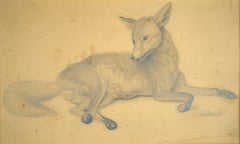
Vigilant Fox - The psyche of the fox -

Vigilant Fox - The psyche of the fox -

By Carl Friedrich Deiker

Located in Berlin, DE

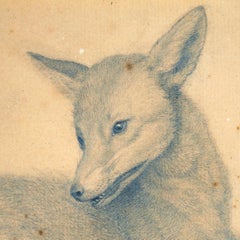
Carl Friedrich Deiker (1838 Wetzlar - 1892 Düsseldorf). Vigilant fox. Pencil drawing on brown paper, 18 × 29.5 cm (inside measurement), 31.5 x 43.5 cm (mount), signed and dated "Deiker [18]54" at lower right. - a little bit stained, with a light water stain at lower right About the artwork Carl Friedrich Deiker's consummate ability to depict animals is already evident in this early work. He brought a whole new psychological dimension to animal painting, so that one could literally speak of animal portraits. The naturalistic appearance of the fox alone makes it seem alive. Every strand of muscle, even every hair, is captured, which requires an intensive artistic study of animal anatomy and physiology. But the fox's real liveliness comes not from its natural appearance, but from its internal movement: Stretched out, it has been brought out of rest. It turns around and, with its ears pricked up, looks intently in the direction from which it has seen something. His mouth is slightly open and his pointed teeth are bared, as if he were growling. Tension gradually takes hold of his whole body. While the hind legs were still in a relaxed position, closely observed by Deiker, one front leg was already raised, ready to begin a rising movement. The fox seems so alarmed with all its senses that one gets the impression that, at any moment, its tail will move jerkily and the animal will jump up. While wild animals have traditionally been portrayed as beasts or anthropomorphised, often for caricatural purposes, Deiker explores their inherent nature by attempting to capture their psychic impulses. The wild animal is neither bestial nor human, but a creature in its own right, valued by Deiker for its own sake. In this way, he brought the dignity of the animal into representation and raised animal painting to a whole new artistic level. About the artist Carl Friedrich Deiker was the son of the drawing teacher Christian Friedrich Deiker and the younger brother of the animal painter Johannes Deiker. In addition to the family art lessons, Christian Friedrich shared a studio with his brother Johannes at Braunfels Castle, Deiker attended the drawing academy in Hanau, and from 1858 he was a student at the Karlsruhe Art Academy, where he studied under the landscape painter Johann Wilhelm Schirmer. Carl Friedrich Deiker was already in demand as an artist during his first year: Grand Duke Frederick I of Baden, Margrave Max of Baden and Grand Duke Michael of Russia bought hunting scenes by him. In 1859 he went on a study trip to the Reinhardswald. Just as the Barbizon School had rediscovered the landscape, Deiker opened up the forest for animal painting. From 1861-64 Deiker had his own studio in Karlsruhe, then moved to Düsseldorf, where his brother Johannes followed four years later. Deiker married a daughter of the landscape painter Karl Hilger and remained in Düsseldorf until his death. In 1868 he finally achieved international fame with his painting 'Pursued Noble Deer' and was regarded as a virtuoso new founder of animal painting. "Deiker brought for the first time a truly great artistic quality to animal painting [...]". - Hans Vollmer From 1870 he participated in the academic art exhibitions in Berlin, Dresden, Munich and Hanover. He was also very busy as an illustrator. He drew for the Gartenlaube, the Salon, the Universum, and produced many of the finely illustrated hunting and animal books of the period. He also worked as a printmaker, while his oil paintings circulated as reprints by Franz Dinger. From 1865 to 1892 Deiker was a member of the artists' association Malkasten. Carl Friedrich Deiker's life's work was honoured with a large posthumous memorial exhibition at the Düsseldorf Kunsthalle in 1892. His son Carl Deiker, born in 1879, also became a painter. Selection of art museums that own works by Carl Friedrich Deiker: Hamburger Kunsthalle / Kunsthalle Karlsruhe / Kunstmuseum Düsseldorf / Wallraff Richartz Cologne. Selected Bibliography H. Schmidt: Johannes and...

Category

1850s Naturalistic Filippo Palizzi Art

Materials

Pencil

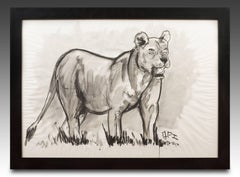
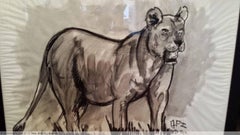
Lioness Fusain Drawing by Jean Poulain

Jean PoulainLioness Fusain Drawing by Jean Poulain, 1940

$2,000Sale Price|20% Off

H 31.11 in W 42.13 in D 1.19 in

Lioness Fusain Drawing by Jean Poulain

By Jean Poulain

Located in Pasadena, CA

Jean Poulain 1884-1967 Jean Poulain was born in 1884 in Katanga (former Belgian Congo). Self-taught artist from an early age, he will be in search of all the emotions and beauty of ...

Category

1930s Naturalistic Filippo Palizzi Art
Materials

Carbon Pencil

Poetry of the bird, surrealist drawing, 1948

Poetry of the bird, surrealist drawing, 1948

Located in PARIS, FR

Joséphine Beaudouin (1909-2005) Poetry of the Bird, surrealist painting, 1948 Oil on canvas Signed "Joséphine Beaudouin" and dated "1948" lower left 13,7 x 10,6 inch Born in Albi in 1909, Josephine Beaudouin (née Cals) showed an early interest in drawing. At the age of twelve, she moved to Paris where her mother, Jeanne Ramel-Cals, ran a literary salon that was frequented by art world figures such as Ambroise Vollard. In 1925, while her first drawings appeared in the magazine Crapouillot, the young artist entered the School of Decorative Arts where she studied fresco painting. She married the architect Eugène Beaudouin in 1928, with whom she traveled throughout Europe. Beaudouin, a member of the Académie des Beaux-Arts, designed a series of buildings that were precursors of modern architecture in France (Clichy, Maison du Peuple; Antony, Résidence universitaire Jean Zay). Josephine Beaudouin exhibited at the Salon des Indépendants, the Salon des Tuileries, the Salon d'Automne and the Salon des Artistes Décorateurs. The work of the one that Jean Cocteau described as "bewitching" is full of mystery. Her work bears the stamp of an extraordinary personality. Indeed, Josephine Beaudouin developed a penchant for dreams at a very early age and took refuge in the works illustrated by Gustave Doré. Her technical virtuosity and overflowing imagination were praised by the critics of her time who unanimously greeted her Marmorées (ill.1). Named by René Barotte, these are paintings made on marble slabs from 1955. The artist exploits the infinite resources of the veins of this support which inspires him poetic compositions with unusual subjects. Marked by surrealism, she returns to the fantastic by delivering a prodigious creation of the mind made of dreamed cities and trompe-l'oeil. The 1948 painting that we propose probably represents a red-billed chough. The bird is a recurring theme in the work of Josephine Beaudouin, as in her life. An avid ornithologist, she kept an aviary in her Parisian home where many island birds were kept. She also built up a collection of stuffed birds. Still on this theme, the writer Claude Aveline (1901-1992), author of the poem L'Oiseau-Qui-N'Existe-Pas, invited several visual artists to freely interpret what this bird could be. The first series of works was produced between 1956 and 1963. In 1957, Joséphine Beaudouin delivered a work with a pen of great finesse, now preserved at the Centre Pompidou (ill.2). Several renowned artists also responded to the invitation of the poet such as Jean Cocteau and Ossip Zadkine. The precision of the graphics of our painting testifies to an attentive observation of the anatomy of the birds. The artist paints with great delicacy: the technique is impeccable, the drawing is careful, the material is smooth, the details are represented with great finesse and mastery. Bibliography : Fernand Pouillon...

Category

1940s Surrealist Filippo Palizzi Art

Materials

Canvas, Oil

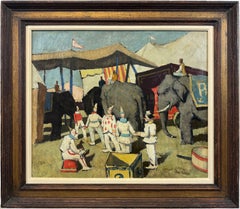
“Circus Yard” American Regionalist, Elephants, Tents, Performers, Clowns, Oil

“Circus Yard” American Regionalist, Elephants, Tents, Performers, Clowns, Oil

By Paul Sample

Located in Yardley, PA

“Circus Yard” by Paul Starrett Sample (American, 1896-1974). A vibrant circus scene by the noted American regionalist, Paul Starrett Sample. This work captures the lively bustle beh...

Category

Mid-20th Century American Realist Filippo Palizzi Art

Materials

Canvas, Oil

Previously Available Items
Pastore con Pecore XIX secolo

Pastore con Pecore XIX secolo

By Filippo Palizzi

Located in Milan, IT

Inchiostro su carta. Firma in basso a sinistra. L'artista napoletano Filippo Palizzi, definito anche "il pittore degli animali", è considerato un rinnovatore della pittura napoletan...

Category

19th Century Other Art Style Filippo Palizzi Art

Materials

Ink

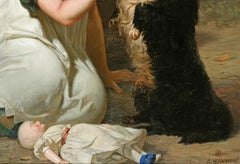
Filippo Palizzi Oil On Canvas 19th Century, Little Dogs In The Living Room 1886

Filippo Palizzi Oil On Canvas 19th Century, Little Dogs In The Living Room 1886

By Filippo Palizzi

Located in Milan, IT

Oil on canvas. Signature of the artist, date bottom left, the name "Fox" under the black dog: a paper label on the back explains, with the title, that Fox is the name of the dog. On the back, there is another label from the Art Gallery of Montecatini, where the painting has been displayed in 1972. Filippo...

Category

1880s Other Art Style Filippo Palizzi Art
Materials

Oil

Filippo Palizzi art for sale on 1stDibs.

Find a wide variety of authentic Filippo Palizzi art available for sale on 1stDibs. You can also browse by medium to find art by Filippo Palizzi in oil paint, paint, canvas and more. Not every interior allows for large Filippo Palizzi art, so small editions measuring 9 inches across are available. Customers who are interested in this artist might also find the work of Louis Aimé Japy, ANDRE VON MORISSE, and Yvonne Coomber. Filippo Palizzi art prices can differ depending upon medium, time period and other attributes. On 1stDibs, the price for these items starts at $1,337 and tops out at $61,273, while the average work can sell for $7,631.

Artists Similar to Filippo Palizzi