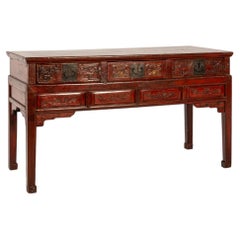
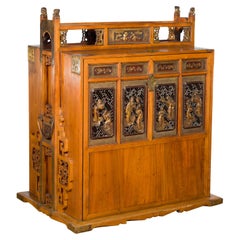
This remarkable Chinese altar cabinet was probably made in the late 19th or early 20th century, during the final decades of the Qing dynasty or the early Republic period. Its elaborate decoration and combination of a reddish-brown finish, black panel backgrounds, and warm amber-colored carvings suggest an origin in southeastern China, possibly Fujian Province. The design reflects the richly ornamented regional Qing tradition, combining architectural forms with narrative scenes and symbolic animal motifs.
The cabinet has a stately, almost architectural presence. A broad, overhanging top with raised ends crowns the enclosed upper section, which stands on tall legs. The open space beneath the cabinet lends visual lightness to the design, creating a handsome contrast with the intricately decorated facade.
The front is divided into five framed panels: three smaller panels above two elongated panels. Set against black backgrounds, relief carvings depict figures in traditional robes, birds, and mythical creatures. Faces, folds of clothing, wings, and scaled bodies are rendered with considerable attention to detail. The central upper panel features a bearded figure riding a large bird. These scenes draw upon the imagery of Chinese legends and religious traditions, lending the cabinet a distinctive narrative character.
The upper section is flanked by broad, shaped brackets carved with dragons. Their elongated bodies follow the contours of the wood, weaving among stylized clouds and scrolling ornaments. The curved lower apron is similarly embellished, featuring opposing dragons arranged around a central motif. The carving continues down the front legs, where expressive animal heads transition into flowing forms and partially pierced decoration. The more restrained sides and back emphasize that the cabinet was intended to be displayed with its decorated facade facing the room.
Altar furnishings of this type traditionally played an important role in the veneration of ancestors and deities. They were placed in a prominent room within the home or in an ancestral hall. The top would hold objects such as ancestral tablets, religious figures, incense burners, and offerings. The imposing height and symbolic decoration complemented this ceremonial purpose. This example was probably made for such a setting.
An unusual detail is the drawer that opens from the side, fitted with a metal ring pull on a round backplate. This arrangement provides storage while preserving the uninterrupted decorative composition of the facade. The top consists of a broad wooden panel set within a frame, with raised, molded edges at either end.
The wood has a deep, warm reddish-brown color with a rich sheen and a beautifully aged patina. Old signs of use, small dents, scratches, and localized wear to the finish contribute to its historic character. The lighter relief carvings stand out beautifully against the black backgrounds and darker surrounding frames.
The cabinet has been carefully cleaned in our workshop, with respect for its aged finish and accumulated patina. Particular care was taken to preserve the delicate carvings and the characteristic signs of use, retaining the piece’s historic appearance.
With its distinctive proportions and elaborate decoration, this altar cabinet makes an impressive focal point in an entryway, living room, or collection of Asian art. It combines a ceremonial presence with the warmth and expressive character of aged, hand-worked wood.