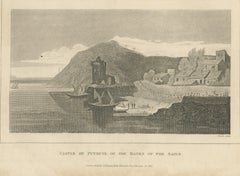
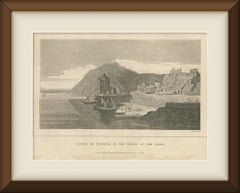
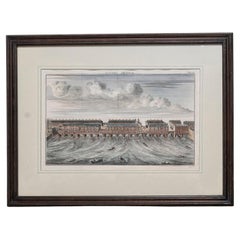
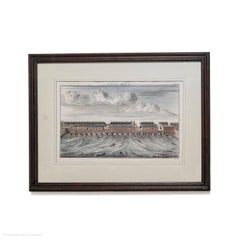
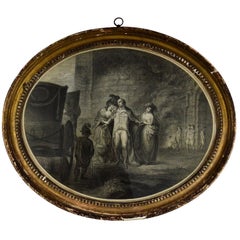
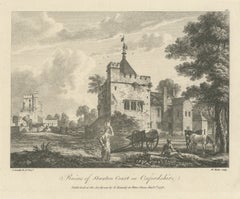
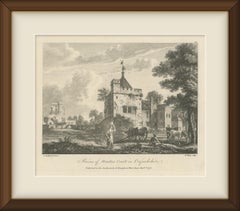
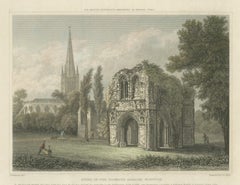
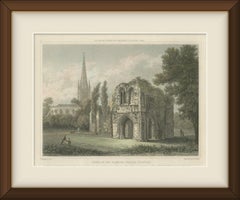
This original copper engraving of the ruins of Stanton Court in Oxfordshire, after Paul Sandby, was published by G. Kearsly in London on 1 January 1778 for The Virtuosi's Museum, Sandby's celebrated series of views of British castles, abbeys and country seats. The plate is lettered "Ruins of Stanton Court in Oxfordshire" and numbered 49 at the top right.
The view shows the crenellated tower of the old manor at Stanton Harcourt, topped by a weathervane, beside the manor buildings, with a second ruined tower and cattle to the left. In the foreground Sandby places the everyday life of the countryside: a milkmaid, a resting man, a cart and horses. Stanton Harcourt, the ancient seat of the Harcourt family, was already partly ruinous by the eighteenth century, and its surviving tower was known for Alexander Pope, who worked there on his translation of Homer.
The lettering reads "P. Sandby R.A. Pinxt", "W. Watts sculp." and "Published as the Act directs, by G. Kearsly, in Fleet Street Jany 1st 1778". Paul Sandby, a founding member of the Royal Academy, is often called the father of English watercolour, and The Virtuosi's Museum, issued in monthly numbers between 1778 and 1781, spread his picturesque vision of Britain to a wide audience. William Watts, a leading landscape engraver of the day, translated the drawing into a delicate copper engraving. The impression is uncoloured.
As a Paul Sandby engraving from the first year of The Virtuosi's Museum, this plate is a good example of Georgian topographical printmaking and of the early picturesque taste for ruins. It would sit well with other Oxfordshire views or English country house prints...
Category
Late 18th Century British Antique Georgian Prints